China EV makers: Who’s ahead in the race so far?
The Business Times takes stock of some listed EV automakers

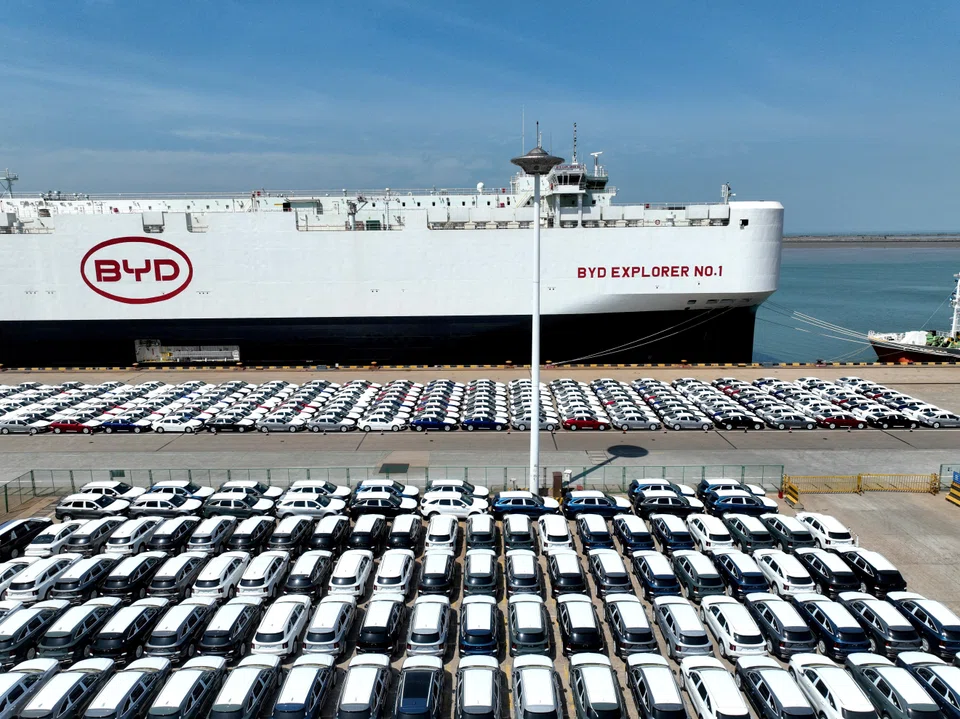
BYD, the China electric vehicle (EV) brand that unseated Tesla as the global leader in the green vehicle market in 2023, might not be much affected by the upcoming hike in European Union tariff, according to analysts from Citi.
A day before the tariff hikes were announced, the analysts said in a note that they believe the trajectory of China EV automakers’ inroads abroad would not be derailed – even without the European market – as Chinese exports face extra import duty for battery EVs (BEVs).
The European Commission announced on Jun 12 that higher provisional import duties would be levied on the BEV imports from three Chinese carmakers – on top of the existing 10 per cent. This makes it a total of 27.4 per cent in import duties for BYD, 30 per cent for Geely Automobile and 48.1 per cent for SAIC Motor.
Post revision, the other companies cooperating with the subsidy investigation face a tariff of 31 per cent and the non-cooperating ones will be charged 48.1 per cent. The tariff hikes are effective from Jul 4.
Morningstar noted in a May report that the year-to-date price dips in EV automaker shares provide “compelling” buying opportunities for long-term investors.
EV automaker counters have been pummelled by intensifying price competition in China and slowing global demand, until subsidies drove better sales in China recently.
The retail volume of EVs surged to 800,000 units in China in May – a 38.5 per cent year-on-year increase and an 18.7 per cent month-on-month rise – to mark the highest monthly figure for 2024.
But several automakers, including leader BYD, fell short in their first five months of sales or deliveries, when they should have reached 41.7 per cent of their annual target.
The Business Times takes stock of some listed EV automakers and their prospects.
SEE ALSO
BYD
BYD’s exports to Europe would still be able to make a net profit margin of 8.6 per cent at the current production scale – higher than the per-car profitability in its domestic market – assuming that BYD and consumers split the tariff burden equally.
If customers incur 30 per cent or 80 per cent of the tariff hike, BYD’s exports to Europe can make a net profit margin of 5.1 per cent or 13.8 per cent respectively, noted Citi.
The Citi analysts reiterated BYD as their top pick for the Chinese EV sector.
Indeed, the China EV automaker, which has a market value of 658.8 billion yuan (S$125.3 billion), is a clear favourite among analysts. Market watchers believe BYD has the attributes to pull ahead amid a seemingly endless price war in the country, slowing global demand and rising trade barriers.
S&P Global Ratings said the brand will likely remain China’s biggest EV maker by sales for at least the next two years. In contrast, most EV companies will likely remain in the red in the next two years due to their small size, high operating costs and price competition.
“The firm has the advantages of large scale, diversified offerings, proprietary technologies, vertical integration, and low costs. These attributes are difficult to replicate quickly, given the technology and investment hurdles,” added the credit ratings agency in a report published in late May.
Analysts from OCBC, DBS, CGS International, Morningstar and HSBC are also bullish about BYD’s EV prospects. The company also has other products, including EV batteries.
BYD will capitalise on its cost advantages to cut EV prices, putting a margin squeeze on its smaller competitors in China, wrote CGS analyst Ray Kwok in a report published in May.
From battery EVs, BYD has changed its focus to plug-in hybrid EVs (PHEVs) that also use fossil fuel to power an internal combustion engine. These hybrid EVs have gained in popularity in China’s low-tier cities and overseas markets such as South-east Asia and Latin America, said Kwok.
The Chinese government’s recent relaxation on auto loan restrictions and the newly announced trade-in subsidies, DBS analyst Rachel Miu pointed out, are likely to make BYD one of the major beneficiaries. Thus, the analyst expects deliveries from BYD to sequentially pick up from the second quarter of 2024.
But UOB Kay Hian (UOBKH) takes a contrarian view on BYD, noting that its domestic retail sales of about one million for the year to mid-May were lagging UOBKH’s annual estimate of 3.4 million for the Chinese market, despite the price cuts of 10 to 20 per cent in February.
BYD will cannibalise some of its own models’ sales as well with the recent launch of some new models, UOBKH flagged.
Geely
UOBKH prefers Geely Automobile to BYD from a long-term perspective because of Geely’s “better” prospects and product features. For example, Geely’s new generation PHEV system has a slightly superior heat efficiency.
Morningstar named Geely and BYD as its two top picks.
“Benefiting from a strong model lineup, together with the recently launched Zeekr 007 and Galaxy E8, we believe Geely will be able to further increase EV contribution,” the analyst said.
Mass-market and legacy automaker Geely Automobile’s EV business, however, is still suffering a loss at the Ebitda (earnings before interest, tax, depreciation and amortisation) level, despite an annual sales volume of close to half a million units in 2023, pointed out S&P.
To turn a profit, automakers must deliver an annual sales volume of 300,000 to 500,000 units, which industry watchers say is a breakeven point at the net profit level for EV makers.
Li Auto
BYD and Li Auto are the only two EV manufacturers in China expected to achieve profitability from 2024 to 2026, owing to their stronger deliveries and lower research and development (R&D) expenses per unit, noted Kwok of CGS.
Li Auto was the leader in China’s premium sports utility vehicle (SUV) market in 2023, he pointed out. “It remains an ‘add’ and our top pick for China’s EV sector as it has EV deliveries and vehicle profit margins that beat the industry average in FY2024.”
HSBC has a “buy” recommendation for the automaker for its “strong” product cycle and recent catalysts such as the ramp-up of SUV model L6 that would boost sales.
DBS analyst Miu pointed out that the automaker is one of the few profitable EV players to date. Said the analyst: “We believe the recent correction in its share price reflected most of the negatives while it has yet to price in the potential upside of Li L6 after production is ramped up.”
Also, she pointed out that Li Auto, which has little exposure to the EU market, may draw some buying attention.
Li Auto’s cumulative deliveries for the year to May reached 141,207 units, falling short of UOBKH’s estimate of 450,000 units and the company’s target of 560,000 to 640,000 units for the year.
“It is challenging for Li Auto to meet either our sales estimate or its own delivery target for the full-year 2024, given the ongoing sales momentum, the lack of new models through end-24, and increasing competition,” wrote the UOBKH report that picked Li Auto as a top “sell”.
Meanwhile, some shareholders of the Nasdaq-listed counter have initiated a class action lawsuit in the US, alleging that Li Auto inflated market demand for their new multi-purpose vehicle, the Li Mega, after the automaker downsized its delivery forecast in March.
Nio
DBS analyst Miu said Nio ’s present valuation has yet to factor in the contributions from its new mass market sub-brand and the synergies from the enhanced battery-swapping network to support sales. Thus, the analyst maintained a “buy” recommendation for the stock.
Kwok of CGS, who has an “add” call on Nio, said: “We expect Nio’s Q2 2024 EV shipments to rise 40 per cent quarter on quarter and 79 per cent year on year (to 50,000 units), powered by newly upgraded models and expanded sales channels.”
Nio has reined in expenditure, slowed expansion in overseas markets and cut jobs over the past year, as its high-end club-like showrooms and battery-swapping operations incur high cost.
Nio and Xpeng have accumulated large amounts of cash through IPOs and share placements amid high equity market interest in the EV segment in recent years. This has provided a buffer against cash burn, noted S&P Global.
XPeng
Another of UOBKH’s top “sell” calls, XPeng will roll out the cheaper sub-brand Mona by the third quarter of 2024. But the analyst finds that the automaker will face an uphill task to achieve the brokerage’s 2024 delivery estimate of 200,000 units or its own delivery target of 280,000 units, due to the fierce competition in the mass-market segment.
Taking an opposite view is DBS, which pointed out that XPeng’s clear timeline for new model launches this year will boost investor sentiment.
Kwok of CGS pointed out the automaker’s expanding EV portfolio with models that range from the A-class to mass market and premium segments. Thus, he called for an “add” recommendation in view of Xpeng’s strong EV deliveries and improved margins in vehicle sales in 2024.
Decoding Asia newsletter: your guide to navigating Asia in a new global order. Sign up here to get Decoding Asia newsletter. Delivered to your inbox. Free.
Copyright SPH Media. All rights reserved.