



China housing sector to stay fragile; restoring confidence is key

Angela Tan
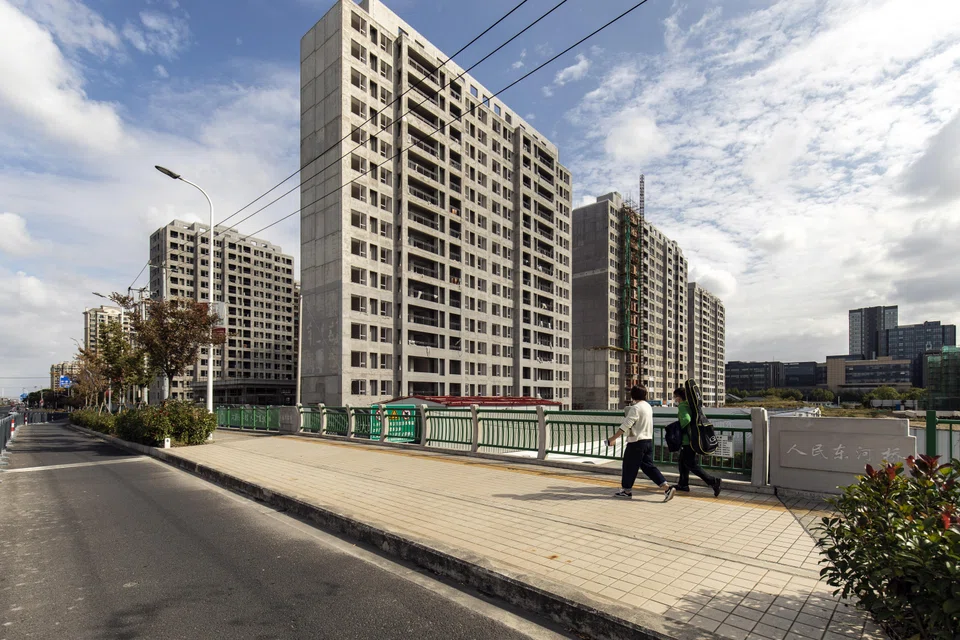
CHINA’S property sector may continue to decline, if not stagnate, next year. Despite an all-out campaign by financial regulators to rescue the sector, economists said a full recovery is still distant.
From land sales to financing, and from construction to interior decorations, property was China’s most important growth engine in the past two decades. It directly accounted for some 13 per cent of gross domestic product, or 30 per cent including related industries.
But the days of rapid, breakneck growth for the sector are over.
Sheldon Chan and Leonard Kwan, portfolio managers at T Rowe Price, said: “Although urbanisation may continue to be a driver, as will upgrading, the consensus is that the overall pace of growth will slow. In relative terms, the property sector is expected to become less immodest to the Chinese economy over time.”
Behind the slowdown is an increasing government concern about affordability.
Oxford Economics senior economist Louise Loo said that the price of newly built residential housing in China was 8.5 times the average household disposable income in 2021. While she said a market collapse would be “unlikely” in 2023, she noted that “China’s housing market will instead undergo a protracted L-shaped downturn”.
It will take almost a year to absorb the excess housing supply as of the third quarter of this year, she added. Downside risks to her outlook included spillovers from property sector debt, including high-profile defaults leading to a sharp loss of confidence.
Two major policy measures – the “Three Red Lines” in August 2020 to curb developer debt levels, and the “Two Red Lines” in January 2021 to constrain banks’ property-related lending – contributed to a series of high-profile credit defaults by leading property developers, including Evergrande and Sunac.
But the release of a new 16-point plan in November suggested that tightening for the property sector is over.
The plan included cutting mortgage rates, requiring banks to increase property sector lending, establishing investment funds to support troubled developers on the delivery of pre-sold homes, giving local governments more flexibility to ease local housing policies, and the lifting of a ban on equity refinancing.
Ricky Tsang, credit analyst at S&P Global, said these policies were meaningful and may mark a turning point in China’s property crisis over the next three to six months.
“These steps will add about one trillion yuan (S$190 billion) of fresh liquidity, stopping the downward spiral of developers of higher credit quality,” he said.
Like Oxford Economics’ Loo, Tsang did not see the new measures as likely to create a boom for developers. He estimated that China property sales would drop 26-28 per cent this year, and a further 5-8 per cent in 2023, as highly leveraged private developers continue to struggle.
The recent measures were not intended to bail out the sector, he added, but they will set a floor to the crisis and rebuild confidence in the sector, leading to an L-shaped recovery.
Andrew Tilton, chief Asia-Pacific economist at Goldman Sachs, echoed this cautiousness.
He said the measures did not resolve default risks, but should ease short-term funding pressures: “Broad macro policy is likely to remain supportive into early 2023, though (it) will be dialled back somewhat once growth improves.”
Jing Liu, HSBC’s chief economist for Greater China, was hopeful that Beijing’s moves would improve market sentiment, attract private market participation, and eventually stabilise the housing market. “Combined with the Covid-19 policy calibration, we expect a boost to a broader category of household consumption from both the housing wealth effect and the reopening theme,” she said.
The property sector’s reliance on pre-sales will, however, be a thing of the past. Tsang of S&P Global reckoned this would be for the better: “Pre-selling homes was often just another form of leverage, adding risk to already-aggressive borrowing practices. The market also won’t likely miss private developers’ heavy use of financial engineering. The hidden debt nested within minority interests and joint ventures contributed to the recent rounds of defaults.”
In its place will come a steadier, more stable market. The state-owned enterprises that are coming to dominate will be less prone to veer into liquidity crunches. They are less aggressive than the private companies in their leveraging and financial innovation, and can typically receive extraordinary government support if they run into trouble.
Copyright SPH Media. All rights reserved.
TRENDING NOW

First Resources blames El Nino, outside fires for Kalimantan hotspots amid haze scrutiny

High Court rules against Julius Baer’s Singapore trust arm in US$50 million family trust dispute
Singapore key exports jump by higher-than-expected 68.4% in September, led by non-electronics

MSCI proposes downgrading Indonesia to standalone market status

