China property sector still reeling despite easing of some 2020 curbs
Since the start of the Russian invasion of Ukraine, almost US$8 billion has flowed out of Chinese equities, around one-third of the total for emerging markets, said Jesse Rogers at Moody’s Analytics.

CHINA’S property sector - which accounts for around a quarter of the economy - continues to reel as Beijing struggles to balance the taming of heavily-indebted property developers and its strict zero-Covid policy which is restricting travel in its 2 largest cities.
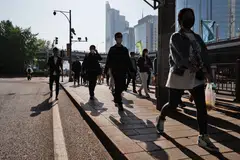
Shanghai, China’s largest city with about 28 million people, has been locked down since March 28, while the capital city of Beijing, with a population of 21 million, began tightening restrictions at the end of April.
New-home sales in 23 major cities tracked by China Real Estate Information Corp fell 33 per cent by area over the crucial 5-day Labour Day break compared with a year earlier.
“So, you can imagine the central bank may be lowering mortgage rates, and cities may be relaxing purchasing restrictions. But if you can’t go out of your apartment, it doesn’t help. You don’t have transactions,” said Hui Shan, chief China economist at Goldman Sachs Research.
China’s top 100 developers reported sales volume contracted by 56.5 per cent on year in March, down further from the 43.4 per cent contraction in Jan-Feb. Land sales, which are regarded as a leading indicator for the property sector, continue to contract in terms of volume and value.
Jeffrey Halley, senior market analyst of Asia Pacific, at Oanda, said: “China’s private developer leverage saga has been knocked off the headlines but remains a slow-moving train wreck that is also being exacerbated by the zero-Covid policy.”
For years, Chinese developers, including China Evergrande Group, have relied on high-leverage financing to target rapid growth through a build-to-sell quickly model. That came to a halt after Beijing introduced new measures in August 2020 to control the total debt level of major property developers, and market liquidity tightened as Beijing stressed that homes are for people “to live in, not for speculation”.
As many local governments rely on land sales for revenue, the curbs have implications on consumption, confidence and upstream sectors, including steel and cement production.
Shan said: “The repercussions can be quite significant given the degree of the decline we have been seeing.”


Hence, Beijing marginally adjusted the “2 red lines” for the property loans to allow state-owned developers to borrow more to acquire troubled projects and to lift lending restrictions on public rental housing. Local governments are allowed to ease some local property curbs based on local conditions.
Amid weakening housing demand, banks in more than 100 cities have lowered their local mortgage interest rates by an average 20-60 basis points, with growth in outstanding mortgage loans slowing to 8.9 per cent year-on-year at the end-March, from 11.3 per cent at the end of 2021. Property development loans remain subdued, as the growth rate of their outstanding amount slowed to 0.3 per cent year-on-year at the end of March, from 0.8 per cent at the end of 2021.
“Despite all the easing measures, the property sector worsened as Beijing has stuck to most of its major property curbs to achieve its long-term goals and as the latest Omicron wave hit China’s major cities,” the Goldman Sachs economist said.
The US investment bank reckons the property sector may deteriorate further on expansive lockdowns: “In cities under lockdown, household mobility is severely restricted. Households in cities that are not under lockdown may yet turn more cautious on their home purchase plans as uncertainty surrounding the Omicron variant and lockdowns mounts.”
Jesse Rogers at Moody’s Analytics said that while the risk of a full-blown property market crisis has subsided - with the restructuring of troubled private developers slowly take shape, the new stimulus and relaxation of some lending rules for real estate developers - China’s growth will still fall short of the official target of about 5.5 per cent for 2022.
Rogers added: “Since the start of the Russian invasion of Ukraine, almost US$8 billion has flowed out of Chinese equities, around one-third of the total for emerging markets. Though flows have since stabilised, fears of renewed troubles in housing and over Covid-19 disruptions to supply chains have prevented a full recovery.
“Subdued sentiment will continue to weigh on real estate, and less building will mean reduced demand for commodities produced by the rest of the emerging world.”
The Shanghai Composite has fallen 17 per cent this year, the worst performer in Asia so far, while Hong Kong’s Hang Seng Index has dropped 16 per cent.
Decoding Asia newsletter: your guide to navigating Asia in a new global order. Sign up here to get Decoding Asia newsletter. Delivered to your inbox. Free.
Copyright SPH Media. All rights reserved.