



China races to build record biobank to rival US drugs research
Beijing has equally begun to protect its own nascent databases, passing a biosecurity law in 2020
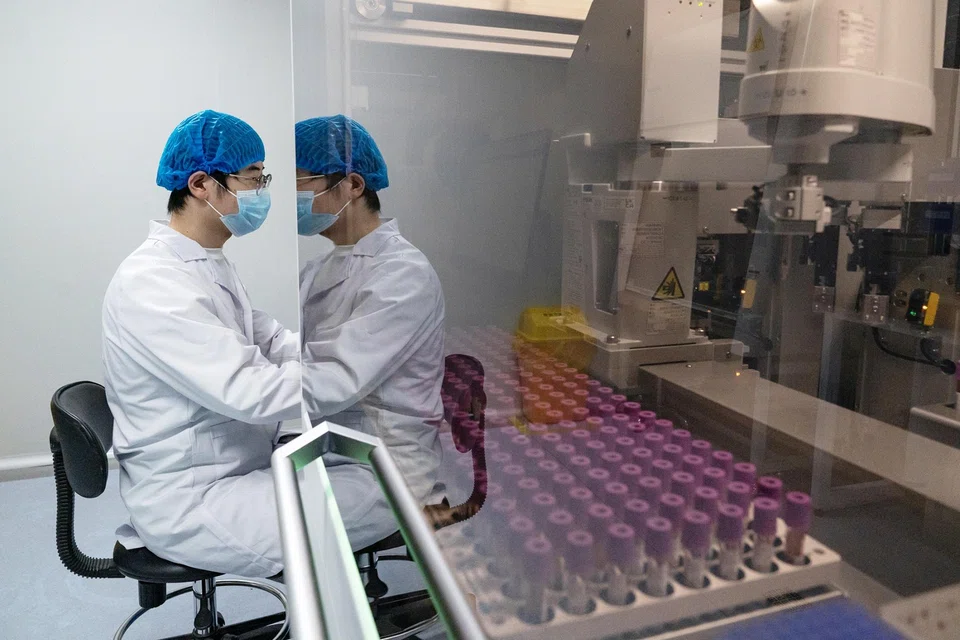
[BEIJING] As a fledgling researcher in the US, Zhang Li was struck by the efficiency of extracting human tissue in the morning and mining it for data the same afternoon.
Such a streamlined process had been missing from his years of training as a bio data scientist in China. Inspired, he returned home to Beijing to join the Chinese Institute for Brain Research and launch a national database that will collect blood and DNA samples from 33,000 children to help identify patterns of brain disease and their risk factors.
“Biomedical data is extremely valuable and is fundamental for us to find solutions to diseases and to delay ageing,” said Zhang, surrounded by robotic arms carefully organising blood samples.
His lab is part of a rapidly growing network of biobanks – huge repositories of biomedical data and biological samples such as blood, saliva and cells that form the backbone of drugs research. The sector has emerged as a new front in geopolitical rivalry, with many biobanks backed by the Chinese government as it attempts to challenge Western dominance of the global bioresearch economy, set to be worth trillions of US dollars.
For Chinese scientists, having access to homegrown biobanks could accelerate the advance of biotechnology companies and cement the country’s place as a global innovation powerhouse, but it is a complex process that could take several years to come to fruition.
The infrastructure push has taken on greater urgency since the United States and other Western nations began excluding Chinese scientists from accessing some of its most sensitive databases for research and limited its participation in international collaborations. Once widely and freely shared among scientists around the world, biomedical data is increasingly treated like semiconductor technology or advanced artificial intelligence, a matter of national security that governments are hesitant to let rivals access.
The result is a gradual shift from open scientific exchange towards a more fragmented, competitive landscape.
“The concept of biodata as a sort of strategic resource has definitely been growing in the US, especially as the recognition of the competition with China over biotechnology and bioeconomy has grown,” said Vikram Venkatram, research analyst at Georgetown University’s Center for Security and Emerging Technology.
Last year, Washington blocked researchers from China and five other countries from accessing 21 biomedical datasets maintained by the National Institutes of Health and restricted some Chinese biotechnology companies from government-funded contracts. US officials argued that some of the world’s most advanced genetic information could be exploited to threaten national security, public health, or provide military advantages.



Among them is a comprehensive dataset on cancer that covers 46 per cent of the US population and which has spawned at least 17,000 research papers. The Department of Justice said such bulk data sets could be used by foreign adversaries for economic benefit and provide intelligence services with information to blackmail individuals.
The repudiation has spread: in the UK, politicians have raised concerns about the use of its biobank data by Chinese researchers and in February, the European Union barred Chinese organisations from participating in Horizon Europe, a 93.5 billion euros (S$140 billion)funding programme.
Chinese scientists told Bloomberg News that the restrictions have already interrupted some research, but that the full implications were not yet clear.
Pursuit of self-reliance
Beijing has equally begun to protect its own nascent databases, passing a biosecurity law in 2020 that placed stricter controls over the collection, storage and overseas transfer of genetic data.
China’s efforts in developing an integrated biobank system began later than most other major economies, leaving it heavily dependent on Western data for its recent scientific discoveries, such as ways to predict dementia with a simple drop of blood, drugs to treat strokes and early diagnostic tools for colorectal cancer.
Recent progress in biobank infrastructure is underpinned by the Chinese Communist Party’s aggressive pursuit of self-reliance in science and technology, increasingly gaining ground in strategic fields including AI, semiconductors, energy and materials science.
“China wants to achieve a self-reliance of biomedical dataset, as part of China’s efforts achieving what Xi Jinping called holistic security,” said Huang Yanzhong, senior fellow for global health at the Council on Foreign Relations. “China does not want to be subject to control by other countries, especially those they have geopolitical tensions with”.
As a country of 1.4 billion people, China does not lack data. But its biobank system has long been fragmented, with different institutions using varying standards for data collection and storage. Chinese hospitals, universities and government-backed research centres are now in the complex process of collecting, consolidating and digitalising millions of samples to create a powerful engine for biotech innovation.
China’s flagship project, the National Biobank, has grown into one of the world’s largest since launching in Shenzhen in 2016 and Beijing is pushing to make it the biggest. Known in local media as ‘China’s Noah’s Ark’, it houses 10 million blood and cell samples from humans, animals, plants and marine organisms, and last year began to further integrate 10 biological databases from around the country.
“In the age of life science, those who possess abundant genetic resources and the knowledge to understand and use them, hold the advantage, just like land in the agricultural era and energy in the industrial era,” Mei Yonghong, then director of China’s national biobank and a former official from China’s Ministry of Science and Technology, told state media when it opened.
Likewise, the National Genomics Data Center has more than doubled the total size of its data files and integrated eight major databases from across the country over the past two years.
The stakes are high. The detailed biomedical data stored in biobanks underpins key frontiers in the global biotechnology race. For example, by analysing the environmental and genetic drivers of disease, researchers can aid the development of precision medicine which uses a patient’s biomarkers to determine what drugs they are likely to respond to.
Around 80 per cent of China’s bioscience still depends on US-based databases, according to a scientist at the government-affiliated Chinese Academy of Sciences, who asked not to be identified because he’s not authorised to speak publicly.
The US move to guard some of its most sensitive data is already impacting some colleagues, who have sought workarounds, including collaborating with scientists in countries with free access, said the person, who estimates it could take between five and 10 years for China to be able to rely on its own databases. The sentiment in the industry is generally pessimistic, with expectations that the ability to share information will deteriorate further, the source said.
The new fractures threaten a further retreat in US-China technology research that has seen collaboration already fall to a 20-year low and sparked warnings that it could impact global innovation.
The access restrictions are one of the biggest changes to the industry in a century, undermining open scientific exchange and leading to isolation of information, according to Nie Zhiqiang, a doctor at Guangdong Provincial People’s Hospital, who analysed the fallout in a self-published opinion article after the US ban on access to 21 sensitive databases.
In a statement to Bloomberg News, the US Department of Health and Human Services said its standards were “grounded in openness, scientific integrity, and respect for human dignity”.
“The United States must protect its research by safeguarding intellectual property and maintaining transparency and security in international collaborations,” it added.
The Chinese government did not respond to requests for comment.
Opportunities and risks
In theory, China’s advances in biomedical research and its investment push in technical infrastructure could have global benefits.
In particular, it could add ethnic diversity to a body of scientific data that is historically skewed towards Europeans. Genetic variants, gene expression and even disease pathways can differ by ancestry and environment, while patients can respond differently to drugs depending on their ethnic group.
But it is unclear what access the rest of the world will have to China’s growing biobank system. Although China’s biobanks do not officially exclude overseas researchers from accessing data, permission is governed by a tiered system based on data sensitivity and whether they are working in collaboration with Chinese scientists.
There are also ethical concerns. The National Biobank in Shenzhen was launched by the Chinese government in partnership with an institute funded by BGI Group, a Chinese company blacklisted in the US for allegations that its genetics technology was used for surveillance of the country’s minority groups. BGI has denied the allegations. The biobank is now run by a public sector research centre based in the tech and innovation city.
For scientists such as Zhang Li, the immediate focus is practical: to build up a health data infrastructure ready for a future in which AI will enable new possibilities.
The project he is working on involves more than 70 hospitals and research institutions and is due to run for 15 years. The genetic information, survey data and brain scans it accumulates could make it the world’s largest biobank on the mental health of children and adolescents and offer particular insights into the rise in ADHD and autism.
“It’s like semiconductor chips. China develops chips because, firstly, it is important, not because of geopolitical tensions,” Zhang said. BLOOMBERG
Decoding Asia newsletter: your guide to navigating Asia in a new global order. Sign up here to get Decoding Asia newsletter. Delivered to your inbox. Free.
Share with us your feedback on BT's products and services
TRENDING NOW

DBS, OCBC, UOB rout lops billions off STI as inflation, rate concerns spook investors

Grab CEO’s wife Chloe Tong on life with Anthony Tan and finding her purpose

OCBC sheds S$8 billion in value as shares close nearly 6% down; analysts cautious on banks

Deal between tycoon friends sparks scrutiny of Philippine power sector

