



China, Singapore among economies under US trade probe; MTI disputes US trade surplus claim
The administration is planning another investigation related to a ban on imports made with forced labour
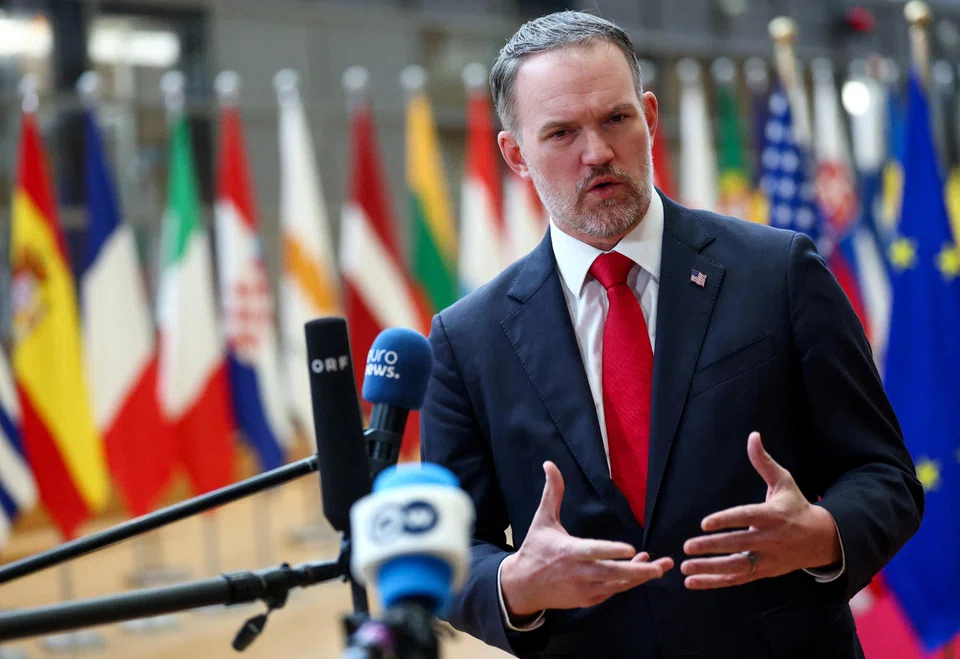
[WASHINGTON] US President Donald Trump’s administration started the first of several sweeping trade investigations that set the stage for new tariffs, the centrepiece of a push to replace levies struck down by the US Supreme Court.
US Trade Representative (USTR) Jamieson Greer announced on Wednesday (Mar 11) that his office would begin a probe into 16 major economies under Section 301 of the Trade Act focused on alleged excess manufacturing capacity.
The investigations, which typically take months to complete, are required for the president to unilaterally place duties on imports from specific countries deemed to employ unfair trading practices.
Economies that will be subject to the enquiry include some of the US’ largest trading partners: China, the European Union, Mexico, India, Japan, South Korea and Taiwan.
Switzerland, Norway, Indonesia, Singapore, Thailand, Malaysia, Cambodia, Vietnam and Bangladesh will also be investigated.
“Our view is that key trading partners have developed production capacity that is really untethered from the market incentives of domestic and global demand,” Greer told reporters.
The move marks the formal kick-off of the administration’s effort to rebuild Trump’s tariff wall after the landmark Supreme Court decision against his global duties last month.
Tariffs have been a core plank of Trump’s economic policy, and he had used his ability to unilaterally impose them to wield leverage against foreign countries.
While Trump and his team argue they simply want continuity in their trade policy, the administration’s rush to respond to the court defeat has yet again roiled global trading relations.
SEE ALSO



Launching a new trade investigation risks stirring up tensions with Beijing just weeks before a planned summit between Trump and Chinese President Xi Jinping. Targeting Mexico could further damage the already strained efforts to renegotiate the US-Mexico-Canada Trade Agreement that Trump signed during his first term.
Canada was not among the initial batch of targeted countries.
In a Federal Register filing, Greer’s office levied allegations of overcapacity for each economy, saying China maintains a trade surplus across several sectors. It singled out the EU – in particular Germany and Ireland – over its chemicals, machinery and vehicles, and Taiwan over semiconductor chips and electronics.
“Evidence suggests that China’s goods trade surplus is driven by increasing excess manufacturing capacity and production in numerous sectors,” USTR said in the filing, submitted by General Counsel Jennifer Thornton.
It also cited examples of foreign firms that are aggressively expanding overseas, such as Chinese automaker BYD. Sectors “plagued by excess capacity and production” include aluminium, automobiles, batteries, electronics, machinery, paper, plastics, robotics, satellites, semiconductors, ships, solar modules and steel.
“In many of these sectors, the US has lost substantial domestic production capacity or has fallen worryingly behind foreign competitors,” the agency said in the document.
Greer signalled the administration has no intention of slowing down. USTR plans to hold a public hearing around May 5 following an open comment period on the probe. After that, it can propose corrective actions, including tariffs.
MTI statement
In a statement on Thursday night, Singapore’s Ministry of Trade and Industry (MTI) referred to the Federal Register notice, which claimed Singapore had a bilateral trade surplus with the US in both goods and services amounting to US$27 billion in 2024.
“On the contrary, according to US Bureau of Economic Analysis (BEA) data, Singapore had a bilateral goods trade deficit of US$1.7 billion and a services trade deficit of US$25.1 billion with the US in 2024, amounting to a total trade deficit with the US of about US$27 billion,” said MTI.
The ministry also noted another point mentioned in the notice that suggested that Singapore has continued to expand manufacturing capacity despite a drop in industrial occupancy rates.
“In fact, Singapore’s industrial space occupancy rates are very healthy at around 90 per cent and have been consistently so. Land is a scarce resource in Singapore and the amount of land set aside for industrial use has decreased over time due to other land use needs,” said MTI.
The ministry added that it has provided the USTR with this information and would be seeking clarification on the trade data and on the Section 301 investigations.
Chinese Foreign Ministry spokesman Guo Jiakun said “trade wars do not serve the interests of any party”, and called for “consultation on the basis of equality, respect and mutual benefit”.
“So-called overcapacity is a false narrative, and China opposes using it as a pretext for political manipulation,” he said at a press briefing in Beijing.
South Korea will closely engage with the US to ensure that the balance of benefits under the existing Korea-US tariff agreement is not undermined, and that Korean exporters are not placed at a disadvantage compared with major competitors, the trade ministry said in a statement on Thursday.
No change in policy
As early as Thursday, the Trump administration also plans to open a separate investigation related to a ban on imports made with forced labour that cover at least 60 countries.
Other enquiries are expected to follow, Greer said. He did not specify what industries or countries could be affected, though he suggested they could target countries over digital-services taxes, pharmaceutical pricing and other concerns.
“The policy remains the same. The tools may change, depending on the vagaries of courts and other things, but the policy remains the same,” Greer told reporters.
After the justices ruled that Trump’s tariffs violated the law, the president immediately announced 10 per cent tariffs under a different authority as a stopgap for 150 days, while signalling plans to impose levies under different powers, including Section 301 and Section 232.
He later said he would raise the temporary baseline rate to 15 per cent, though he has so far held off on actually imposing the increase.
Greer said that he would seek to conclude the investigations before the Section 122 levies expire, which would allow any new levies to quickly replace them.
Trump has groused that those provisions lack the same flexibility as the emergency law he had used, though the Section 301 and Section 232 avenues are widely seen as more legally sound. He has already used them to impose tariffs on autos, metals and certain imports from China and Brazil. BLOOMBERG
Decoding Asia newsletter: your guide to navigating Asia in a new global order. Sign up here to get Decoding Asia newsletter. Delivered to your inbox. Free.
Share with us your feedback on BT's products and services
TRENDING NOW

Government to bring forward raising of retirement age, give employers more financial support to create flexi-load jobs

If Europe goes to war, the fallout will be felt in East Asia
Indonesia stocks suffer worst plunge in nearly 30 years as MSCI proposes standalone status

Vietnam’s northern provinces, not Hanoi or Ho Chi Minh City, are powering near 10% GDP growth

