China will continue its zero-Covid policy even at risk of burdening corporates

TWENTY months since closing its borders to foreigners in late-March last year, and with no end to its zero-Covid policy in sight, China's economy is chugging along but economists warn Beijing risks longer-term scarring and burdening corporates, which are already showing weakening credit trends.
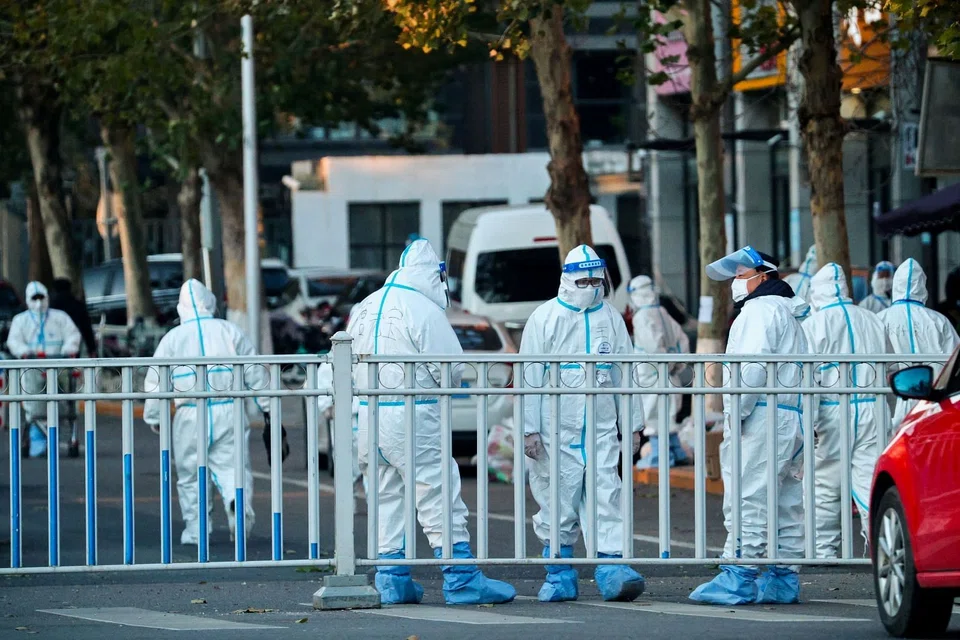
Throughout the pandemic, China has employed lockdowns, quarantines and compulsory testing for the virus. Late October, it offered booster shots as new outbreaks of the highly transmissible Delta variant threaten its zero-Covid tolerance. It started inoculating children as young as three, making it one of the very few countries in the world to do so. As of Nov 10, China has administered 2 shots of the Covid-19 vaccine to more than 1 billion people, covering 75 per cent of its population. But even as the rest of the world is mulling reopening their air and land borders, China remains steadfast in its commitment to zero Covid. While production output and retail sales performed better than expected in October, economists are not changing their outlook for China.
"Given the upcoming Beijing Winter Olympics (starting February 4) and the 20th Party Congress (October-November) next year, we expect the Chinese government to continue its "zero-Covid" policy despite a high vaccination rate and medical improvements," noted Goldman Sachs economists.
"Chances are high that 2022 could be a repeat of 2021 with multiple rounds of local outbreaks and restrictions on transportation and entertainment activities, dragging down household consumption," they said.
Chinese policymakers are more likely to favour economic resilience than speed when it comes to growth, and with President Xi Jinping, 68, looking on track to securing a third 5-year term as the Communist Party's general secretary, the leadership seems to be taking an even longer-term view on development than before.
"With this backdrop, we believe the Chinese economy is settling into a new regime where policymakers accept slower growth in the near term for a more resilient economy in the long run," the Goldman Sachs economists said.
Other analysts also noted that in 2018, Xi had eliminated a term limit on the presidency, opening the way for him to lead China indefinitely.
Jeffrey Halley, senior market analyst of Asia Pacific at OANDA, highlighted risks to China's zero-Covid tolerance.
"Its Covid-zero policy means that if cases in the current outbreak spread, to say port cities, mass closures could result if its previous go-to strategy is anything to go by. That would have a knock-on disruption that would be felt across the globe.
"The state grid operator has already said electricity supply and demand are finely balanced into the winter months recently, and a colder-than-usual winter will definitely bring those stresses to the front of investor thinking again."
Economists at S&P Global Ratings said China's zero-Covid tolerance may further strain corporates if outbreaks continue to bring about mobility restrictions and broad disruptions.
"Higher leverage, weaker cash flows, tighter liquidity, and volatile financing conditions are biting. And all this is occurring amid unprecedented distress events and regulatory actions," they said, adding that China's stance may exacerbate these stresses and push rating momentum further into the negative.
"We anticipate the government will continue its push against excessive leverage and market abuse. Unlike last year, we do not expect a large stimulus to boost corporates over the near term. As a result, corporate risks will remain elevated as the pandemic persists," they noted.
However, there is merit to China's stringent Covid stance and policies, said Louis Kuijs, head of Asia economics at Oxford Economics, noting that fewer people have died from Covid-19 in China compared to other countries. But a country's decision to change its Covid stance depends on respective circumstances.
Kuijs explained: "Some people argue that the Chinese vaccines are less effective than some of the other ones used internationally and that that makes it harder for China to rely on high vaccination levels as a basis to move to a containment strategy. But with the rest of the world having decided on a "containment" strategy, China's stance has become problematic and it will have to choose. If it really wants to continue with its zero-tolerance approach, it would have to permanently cut itself off from the rest of the world, which seems unsustainable.
"It could at some point move in that direction if it wants to, and start to prepare the public for such a move. If domestically-produced vaccines don't seem sufficiently effective, it could in principle just import more effective ones. Unfortunately, politics seem to be a stumbling block to the move away from the current, onerous policies," Kuijs said.
He believes the economic cost for China is not huge given that it is a big country, and remains connected to the rest of the world with today's telecommunication and Internet infrastructure.
"Even for the rest of the world, the purely economic impact is not the biggest issue. I worry more about how a prolonged period with very little international interaction - both at the level of politicians and policymakers as well as in terms of people-to-people contact - tends to reduce trust, understanding and sympathy at an already complicated juncture in terms of international relations. This is clearly unhelpful in terms of the relationship between China and many other countries," Kuijs said.
This year has been a roller-coaster for the Chinese economy and markets, and uncertainties associated with the 2022 outlook are "particularly significant", depending on Covid evolution, property slowdown, energy constraints, and most crucially, the government's policy response, Goldman Sachs economists said.
They warned: "A bottom-up perspective points to a less benign picture. With consumption recovery still hindered by the "zero-Covid" policy, investment dragged by property market deleveraging, and exports unlikely to repeat this year's stellar performance, even 5 per cent growth seems difficult to achieve without notable policy easing."
The economists expect 2022 growth to be 4.8 per cent, below consensus expectations of 5.5 per cent.
"Although we remain more optimistic about Chinese exports and current account surplus than market consensus, net exports are likely to turn from a significant tailwind in 2021 to a small headwind in 2022."
Due to China's zero-Covid stance, consumption recovery may continue its "two steps forward, one step back" pattern. Investment growth should slow markedly in 2022 on continued property market deleveraging. The slowdown in property investment is unlikely to be fully offset by infrastructure investment as policymakers also try to rein in local government shadow borrowing and hidden debt in the broader deleveraging and de-risking efforts.
"New infra" and "green capex", although having the most potential to grow in the coming years, are simply too small at this stage to fill the void left by slowing property investment, the Goldman Sachs economists said.
Decoding Asia newsletter: your guide to navigating Asia in a new global order. Sign up here to get Decoding Asia newsletter. Delivered to your inbox. Free.
Copyright SPH Media. All rights reserved.