
Global Enterprise logo
BROUGHT TO YOU BYsc logo

China’s BYD gears up for global electric car race
Published Mon, Apr 24, 2023 · 05:50 AM
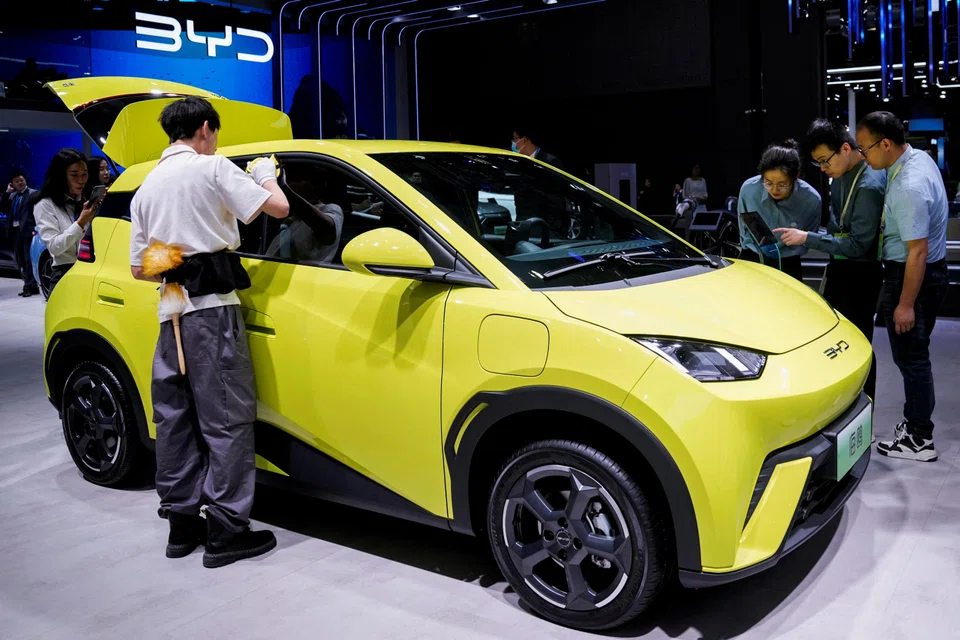
    • Visitors checking out the BYD Seagull car that was on display at the Shanghai Auto Show 2023.
    • Visitors checking out the BYD Seagull car that was on display at the Shanghai Auto Show 2023. PHOTO: REUTERS

    AS the world’s largest auto show dazzled in Shanghai, Chinese electric vehicle maker BYD caught the limelight with the debut of several new models including an all-electric SUV marking the company’s fresh foray into the luxury market.

    The showcase follows a year when BYD posted astonishing results, topping global electric vehicle (EV) makers with record sales of 1.8 million vehicles in 2022. It was the first year BYD abandoned fossil fuel car production and shifted completely to new-energy vehicles (NEVs).

    The Warren Buffett-backed company posted 2022 revenue of 424 billion yuan (S$82.2 billion), almost double the previous year’s total, despite slower sales growth industrywide. Net profit reached 16.62 billion yuan, up more than four-fold year-on-year and equivalent to the sum of the previous five years, according to BYD’s late-March financial report.

    China’s auto market, the world’s largest, is entering a key transition period as growth slows and NEVs and conventional gasoline-powered vehicles face off in direct competition. Since late last year, a brutal price war has rattled the industry with limited effect in bolstering sales.

    “China’s NEV industry has entered the elimination round,” said BYD chairman Wang Chuanfu when discussing the 2022 results. Wang voiced confidence in BYD as the company seized a dominant position in the market with a price range between 100,000 and 200,000 yuan.

    In 2022, more than 75 per cent of BYD’s revenue came from automobile and related businesses, with the gross margin expanding 3 percentage points from 2021 to more than 20 per cent. BYD sold 1.86 million electric and plug-in hybrid vehicles in 2022, more than the previous four years combined and accounting for about 30 per cent of all NEV sales in China.

    Asean Intelligence

    Get insights into businesses across South-east Asia

    Get the free report

    Wang said BYD aims to become China’s largest car manufacturer with a sales target of 3.6 million autos in 2023.

    BYD ranked sixth among Chinese automakers in sales volume in 2022. The top player, SAIC Group, sold more than 4 million units, according to the China Association of Automobile Manufacturers (CAAM).

    Annual sales of 3.6 million vehicles would not only make BYD the largest NEV maker in China but also would most likely rank it among the top 10 auto manufacturers worldwide.

    BYD took 13 years – between 2008 and 2021 – to sell its first 1 million NEVs and less than two years to hit 2 million. Reaching the third million in November 2022 took only six months.

    The growth momentum is supported by a high degree of self-reliance. BYD can produce almost all the components for cars except glass and tires.

    The vertically integrated supply chain helped BYD avoid the disruptions that rattled the global auto industry last year. Over the past year, BYD’s annual production capacity more than doubled from 600,000 units to 1.25 million.

    As several of BYD’s new production facilities are going into operation, the company will be able to grab new market share quickly. According to Zheshang Securities, BYD’s production capacity in operation and under construction totaled 3.05 million units as of the end of 2022, and it is expected to further increase to 4.3 million this year.

    Starting as a battery and electronics contract manufacturer, BYD entered the auto industry in 2003 after acquiring a domestic automaker.

    Five years later, the company made a significant move into the new-energy vehicle market by launching China’s first hybrid plug-in EV, the F3DM. In September that year, BYD received a major investment from American billionaire Warren Buffett and became a darling in the capital market.

    After three years of slow growth between 2010 and 2012, BYD put its focus on NEVs. In 2015, it became China’s largest producer of hybrid plug-in electric vehicles. But business weakened again starting in 2017 as China scaled back subsidies for the NEV industry and market demand remained lukewarm.

    Although China’s auto market expansion slowed over the past few years, consumers’ appetite for NEVs grew. In 2022, BYD became the country’s largest NEV maker with a market share of 31.7 per cent, compared with American EV giant Tesla’s 7.8 per cent.

    BYD is pursuing a strategy of multiple brands to expand its product portfolio while seeking sales overseas. Li Yunfei, general manager of BYD’s brand and public relations, said the company plans to create a brand lineup similar to those of Volkswagen and Toyota.

    Over the past year, BYD entered passenger cars markets in Japan, India, Germany, Sweden and Mexico, exporting nearly 55,000 cars in 2022. Overseas sales in the first two months this year reached 25,000 units, according to BYD.

    Soochow Securities predicted that BYD’s vehicle sales will reach 3 million in 2023, with about 200,000 of the autos exported.

    Zhou Lijun, chief analyst at Yiche Research, said that 2023 marks the opportune moment for BYD to launch a full market offensive to seize greater market share through measures such as launching a price war and introducing new products.

    Price killer

    The shrinking difference in prices between EVs and gasoline-powered cars is advancing the adoption of electric cars, leading to a more rapid replacement of traditional combustion-engine vehicles.

    BYD’s Wang estimated that total sales of NEVs in China will reach 8.5 million to 9 million units in 2023, with a market penetration of more than 40 per cent. BYD aims to capture nearly half the market.

    According to data from industry information provider GGII, the average delivery price of NEVs in China was 175,600 yuan in 2022, for the first time dropping below the average price of gasoline cars, which was 175,900 yuan.

    BYD vice-president Lian Yubo attributed the company’s performance to supportive policies, technological advances and product maturity.

    Amid a cooling market, BYD in February launched a new compact model with a price tag of 99,900 yuan, challenging a key market segment dominated by conventional carmakers like Nissan and Volkswagen.

    BYD already had significant price advantages, and as it pushed prices further below 100,000 yuan, it put tremendous pressure on competitors, said a salesperson of a joint venture between Volkswagen and FAW Group.

    “Considering the lower average selling price, BYD’s overall cost management is even better than Tesla’s,” said Li Xiang, CEO of rival Li Auto. According to BYD’s financial report, its gross profit margin was 22.8 per cent in the fourth quarter, close to Tesla’s 25.9 per cent and much higher than Li Auto’s 19.4 per cent and Nio’s 10 per cent.

    BYD’s highly integrated chain from mineral mining to battery and motor manufacturing allows the company to maximise profits, industry analysts said.

    Self-reliance also helped BYD overcome business disruptions. In April 2022 when China’s NEV industry was hurt badly by Covid-19 lockdowns and sales plunged nearly 40 per cent, BYD’s deliveries rose 37 per cent from the previous month to 104,700 units.

    But the sprawling business chain may also bring more risks from policy and market uncertainties. BYD in recent years has been seeking to spin off its semiconductor and battery businesses for separate listings, although progress has been slow.

    BYD’s vertically integrated business model ensures supply chain reliability and gives it an advantage over competitors during rapid growth. However, as battery technology and semiconductor industries develop, its supply chain system will need to be diversified, said Zheng Bin, a senior partner of Roland Berger.

    Refining brand image

    BYD has long been known as a budget carmaker targeting the low-end market as most of its vehicles were priced at less than 200,000 yuan. However, the company has been working to upgrade its brand image by introducing more sophisticated, higher-value products.

    In August 2022, BYD launched the Denza D9, an electric SUV targeting the high-end market with price starting at 329,800 yuan.

    In January, a luxury sub-brand called “Yangwang” was released. The first SUV model bearing the brand, the U8, debuted April 18 at the Shanghai Auto Show with price tag of more than 1 million yuan. Caixin learned that BYD plans to introduce another high-end sub-brand in the second half of this year.

    Founder Wang Chuanfu has had his sights on the high-profit, high-end market for years. In 2010, BYD set up a 50-50 joint venture with Daimler Greater China to tap into the luxury electric car market. The venture introduced four models under the Denza brand, but sales remained lukewarm.

    In May 2022, BYD increased its stake in the venture to 90 per cent, securing decision-making power over the company’s strategy. Zhao Changjiang, the venture’s general manager, said the company has made improvements in organisational efficiency, communication and resource utilization following the shareholding change.

    BYD plans a brand series similar to those of Volkswagen and Toyota, creating multiple sub-brands to cover a full range of vehicles from compact sedans to full-size SUVs, multi-purpose vehicles and sports cars, with prices ranging from 100,000 to 1.5 million yuan.

    “To achieve scale, it is necessary to have different product series that cater to different people with products at different price levels, whether in the Chinese or the global market,” Zhao said.

    BYD is also stepping up efforts to keep up with the trend of autonomous driving. Wang has said on several public occasions that “the first half of the NEV race is electrification, while the second half is intelligence.”

    BYD was one of the earliest Chinese automakers to collaborate with tech companies in the development of autonomous driving and to introduce new technological features to its vehicles. However, its tech capacity still lags behind that of rivals like Xpeng and Nio.

    BYD has felt the urgency to improve its tech capacity and is looking for better solutions to improve its intelligent driving technology, a person close to the company said.

    In 2022, BYD doubled its R&D investment from the previous year to 18.65 billion yuan, about 4.77 per cent of annual revenue.

    Overseas expansion

    The expanding production capacity is strengthening BYD’s ambitions for the overseas market.

    In May 2021 when BYD reached the milestone of producing its first million NEVs, the company announced a plan to expand abroad. In 2022, BYD geared up its overseas business, making quick strides into several markets, including Europe, Asia Pacific, the Middle East, Africa and the Americas.

    One of BYD’s strategies in the overseas market is to follow in Tesla’s footsteps. According to Li, the company’s decision to enter a particular market depends on market size and penetration rate.

    “If it takes a few years to build a market from scratch, BYD will give up,” Li said. “However, if the market has already been cultivated by brands like Tesla and has a sufficient scale, BYD will consider entering it.”

    The compact SUV model ATTO 3, known as Yuan PLUS in China, is BYD’s main export product. In September 2022, BYD entered European countries such as Norway, Denmark and Germany. On Mar 8, the first ATTO 3 was launched in the UK with a price of £36,500 (S$60,385), compared with £45,000 for the Tesla Model Y.

    A BYD manager said the company will open stores on a large scale in Europe in 2023 and will cooperate with top-ranked and long-established dealers. Overseas management teams will be completely localised.

    BYD is also actively expanding its presence in South-east Asia. In August 2022, BYD announced its entry into Thailand, shortly after the Thai government slashed tariffs on imported NEVs to spur the market. According to BYD’s local sales partner RVER Automotive, as many as 70 BYD dealership stores will be opened by the end of 2023.

    BYD currently exports entire vehicles to overseas markets, according to a company source. But the company plans to build a factory in Thailand to start production in 2024. The plant, with annual capacity of 150,000 units, will supply Thailand and other Asean markets. Investment in this plant may exceed 2 billion yuan.

    Despite a sluggish domestic market, Chinese-made cars are experiencing increased demand abroad. In the first two months of 2023, China’s auto exports surged 43.2 per cent to 682,000 units, according to the General Administration of Customs. During the same period, domestic auto sales dropped 20 per cent to 2.7 million units, CAAM data showed.

    BYD’s overseas sales have expanded quickly. The company sold 25,000 vehicles outside China in the first two months of 2023. In 2022, BYD’s exports totaled 55,000 vehicles.

    Amid fierce competition at home, Chinese automakers are racing to seek new markets overseas. And the issue is particularly pressing for BYD, analysts said.

    There is a risk of oversupply in BYD’s domestic production capacity, so the company needs to focus on exporting to better utilise capacity, they said. CAIXIN GLOBAL

    Decoding Asia newsletter: your guide to navigating Asia in a new global order. Sign up here to get Decoding Asia newsletter. Delivered to your inbox. Free.

    Share with us your feedback on BT's products and services