



China’s consumer prices jump on holiday boost; factory-gate deflation lingers
The nine-day Lunar New Year break boosted domestic travel and consumer spending
 Add BT as a preferred source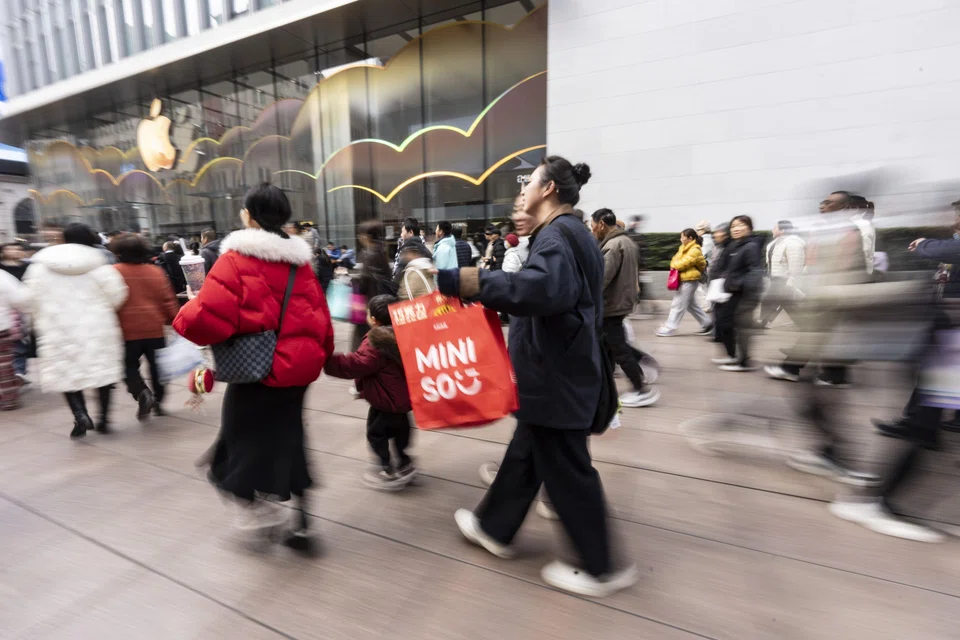
[BEIJING] China’s consumer inflation accelerated to the highest in more than three years due to the effects of the Lunar New Year holiday, while producer deflation persisted as weak demand remained a drag on an economy facing stiff external challenges.
Policymakers have been trying to boost consumption over the past two years, but analysts say more needs to be done to address the supply-demand imbalance.
The consumer price index (CPI) rose 1.3 per cent year-on-year for the fifth straight month of gains and outpaced the 0.2 per cent increase in January, data from the National Bureau of Statistics (NBS) showed on Monday. The pace beat an expected 0.8 per cent rise in a Reuters poll.
A nine-day Lunar New Year holiday boosted domestic travel and consumer spending, lifting the headline CPI reading as services price surged. The holiday period last year was one day shorter and started in late January.
Core CPI, which excludes volatile prices of food and fuel, rose 1.8 per cent year-on-year last month, compared with the 0.8 per cent rise in January.
On a monthly basis, CPI increased 1 per cent, compared with a 0.2 per cent rise in January and an expected increase of 0.5 per cent.
Navigate Asia in
a new global order
Get the insights delivered to your inbox.
The economy has been beset by a years-long property market slump and external trade uncertainties, with protectionist US policies posing fresh challenges to policymakers.
Beijing has vowed to keep cracking down on excessive competition and ensure smoother exit of inefficient production capacity in order to stabilise prices.
However, the deflationary impulse across the economy continues to exert margin pressure on the manufacturing sector, while underpinning expectations of sustained price falls in a further blow to confidence.


There was a modicum of relief in the latest data, however. The producer price index (PPI) recorded the smallest year-on-year drop since July 2024, having fallen 0.9 per cent in February. It declined 1.4 per cent the previous month, and economists polled by Reuters had expected a 1.2 per cent drop.
NBS statistician Dong Lijuan attributed the milder producer deflation to factors including stronger prices in advanced and emerging sectors as well as capacity management in key industrial sectors, according to a statement.
Beijing is aiming for GDP growth of between 4.5 per cent and 5 per cent for the year, slower than the previous year’s “around 5 per cent”, signalling willingness to accommodate reforms that could help the economy reduce its reliance on external demand.
In a report presented at the annual parliamentary meeting, Chinese Premier Li Qiang reiterated that driving “an appropriate rebound” in prices was one of the key considerations for monetary policy.
The government’s CPI target for 2026 remained unchanged at “around 2 per cent”, a goal that China’s state planner said was “conducive to guiding public expectations and boosting market confidence while also leaving room for macro regulation and further reforms”.
China has not achieved its annual CPI goals for years. REUTERS
Decoding Asia newsletter: your guide to navigating Asia in a new global order. Sign up here to get Decoding Asia newsletter. Delivered to your inbox. Free.
Share with us your feedback on BT's products and services
TRENDING NOW

Yeo’s, Tiger Beer and now Gardenia – flight of food manufacturing from Singapore might be just as planned
Xi Jinping has just rewritten the rules of US-China rivalry

Brewing success: How three brothers turned Brewerkz Group’s fortunes around

‘Even a CEO’s job can be replaced by AI’: DBS CEO Tan Su Shan bets big on agentic AI

