



China’s growth seen rebounding in early 2026 despite war in Iran
A solid report would reduce the urgency for additional stimulus by the government
CHINA’S growth likely rebounded in the first quarter of 2026, offering policymakers time to assess the impact of the Iran war on the world’s second-largest economy before stepping in with stimulus.
Gross domestic product is expected to have expanded 4.8 per cent from a year ago, according to the median forecast of economists polled by Bloomberg ahead of the official release on Thursday. That would be an acceleration from the 4.5 per cent gain recorded in the final quarter of 2025, which was the weakest reading since the country reopened after Covid in late 2022.
The US-Israel war against Iran probably only had a limited impact on activities so far, thanks in part to China’s moves in past years to strengthen energy security and insulate its economy from global ructions.
Years of deflationary pressure have also blunted the potential for an immediate impact on consumer prices from higher oil costs.
But as imports of high-tech products jumped in March, driven in part by an investment boom in artificial intelligence, the goods trade surplus shrank almost 5 per cent in the first quarter from a year ago in yuan terms.
Although that could mean less support from net exports, strong global demand linked to AI is helping ward off external threats to Chinese companies at a time when the conflict in the Middle East is wreaking havoc on the world economy.
A solid report would reduce the urgency for additional stimulus, especially after Beijing adopted a more flexible approach toward growth by lowering its GDP goal to a range of 4.5 per cent to 5 per cent — the lowest since 1991.
A rising number of economists is forecasting the People’s Bank of China won’t cut interest rates this year, because the oil shock pushed up inflation expectations.
“We expect policymakers to adopt a wait-and-see mode for now,” Macquarie Group Ltd. economists led by Larry Hu said in a report Friday. “China’s stimulus calculus will depend on the trajectory of the US economy and the ongoing AI boom. Both remain major tailwinds to exports, the key engine of China’s economy.”



Other figures on Thursday are likely to show that imbalances between the supply and demand sides of the economy persisted.
Industrial output is forecast to grow 5.3 per cent in March from a year ago. Even though that would be a step down from the 6.3 per cent rise seen in the January-February period, it would likely be seen as a strong result, given that factories had more days off compared with 2025 due to a later-than-usual Lunar New Year holiday.
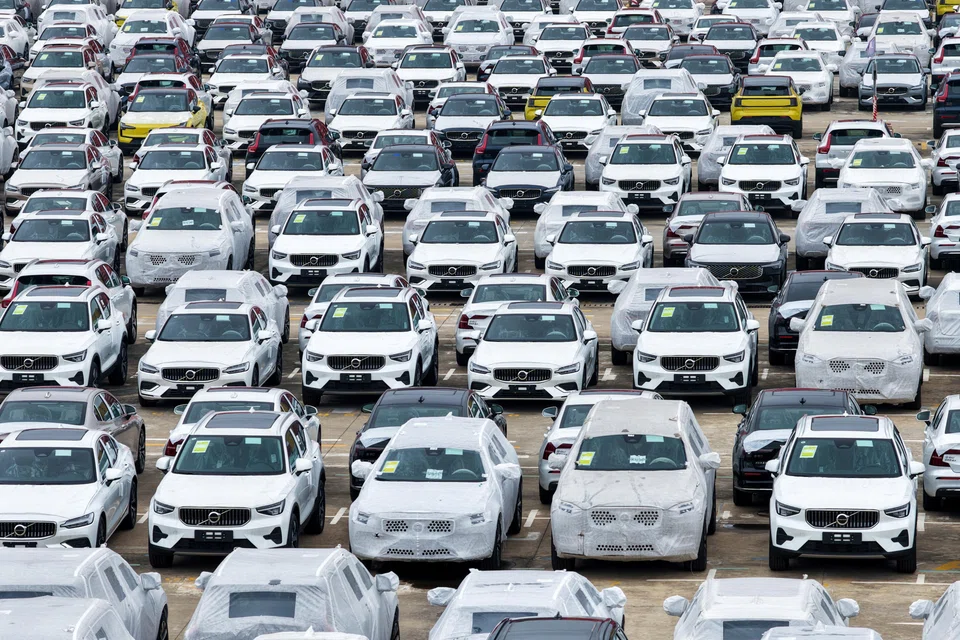
That strength is partly a result of a 15 per cent surge in exports in the first quarter from a year ago. A boom in AI investment is driving overseas sales of high-tech items such as chips, while Chinese green products like electric vehicles continue to grab more market share abroad.
Retail sales are expected to rise just 2.4 per cent in March, weakening from the 2.8 per cent expansion in the first two months and reflecting frail household confidence. Domestic car sales contracted almost 8 per cent in the first quarter from a year ago, partly due to the phasing out of government subsidies.
The property market remained weak despite a rebound in transactions of existing homes in megacities like Shanghai. A proxy for outstanding mortgages declined more than 40 per cent from a year ago in March — indicating people are still reluctant to take on more debt.
Fixed-asset investment is forecast to increase 1.9 per cent for the first three months of the year, an improvement from the 1.8 per cent in the January-February period and the unprecedented contraction seen last year. Economists attribute the uptick to infrastructure projects having been delayed to early this year from late 2025.
Some observers also pointed to an anomaly in the data that suggested last year’s drop might largely have been a result of temporary adjustments to statistical methods. Government bond sales, a key source of funding for construction projects, declined in the first quarter from a year ago.
One consequence of the recent surge in oil prices: China could officially exit from economy-wide deflation after three straight years. Thursday’s figures may reveal that the GDP deflator — a broad gauge of prices across the economy — turned positive.
That’s after data for March showed producer prices rose for the first time since 2022, and consumer prices continued their moderate gains.
Still, analysts warn that such cost-driven inflation could be harmful to the real economy. Higher input prices are squeezing the profits of consumer-facing factories, which have already been suffering narrowing margins for several years. BLOOMBERG
Decoding Asia newsletter: your guide to navigating Asia in a new global order. Sign up here to get Decoding Asia newsletter. Delivered to your inbox. Free.
Share with us your feedback on BT's products and services
TRENDING NOW

DBS, OCBC, UOB rout lops billions off STI as inflation, rate concerns spook investors

Grab CEO’s wife Chloe Tong on life with Anthony Tan and finding her purpose

OCBC sheds S$8 billion in value as shares close nearly 6% down; analysts cautious on banks

Deal between tycoon friends sparks scrutiny of Philippine power sector

