
Global Enterprise logo
BROUGHT TO YOU BYsc logo

China’s holiday spending boom masks patchy recovery
Published Sun, May 28, 2023 · 12:00 PM
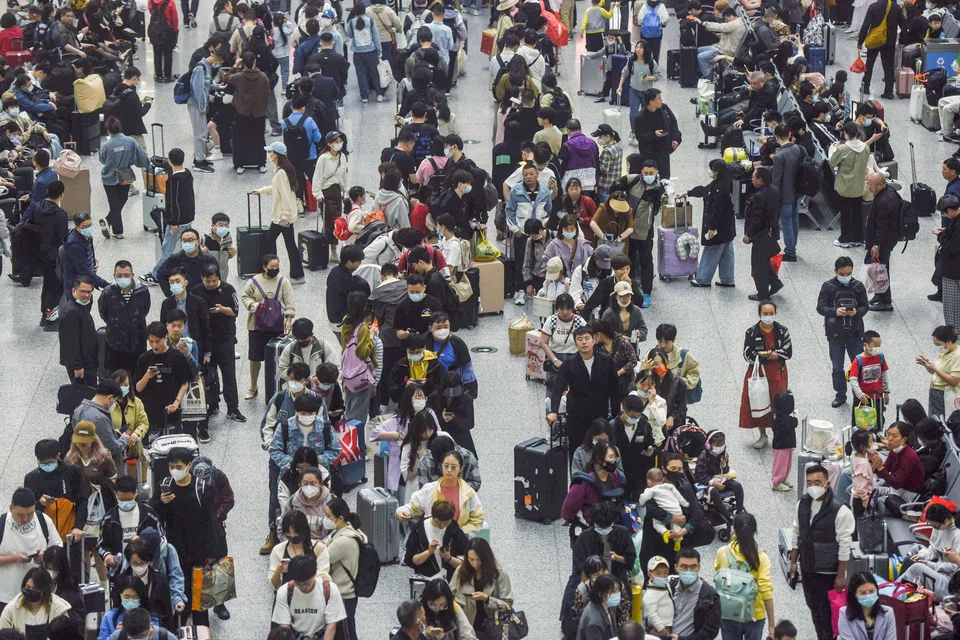
    • Passengers at the Hangzhou East train station in China. Around 270 million domestic trips were made during the five-day Labour Day holiday that ran from Apr 29 to May 3 this year.
    • Passengers at the Hangzhou East train station in China. Around 270 million domestic trips were made during the five-day Labour Day holiday that ran from Apr 29 to May 3 this year. PHOTO: AFP

    HUNDREDS of millions of travellers swarmed China’s tourist hotspots during the recent Labour Day holiday, painting a rosy picture of a rebound in the closely watched gauge of consumer spending.

    But the latest economic data is patchy and analysts are worried that lingering weaknesses in areas such as manufacturing and real estate are holding back a full recovery.

    During the five-day break – the first normal holiday for many Chinese after three years of strict Covid-19 controls – around 270 million domestic trips were made by car, rail, airplane and waterways from Apr 29 through May 3, with the daily average up 163 per cent from last year, according to the Ministry of Transport.


    Railway and airplane trips exceeded 2019 pre-pandemic levels by 22.1 per cent and 4.2 per cent respectively.

    The volume of domestic flights rose by a daily average of 15 per cent from 2019 levels and average ticket prices were up 39 per cent, according to online travel agency Trip.com. Qunar, another agency, reported that bookings for flights to popular domestic cities exceeded pre-pandemic levels by 50 per cent.

    Revenue from domestic tourism during the holiday soared 129 per cent year on year to 148 billion yuan (S$28.3 billion), the Ministry of Culture and Tourism said.

    Asean Intelligence

    Get insights into businesses across South-east Asia

    Get the free report

    Some analysts hope the boom in “revenge spending” will extend into the peak summer holiday season. The China Tourism Academy forecast that nearly 4.55 billion domestic trips will be made this year, while revenue will reach about four trillion yuan, recovering to 76 per cent and 71 per cent of 2019 levels respectively.

    Following years of pandemic restrictions, people have a strong desire to travel, said Flora Zhu, director of corporates at Fitch Ratings. The slow recovery of overseas travel will give an extra boost to the domestic tourism market this year, she added.

    Business conferences and exhibitions across China also contributed to the increase in travel, such as the Canton Fair in Guangzhou and the Shanghai Auto Show. The southern metropolis of Guangzhou hosted around 50 economic and trade exhibitions in the first quarter, according to Xinhua.

    Lingering weakness

    However, while the robust holiday travel data provided an upbeat outlook for domestic tourism for the rest of 2023, analysts pointed out that average per trip spending was about 10 per cent lower than in 2019, despite having an extra one-day holiday this year.

    “We believe the lower spending this year was likely a result of several factors, including a large group of low-income tourists on the road, more visitors to lower-tier cities and rural areas. (There was also) a high share of short trips, likely due to high travel costs as airfares and hotel prices were much more expensive than in 2019,” Fitch Rating’s Zhu and Jenny Huang said in a report.

    At the same time, April economic data mostly missed market expectations, with many analysts pointing out that overall economic recovery has been patchy and appears to be losing momentum.

    The pace of growth was disappointing, analysts said, despite the headline figures’ year-on-year growth benefiting from a low base in April last year, when economic activity plunged during Shanghai’s citywide lockdown.

    Industrial production rose 5.6 per cent in April from a year earlier, according to data released on May 16 by the National Bureau of Statistics (NBS), far short of the 10.5 per cent average estimate in a Caixin survey of economists. Retail sales, meanwhile, increased 18.4 per cent, missing the economists’ forecast of a 21.5 per cent surge.

    Growth in fixed-asset investment slowed to 4.7 per cent in the first four months of the year, weaker than the 5.7 per cent estimate, while unemployment among 16 to 24-year-olds surged to a record high of 20.4 per cent.

    Factory activity contracted. The Caixin China General Manufacturing Purchasing Managers’ Index, which gives an independent snapshot of the manufacturing sector, fell for the second straight month in April. The reading dropped to 49.5 from 50 the previous month and 51.6 in February. A reading below 50 indicates a contraction in activity, while a number above that signals an expansion.

    “In April, the services sector kept up momentum, while manufacturing activity turned comparatively sluggish and became a drag on economic growth,” said Wang Zhe, a senior economist at Caixin Insight Group. “It remains to be seen if the economic rebound is sustainable after a short-term release of pent-up demand.”

    The drop underscores the concerns of China’s leaders about the sustainability of the economic rebound seen in first-quarter GDP data, flagged at a Politburo meeting chaired by President Xi Jinping on Apr 28.

    China’s post-pandemic recovery continues to be challenged by weak “internal dynamics” and insufficient demand, while economic transition and upgrading face new headwinds, according to a transcript of the meeting published by Xinhua.

    The property sector, for example, witnessed a spike in demand in March. But in the first four months combined, investment in real estate development declined 6.2 per cent year on year to 3.55 trillion yuan, with a sharp decline of 7.3 per cent in April, revised data from NBS showed.

    New home sales by area also fell, down 0.4 per cent year on year to 376.4 million square metres in the first four months, according to the revised data.

    “The pace of sales in March was on par with the 2019 levels, which clearly could not be sustained,” said analysts at Goldman Sachs in a report.

    People are also reluctant to borrow. New short-term loans to households plunged 125.5 billion yuan in April from a year earlier, while medium to long-term household loans, which are mainly mortgages, dropped 115.6 billion yuan in the same period, according to credit data released by the People’s Bank of China (PBOC).

    This was likely driven by the deterioration in sales of new homes and remaining mortgage prepayments, Nomura Holdings analysts said in a May 11 report.

    “As the pent-up demand for in-person services may not be long-lived, property woes re-emerge and the export sector deteriorates, we believe the post-Covid sweet spot for China’s economy is drawing to a close,” the analysts said.

    Wang Tao, chief China economist at UBS, noted in a May 17 report: “The first wave of consumption rebound has been boosted by China’s rapid reopening and normalisation of offline activities. However, its sequential momentum is slowing down notably in Q2 after a sharp jump in Q1.”

    State support

    Despite the April weakness, some analysts do not expect policymakers to unleash any major stimulus.

    “The 5 per cent GDP growth target is still well within reach and issues such as property risks and youth unemployment require a more targeted approach,” said the Goldman Sachs analysts in their note.

    “Within monetary policy, symbolic measures such as an RRR (reserve requirement ratio) cut are more likely than policy rate cuts this year given the already wide US-China interest rate differential and RMB depreciation pressure.”

    UBS’ Wang agreed, predicting that the government will maintain a supportive stance but won’t introduce any additional major stimulus in the second quarter.

    Authorities have taken some steps in recent weeks, with the government trying to stem youth unemployment by asking state-owned enterprises to step up the hiring of graduates this year. The State Council also published a plan in April laying out measures to expand recruitment and provide hiring subsidies to employers.

    Caixin economist Wang believes government policies “should focus on expanding domestic demand, stabilising employment, and improving expectations, as well as improving the monetary transmission mechanism to form a virtuous circle of economic development”.

    The PBOC, in its Q1 Monetary Policy Report released on May 15, pledged to keep monetary and credit aggregates at a reasonable total amount, and keep credit growth at a stable pace.

    Ultimately, additional easing is needed, and the government could take action from late June through July, Morgan Stanley analysts said in a May 17 note. This could include an RRR cut, expanded policy banking tools for infrastructure capital expenditure and relaxations on second-home sales.

    “With Q2 growth tracking weaker than expected and a negative output gap, job market pressure may persist and lead to social stability risk. We believe additional policy easing is needed to sustain recovery,” the analysts said. CAIXIN GLOBAL

    Decoding Asia newsletter: your guide to navigating Asia in a new global order. Sign up here to get Decoding Asia newsletter. Delivered to your inbox. Free.

    Share with us your feedback on BT's products and services