China’s zero-Covid stance is inflicting a greater economic cost than 2020

Angela Tan
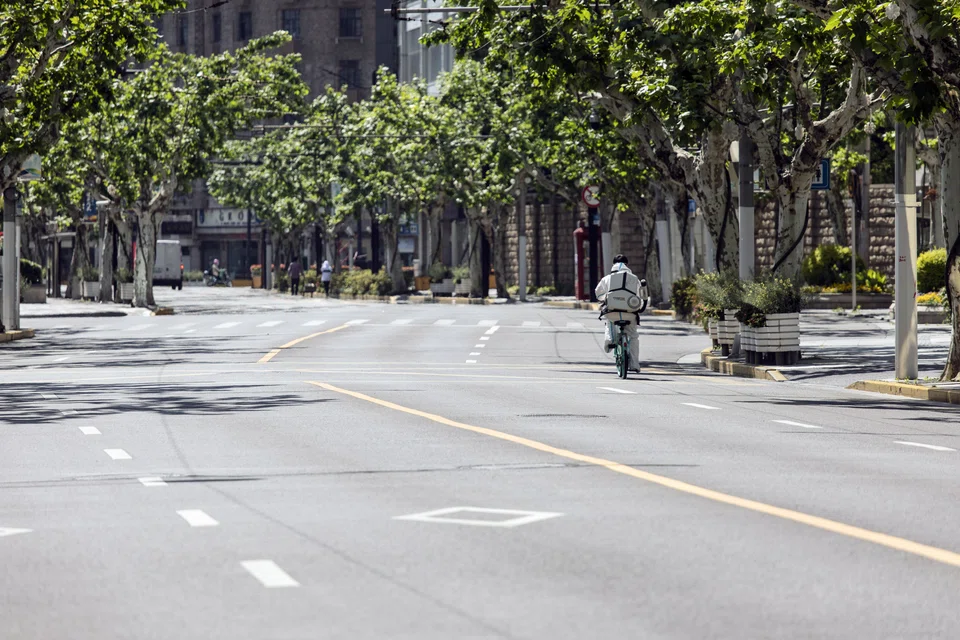
CHINA is headed for a “perfect storm”, and its zero-Covid tolerance is inflicting a greater economic cost than in 2020, when Covid-19 first reared its ugly head.
With China facing multiple headwinds from Covid-19 lockdowns, property sector woes to geopolitical tensions and severe logistic disruptions, economists have lowered their growth forecast to below Beijing’s target of about 5.5 per cent, and investors are re-evaluating their exposures to the country.
Kinger Lau, Goldman Sach's chief China equity strategist, said: “We are in a perfect storm situation where we have a number of economic and regulatory headwinds all going against the market at the same time.”
Besides the Covid outbreak and the property market downturn weighing on the market, there are also the delisting risks of Chinese American depositary receipts from the US stock exchanges, and the spillover of geopolitical risks from Russia to China.
The CSI 300 - which replicates the performance of the top 300 stocks traded on the Shanghai Stock Exchange and the Shenzhen Stock Exchange - is down 20 per cent year-to-date.
Lau believes the strategic investment case for Chinese equities remains intact, with China trading below Goldman’s expected fair value, and that “a good portion” of the concerns and risks are already well discounted in the current stock prices. While China’s growth momentum may have slowed, “4 to 5 percent is still not a bad number in a global context”, he said.

Nomura’s economists, led by Ting Lu, its chief China economist, estimate that the lockdown measures affect some 44 cities that account for 25.3 per cent of China’s population and 38.4 per cent of the country’s gross domestic product (GDP). Yet, these figures may underestimate the full impact of China’s zero-Covid strategy, as many other cities have mobility restricted while mass testing is conducted.
Lu cut his second quarter gross domestic product (GDP) growth forecast for China to 1.8 per cent on year, and the 2022 projection to 3.9 per cent last month.
China’s zero-Covid stance is seen inflicting higher economic costs than in 2020, he said. The Omicron is much more infectious, making zero Covid more costly and difficult. Also, as the rest of the world shifts to living with Covid, it will be increasingly challenging for China to eliminate Covid unless it closes all cross-border travel.


Time-wise, the current wave broke out in March, when factories and construction sites started running at full capacity. Location-wise, the epicentre is in the Yangtze River Delta which is the economic, financial and logistics centre of China. As a result of the latest restrictions, the suppliers’ delivery time sub-index (SDTS) - a sub-index for the official manufacturing Purchasing Managers Index (PMI) - slumped to 46.5 in March, its lowest print since February 2020. The situation has worsened in April as many cities have been put under partial or full lockdown since late March. Tesla reopened its factory in Shanghai on April 19 after a 22-day stoppage, which caused an output loss of more than 50,000 vehicles.
Lu said: “Unlike in spring 2020, when there was a general belief that Covid-19 would end in the summer, Chinese people are now unclear when the zero-Covid strategy will end. Without the ending in sight, Chinese households and private sector corporates will very likely cut their investment in homes and capital goods.
“With other countries shifting to full reopening, China’s export growth is set to slow even without lockdowns. Foreign direct investment may drop due to escalated restrictions on cross-border travel, disruptions to production and logistics.”
Nomura expects China to adhere to the restrictive zero-Covid strategy until the summer, with some adjustments after that due to mounting economic pains. Then after the ruling Chinese Communist Party’s 20th Party Congress conference, which may be held in October, further moderation of the dynamic stance is expected, but not a full shift to living with Covid yet.
“In March 2023’s National People’s Congress (NPC), the leadership change will be fully completed with the next president, premier and ministers determined. We expect an almost full shift to living with Covid after that, even though Beijing may still retain the name of zero-Covid strategy,” Nomura’s economists said.
But even if China manages to rein in the current outbreak, a smooth exit from its zero-Covid strategy will be difficult, given that below 60 percent of its elderly population aged 80 and above have been vaccinated.
Hui Shan, chief China economist at Goldman Sachs Research, said: “So, if the Hong Kong experience is of any guidance, that scares the policymakers and, frankly, a lot of citizens in China about opening up. So, we're stuck in this situation where the Omicron is very contagious, but we still have the zero Covid policy which, in turn, means a lot of restrictions and a lot of pressure on the economy.”
Hong Kong, which was almost virus free the past two years, was caught off-guard when the more transmissible Omicron killed thousands of unvaccinated seniors early this year, forcing the city into a lockdown. It reported an economic contraction of 4 per cent in the first quarter, far worse than the 1.3 per cent drop in GDP predicted by economists.
Decoding Asia newsletter: your guide to navigating Asia in a new global order. Sign up here to get Decoding Asia newsletter. Delivered to your inbox. Free.
Copyright SPH Media. All rights reserved.