



Chinese firms struggle to catch up with South Korea, Taiwan leaders in AI chips, say analysts
Less-robust internal supply chains and US restrictions on China seen as holding down progress

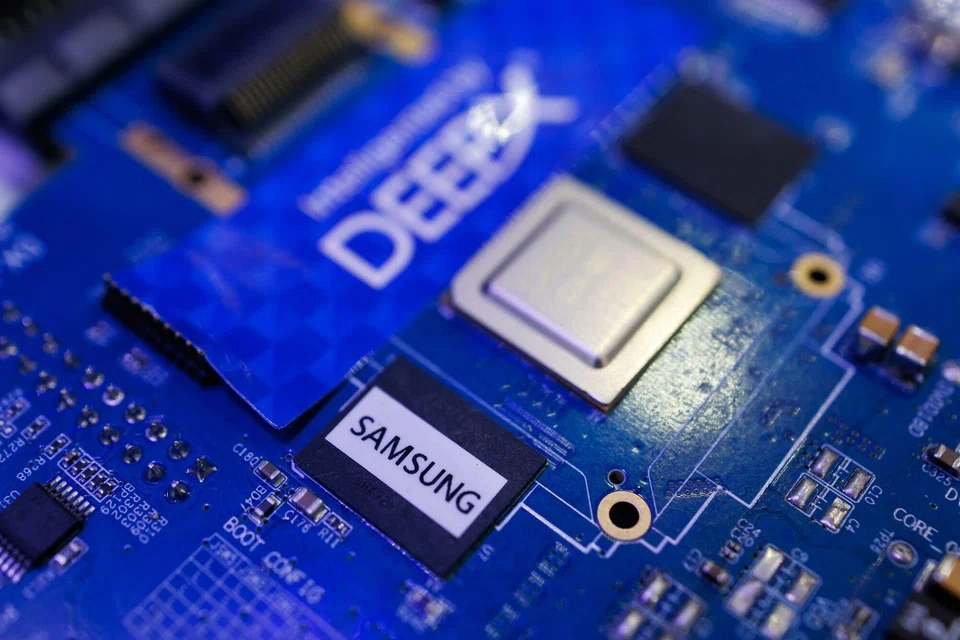
[SINGAPORE] Chip players from South Korea and Taiwan continue to be vital components in the artificial intelligence supply chain in Asia, said analysts, which mainland Chinese names may still struggle to beat.
This is particularly so in the market of memory chip production – with SK Hynix and Taiwan Semiconductor Manufacturing Company (TSMC) known as the leaders in the field.
“(As of) right now, I do not think there are any players from China which are as strong as them (in this area),” said Liu Ninghui, head of investment strategy and research for Asia-Pacific at State Street Investment Management, in an interview with The Business Times in Hong Kong.
Other analysts have noted that the internal supply cushion for Chinese firms to produce memory chips is not as robust as that of its South Korean competitors. This, along with continued US technology restrictions on China, is exacerbating progress in this area.
ChangXin Memory Technologies, for example, is expected to double its memory chip production by this year, but its offerings still underperform those from Samsung and SK Hynix “in power consumption and form factor”, said a Reuters report in late-2025.
Memory chips are essential components in storing data in electronic devices, particularly in systems such as dynamic random-access memory used in laptops and smartphones.
A significant rise in memory prices in recent times has been noted by Morningstar analysts, due to rising AI demand and global supply-chain disruptions from the Iran war.
Major chip manufacturers such as Samsung and SK Hynix, in particular, have shifted more towards high-bandwidth memory chip production, used most in data centres and AI accelerators.
Supply shortages and a sharp up cycle in memory prices are therefore signalling a “significantly stronger demand runway than anticipated” for chip leaders such as SK Hynix, said Jing Jie Yu, equity analyst at Morningstar. This comes as the market has been pricing in higher memory prices recently.

Lorraine Tan, Morningstar’s director of equity research for Asia, noted that this also means that the overall performance of South Korea’s Kospi could potentially peak in the first half of 2027.
“Broad-based improvement in capital allocation and shareholder returns… (could also support further) escalation in the (South) Korean market,” she said.
SK Hynix shares were at about 1.3 million won at Wednesday’s (Apr 29) close – they have nearly doubled in value in the year to date (YTD). They exceeded Morningstar’s fair value estimate of around one million won on Apr 24, which was raised from 623,000 won.
Samsung shares were at 220,000 won, up 88.5 per cent YTD, while shares of Hanmi Semiconductor had increased 180.6 per cent YTD to 357,500 won.
TSMC has also stayed in positive terrain, with the company’s chip and performance upgrades likely to keep competition at bay, according to Phelix Lee, senior equity analyst from Morningstar. He has a target price of NT$2,700 on the stock.
This positivity on the Taiwanese player is shared by John Lin, chief investment officer of emerging-markets value equities and China equities at AllianceBernstein. “Companies like Nvidia may be selling the ‘sexy’ chips in the US – but TSMC is the one who makes them,” he said.
Tan noted that the prices of memory chips are expected to “remain strong through the next 18 months”, though increased production capacity in 2028 could soften them.
China AI plays
With regard to share-price performance, certain Chinese names in this space are holding their own, however.
State Street’s Liu said that this comes as certain midstream, industrial sectors – such as robotics, advanced manufacturing, semiconductor equipment, on top of power generation – are where “things are starting to take off” now in the country.
“(Such aspects) are the backbone behind the current economic development (in China), and forms the majority of its exports,” he said.
Morgan Stanley analysts said that the strength of certain Chinese AI plays can also boost Hong Kong equity markets, as AI and large language model names become a much bigger driver for it – to the extent of “reshaping index composition, performance, liquidity, and fund flows”.
They noted how Knowledge Atlas – a Beijing-based AI company formerly known as Zhipu AI, and Shanghai-based MiniMax – are likely to enter the Hang Seng Tech Index on Jun 8 with a combined 5 to 7 per cent weight.
“It would have lifted the index’s year-to-date performance by around five percentage points, if included at listing,” the analysts wrote in a Monday report.
But challenges such as trade difficulties between the US and China could slow down the latter’s AI chip production.
A report from Reuters said that China’s No 2 chipmaker Hua Hong Semiconductor is facing certain blocks from the US Department of Commerce, which ordered various chip-equipment companies to stop tool shipments to them. Sources familiar with the matter stated this is a bid to slow down the development of chips by China.
DeepSeek also has seen mixed reviews from analysts.
Ellie Jiang, head of Asia Internet and software research from Macquarie Capital, said its latest V4 model has “superior ability” to deliver performance at the same level as that of leading industry competitors. This would raise the “efficiency floor” of the sector, she added.

But Ivan Su, Morningstar senior equity analyst, pointed out that value in AI is created when capability is embedded into revenue engines – something DeepSeek lacks, but which several other firms have.
He did note that DeepSeek V4’s use of Huawei Ascend chips is consistent with his view that Chinese AI firms are gradually shifting to home-grown silicon.
“This should benefit China-listed GPU (graphics processing unit) names and foundries like SMIC and Hua Hong over the long run,” he added.
Outlook on broader Chinese equities
Recent earnings from various Chinese companies have been strong – and “growing” – with AllianceBernstein’s Lin taking a bullish stance on the market, saying that “cheap valuations” of the market should encourage investor buy-in.
However, noted Liu, valuations are not the only metric which determines success – particularly when it comes to China equities.
A market rally in China in the coming year is not guaranteed, he said, adding that he avoids simply recommending broad indices to clients, as the country does not have “homogenous” development.
“China’s market development is highly fragmented, which means that its growth can vary in different sectors,” the State Street analyst noted.
He said that from the bottom-up, some companies deliver very strong results, with the country’s export boom a “bright spot” in recent years. Innovative medical drugs are China’s forte, alongside its strong standing in robotics and AI development.
Both Liu and Morningstar’s Tan said that investors still have to be more “selective”, regarding China market investments.
“The Hong Kong and mainland Chinese companies in our coverage universe are, on average, only slightly undervalued,” Tan told BT. “But the gap in share-price performance has widened, so sectors are either overvalued or undervalued (now).”
Decoding Asia newsletter: your guide to navigating Asia in a new global order. Sign up here to get Decoding Asia newsletter. Delivered to your inbox. Free.
Copyright SPH Media. All rights reserved.
TRENDING NOW

LTA proposes combining car COE categories, adding rebate-surcharge system
StarHub to acquire MyRepublic’s mobile business amid ongoing telco consolidation

DBS, OCBC, UOB rout lops billions off STI as inflation, rate concerns spook investors

Grab CEO’s wife Chloe Tong on life with Anthony Tan and finding her purpose

