Chinese tourist arrivals to Japan slow as tensions simmer
Beijing’s advisory discouraging travel to Japan, and its directive for airlines to cut flights until March 2026, raise the risk of a prolonged downturn
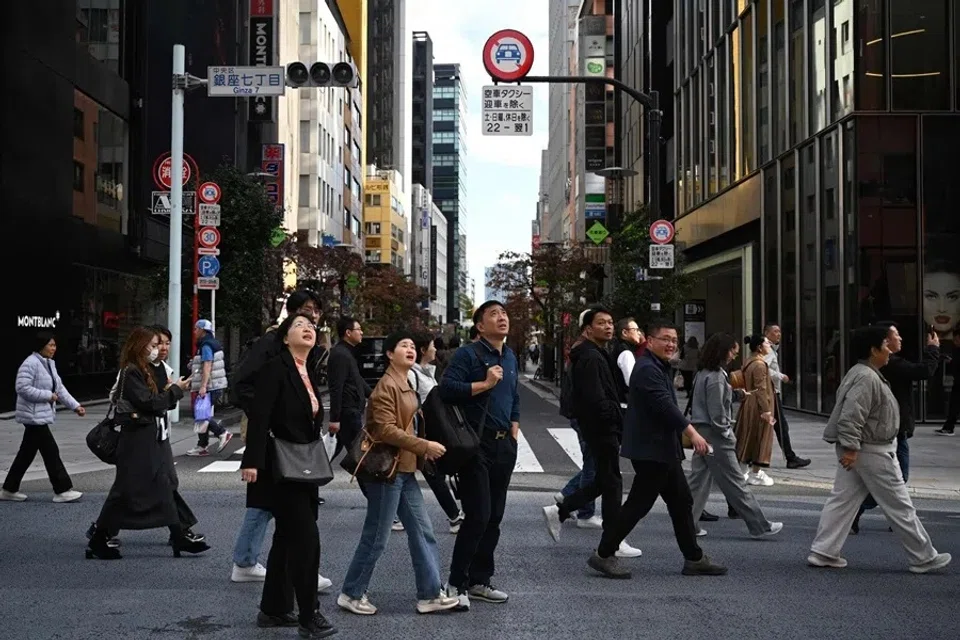
[TOKYO] Growth in Chinese visitors to Japan slowed in November to its weakest pace in nearly four years, as Beijing curbed travel amid rising tensions over Prime Minister Sanae Takaichi’s remarks on Taiwan.
Arrivals from China rose by just 3 per cent from a year earlier to 562,600 – the slowest increase since January 2022, the Japan National Tourism Organization (JNTO) said.
The number of visitors from China was growing at a pace of 40.7 per cent in the first 10 months of the year, an earlier JNTO statement showed.
The slowdown offers the clearest sign yet that geopolitical tensions are beginning to reshape Japan’s tourism outlook.
Beijing’s advisory discouraging travel to Japan, and its directive for airlines to cut flights until March 2026, raise the risk of a prolonged downturn.
Compared against projected outlays if the growth trend had stayed intact, the total amount lost in tourism spending comes up to around 57 billion yen (S$474 million), a Bloomberg calculation revealed.
The cumulative number of Chinese people entering Japan from January to November this year was over 8.7 million, the data showed. The figure includes people who enter Japan as tourists, immigrants and students.
JNTO noted that the demand from China typically eases in December, but the latest slowdown was compounded by the Chinese government’s warning against travel.
Japan had otherwise been enjoying the strong growth in Chinese tourism, with arrivals more than doubling in November from the same month in 2024.
SEE ALSO




Overall, inbound traffic climbed 10 per cent year on year in November, the report showed. The increase in arrivals was also driven by visitors from South Korea, Taiwan and the US.
South Korea remains Japan’s largest source of tourists, followed by China, Taiwan and the US, respectively.
Still, China’s pullback carries outsized weight. Chinese travellers are Japan’s biggest spenders, accounting for a fifth of the nation’s 8.1 trillion yen in tourism revenue. Their retreat hits an economy in which population decline leaves tourism as one of the few reliable growth engines.
Japan could lose 1.2 trillion yen in tourism revenue in 2026 if travel freezes persist, said Hiromu Komiya, an economist at the Japan Research Institute.
Corporate sentiment
China’s travel curbs are splitting corporate sentiment.
About 40 per cent of firms – mainly in retail, food services, lodging and tourism – report negative effects, while another 40 per cent report little to none of them, a December survey of over 1,000 companies by Tokyo-based research firm Teikoku Databank found.
Osaka, Japan’s second-largest economic hub and a key tourism gateway for Chinese tourists, is suffering the sharpest fallout. Kansai International Airport has logged the steepest flight cuts nationwide.
Bookings for Osaka-bound trips from China for winter and early spring departures are down 55 to 65 per cent, a deeper drop than the national average, marketing researcher China Trading Desk said.
Luxury spending by Chinese visitors in Osaka is projected to fall roughly by half to US$40 million from US$60 million a month.
Retailers are feeling the shift immediately.
Isetan Mitsukoshi Holdings said duty-free sales fell around 20 per cent in the first two weeks of December from a year earlier, while overall sales slipped around 2 per cent.
Matsuya’s Ginza flagship store’s duty-free sales fell about 15 per cent in November from a year earlier, in addition to a 1.2 per cent dip in overall sales.
Some companies expect conditions to stabilise as Japan gradually reduces its reliance on China and overtourism concerns ease, the Teikoku Databank survey found.
Japan has also been pressing regional destinations to diversify their visitor mix since post-pandemic reopening.
Progress is uneven but evident. In Gifu, Chinese guests now make up 10 per cent of stays, down from 41 per cent in 2019, government data revealed. In Shizuoka, that number has fallen to 45 per cent from 71 per cent. BLOOMBERG
Decoding Asia newsletter: your guide to navigating Asia in a new global order. Sign up here to get Decoding Asia newsletter. Delivered to your inbox. Free.
Share with us your feedback on BT's products and services