


Dearth of China tourists hindering Asia’s economic recovery

THE global pandemic and ensuing slump in global tourism didn’t hurt only Asia, but the region certainly has its share of top global travel destinations and the Covid-fuelled collapse in tourism was an unwelcome additional cost to bear.
According to United Nations research, travel restrictions caused a cumulative 95.3 per cent plunge in international arrivals to Asia and the Pacific between January and July 2021 – the biggest decline in international arrivals globally – compared to the same period in 2019. Prior to this, international tourist arrivals to Asia Pacific had risen from 208 million in 2010 to 360 million by 2019, and the sector was poised to deliver further growth before the world went into collective quarantine.
Across the region, including China, the World Travel and Tourism Council estimates that the tourism sector directly accounted for around 185 million jobs pre-pandemic, with more than 30 million of these jobs disappearing during the pandemic. The pain has been felt disproportionately by the region’s less developed economies, where alternative sources of foreign currency income are less available.
As a percentage of total exports, Asia’s most tourism-dependent economies in 2019 included Cambodia, Laos, and Sri Lanka. Not surprisingly, middle-income Thailand also made it into the top end of the range, with nearly 20 per cent of 2019 exports accounted for by international tourism receipts. High-income Australia isn’t too far behind.
Tourism revenues haven’t bounced back much
Tourism revenues plunged in 2020 (along with total exports), and though we are still waiting for World Bank data for 2021, the situation probably didn’t improve much until this year. The improvement in tourism revenue would have been very welcome in Asia, as the Russian invasion of Ukraine and subsequent spikes in energy prices have left their mark on current accounts around the region.
For a region that has generally run large and steady current account surpluses and amassed large stocks of foreign exchange reserves, the surge in energy prices for all but a few net energy exporters (Indonesia, Malaysia, Australia) has eaten away at the external balances, leaving some economies looking at their first deficits since before the 1997 Asian financial crisis.
On top of this, central bank intervention to temper currency depreciation has taken a toll on FX reserves.
So, while it may not totally eradicate the damage caused by this big terms-of-trade shift and the current strength of the US dollar, some additional tourism revenues would at least help to ease the pain.
But for all that we read about “revenge travel” and spending, the tourism statistics are quite disappointing. In terms of the region’s foreign tourist arrivals, nowhere do the latest figures come even close to pre-Covid levels.


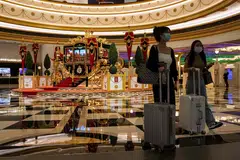
Singapore, which has had the biggest recovery in tourism across the region, is still seeing only about 40 per cent of the pre-Covid levels of inward tourism. And for tourism stalwarts like Thailand, the figure is 30 per cent or less.
Hotel room rates and foreign occupancy figures add to the story. Using Thai data as a proxy for much of the rest of the region, the numbers show that hotel room rates have recovered to about half of their pre Covid levels.
There is still very low foreign occupancy, which suggests that local tourism is still filling most of the gaps.
The reasons for the foreign tourist shortfall may be explained by some of the passenger-seat-kilometre data. Both Singapore and India data on airline capacity remain at levels less than 80 per cent of pre-Covid capacity, as (possibly) shortages in maintenance crews to re-commission mothballed aircraft, as well as shortages in cabin staff and flight crew, have curbed availability. Anecdotally, this shows up in some steep increases in airline prices, over and above any reflection of higher aviation fuel costs. Why fly to a low-cost tourism destination when the cost of getting there has soared?
The elephant not in the room
In the end, though, more than expensive plane tickets or seat availability, Thai visitor arrivals data by nationality show that there is one single factor behind the dismal tourism numbers and revenues: the absence of China. And even though we are beginning to see Asean visitor numbers pick up some of the slack, it is extremely unlikely that Asia-Pacific tourism can manage a full recovery without the return of Chinese tourism.
On this point, recent weeks have delivered both disappointment and hope. Dismay came from China’s re-commitment to its zero-Covid strategy at the 20th national congress of the Chinese Communist Party in October, though the authorities now look poised to ease some Covid curbs soon, following widespread protests across the country in November.
Markets had earlier collectively registered their disappointment at what they surmised could mean another year of dismal Chinese demand, which would have been especially bad news for Asia’s tourism sector.
Action on the ground has seemed somewhat more hopeful. International travel restrictions for foreign business executives had been eased, with certain events trialled with fewer Covid curbs (for example, the Beijing Marathon on Nov 6, and upcoming Shanghai trade expos in December). These would potentially be a precursor to some slow rewind on other travel restrictions.
Tourism across Asia is still a long way off from being able to declare recovery, and especially without China’s tourists, that prospect still seems distant. But we may at least be seeing the first stages of a slow re-opening in China.
The writer is head of research and chief economist, Asia Pacific, at ING
Decoding Asia newsletter: your guide to navigating Asia in a new global order. Sign up here to get Decoding Asia newsletter. Delivered to your inbox. Free.
Share with us your feedback on BT's products and services
TRENDING NOW

Gas Supply may pursue remedies if contract breached following Indonesia’s export cuts: Tan See Leng

Why the biggest business decision about AI isn’t which model to choose

If Europe goes to war, the fallout will be felt in East Asia

Singapore expects all parties to honour commitments, says PM Wong after Indonesia cuts gas exports

