


Global Enterprise logo
BROUGHT TO YOU BYsc logo

Fed’s quarter-point rate cut does not signal a sustained easing cycle: analysts

Market watchers believe the US dollar could see near-term resilience while the recent gold rally could slow down

Summarise
Deon Loke
Published Thu, Sep 18, 2025 · 01:44 PM
    • Fed chairman Jerome Powell was careful to frame the decision to cut rates as a “risk management” adjustment, pushing back against market hopes that this was the start of a sustained and aggressive easing cycle.
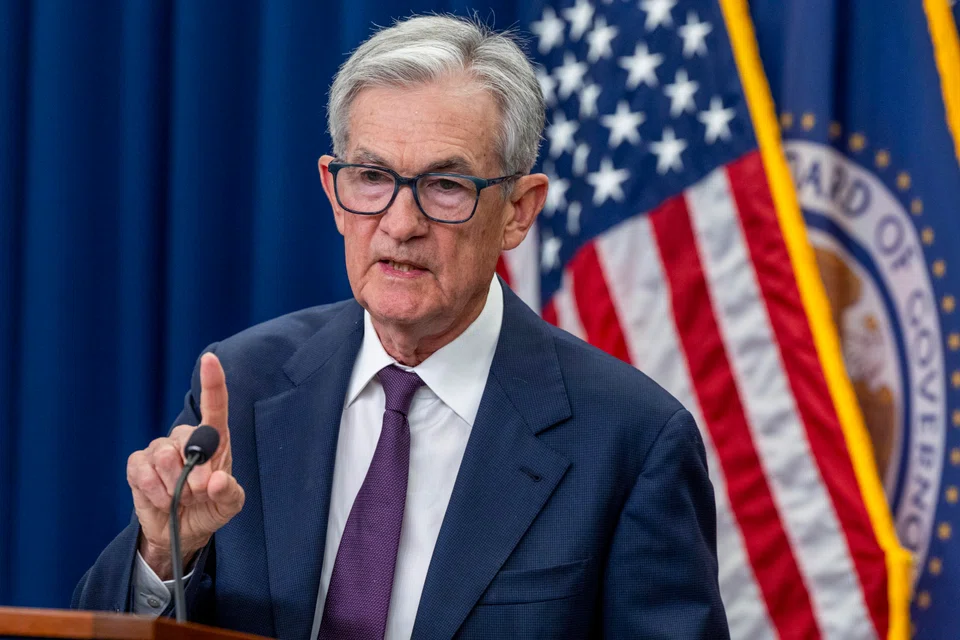
    • Fed chairman Jerome Powell was careful to frame the decision to cut rates as a “risk management” adjustment, pushing back against market hopes that this was the start of a sustained and aggressive easing cycle. PHOTO: EPA

    [SINGAPORE] Asia’s equities markets fluctuated on Thursday (Sep 18) amid mixed reactions over a much-anticipated US Federal Reserve interest rate cut that was paired with a deeply cautious outlook on future policy.

    The Federal Open Market Committee (FOMC) lowered its benchmark rate by 25 basis points (bps) to a target range of 4 to 4.25 per cent – a move that officials said was prompted by a shift in focus towards emerging risks in the US labour market.

    However, Fed chairman Jerome Powell was careful to frame the decision as a “risk management” adjustment, pushing back against market hopes that this was the start of a sustained and aggressive easing cycle.


    The result was a “hawkish cut” scenario that has left global markets in a state of uncertainty.

    The ambiguity was evident on trading floors across the region on Thursday.

    Gains were led by Japan’s Nikkei 225 index, which climbed to a record intra-day high, and South Korea’s Kospi.

    Asean Intelligence

    Get insights into businesses across South-east Asia

    Get the free report

    But the optimism failed to spill over into other major markets – Hong Kong’s Hang Seng Index and Malaysia’s KLCI were in negative territory, and Singapore’s benchmark Straits Times Index was nursing a marginal loss.

    “Wall Street did not react with exuberance despite the rate cut and indications of more to come this year. This is because the FOMC’s moves were in line with market expectations and have been well-telegraphed in recent weeks,” said Vasu Menon, managing director for investment strategy at OCBC.

    However, Menon highlighted that details of the Fed communique “shows a mixed picture that points to uncertainty about the Fed’s rate trajectory for 2026”.

    “There is also uncertainty at the Fed going into 2026 regarding the replacement of its chairman Jerome Powell, whose term expires in May 2026,” he added.

    Divergence seen

    At the heart of the market’s indecision is also a growing divergence between the central bank’s own forecasts and the market’s pricing of future cuts.

    Based on the dot plot released on Wednesday, the median FOMC member projection is two more cuts in 2025 and then only one more reduction in all of 2026.

    But in the run-up to the meeting and now, the market has been siding with the minority view that another three cuts are on the cards for next year, pricing in a more aggressive path of continued easing.

    Despite the growing divergence between the central bank and market expectations, DBS chief economist Taimur Baig said: “We think the majority view of a terminal rate of 3.5 per cent will not be easy to sway, especially if inflation begins to surprise on the upside.”

    “Tariff pass-through, labour-market tightness owing to the immigration crackdown, stimulatory impact of tax cuts, massive energy demand around AI (artificial intelligence)-spending, strong household and corporate balance sheets, and a booming equity market, all point towards upside risk to inflation, in our view,” he said, citing reasons for the opinion that the rate-cut cycle will stall after 100 bps of easing.

    Effect on asset prices

    This tug of war is already having a direct impact on asset prices. Some analysts now expect the US Treasury curve to steepen, with long-term yields remaining elevated as the “risk management” nature of the cut is seen as supporting growth and inflation, rather than fighting a severe downturn.

    Other market watchers see a clear opportunity in fixed income, arguing that the Fed’s new focus provides a supportive backdrop for bonds.

    “In particular, high-quality credit, such as global investment-grade corporate bonds, stand out as a compelling way to build a defensive ballast in portfolios. Yields remain attractive – around 5 per cent – offering meaningful income potential and a cushion against volatility,” noted Manusha Samaraweera, investment director at Capital Group.

    Glenn Thum, research manager at Phillip Securities Research, said: “Asean currencies may soften against the US dollar, but local bond markets should rally.”

    For currencies and commodities, the outlook has also shifted, with many expecting near-term resilience in the US dollar and a slowing of the recent rally in gold.

    Deputy global head of multi-asset bespoke solutions at Aberdeen Investments, Ray Sharma-Ong, cited the rationale for the expectation: “Positioning was oversold going into today’s FOMC, and Powell’s emphasis that there are ‘no risk-free paths’ alongside the Fed’s function (of) focusing on ensuring stability in the labour market reduces the likelihood of aggressive front-loaded cuts in 2026.”

    Continued equity strength may hinge on the Fed’s ability to strike a balance between easing enough and managing inflation, analysts suggest.

    “For investors who are prepared to take a medium-term view, there is still a case to stay invested given that Fed rate cuts, in the absence of a recession and an abundance of liquidity, have proven to be positive for equity markets,” said OCBC’s Menon.

    He added: “The current bull market began at the start of 2023, and it has gone on for just over two years. History shows that barring unforeseen circumstances and based on averages, the bull (market) can continue for a few more years.”

    Decoding Asia newsletter: your guide to navigating Asia in a new global order. Sign up here to get Decoding Asia newsletter. Delivered to your inbox. Free.

    Copyright SPH Media. All rights reserved.


