G7 vows action against ‘unfair’ China business practices
 Add BT as a preferred source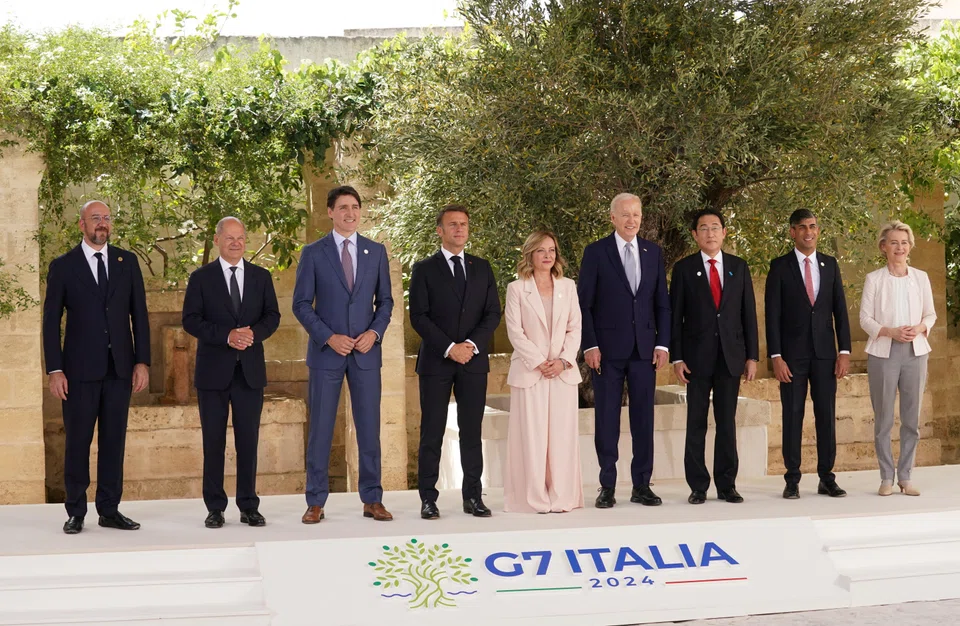
LEADERS of the Group of Seven vowed on Friday (Jun 14) to tackle what they called unfair business practices by China that were undermining their workers and industries, according to a draft statement on the final day of their annual summit.
The G7 also warned of action against Chinese financial institutions that helped Russia obtain weaponry for its war against Ukraine.
The leaders of Italy, the United States, Britain, Canada, France, Germany and Japan were on Friday discussing concerns surrounding China’s excess industrial capacity, that Western governments say is distorting local markets.
Pope Francis was then due to make an historic appearance at the summit in southern Italy to discuss artificial intelligence.
The draft statement, seen by Reuters, stressed the G7 was not trying to harm China or thwart its economic development but would “continue to take actions to protect our businesses from unfair practices, to level the playing field and remedy ongoing harm.”
The US this week imposed fresh sanctions on China-based firms supplying semiconductors to Russia amid worries over Beijing’s increasingly aggressive stance against Taiwan and run-ins with the Philippines over rival maritime claims.
“China is not supplying weapons (to Russia) but the ability to produce those weapons and the technology available to do it, so it is in fact helping Russia,” US President Joe Biden told reporters at the summit on Thursday after signing a bilateral security pact with Ukrainian President Volodymyr Zelenskiy.
During the first day of their meeting in southern Italy, the G7 nations agreed on a deal to provide US$50 billion of loans for Ukraine backed by interest from frozen Russian assets – hailing the accord as a powerful signal of Western resolve.
G7 leaders also promised sanctions against entities that helped Russia circumvent sanctions on its oil by transporting it fraudulently.

In the draft, the leaders will commit to accelerating their transition away from fossil fuels during this decade.
“We will transition away from fossil fuels in energy systems in a just, orderly, and equitable manner, accelerating actions in this critical decade, to achieve net-zero by 2050 in keeping with the best available science,” the draft said.
Other commitments on climate policy in the draft include a pledge “to phase out existing unabated coal power generation in our energy systems during the first half of 2030s.”
With the COP29 United Nations climate conference due to start in November, the leaders of G7 said they would submit “more ambitious” national climate plans, according to the draft.
The document commits to a collective effort to reduce methane emissions by 75 per cent by 2030 but, in a section likely to upset environment activists, the leaders give a green light to public investments in natural gas, a polluting fossil fuel.
“In the exceptional circumstance of accelerating the phase-out of our dependency on Russian energy, publicly supported investments in the gas sector can be appropriate as a temporary response, subject to clearly defined national circumstances,” the draft said.
Abortion wording row
The draft reiterated commitments made at the G7 meeting in Japan last year on sexual and reproductive rights but did not directly mention the word abortion.
The issue has caused a dispute between France and Italy after Rome – which holds the G7 rotating presidency – demanded the removal of a reference to “safe and legal abortion” from the final statement.
The pope will be joined by 10 other heads of state and government, including the prime minister of India and the king of Jordan, as the G7 throws open its doors to outsiders to show it is not an aloof, exclusive club.
Besides his speech on AI, the Pope will hold multiple bilateral meetings, including with Biden, Zelenskiy and Turkish President Tayyip Erdogan.
“It is a historic day. We will welcome the Holy Father. It is the first time for a pontiff at a G7. I am proud it will happen under the Italian presidency,” Italian Prime Minister Giorgia Meloni told reporters on Thursday.
Leaders will also discuss immigration, a crucial issue for Meloni who is pushing Europe to help her curb illegal flows from Africa and who has launched a flagship plan to boost development in the continent to tackle the root cause of the departures.
Many of the leaders will leave Italy late on Friday, including Biden, and Meloni said they had already agreed on the summit’s conclusions, to be approved at the end of the day.
On Saturday, there will be room for bilateral meetings for those staying on, ahead of a final news conference from Meloni. REUTERS
Decoding Asia newsletter: your guide to navigating Asia in a new global order. Sign up here to get Decoding Asia newsletter. Delivered to your inbox. Free.
Share with us your feedback on BT's products and services