Global businesses ‘overly optimistic’ of a sharp rebound in exports: Allianz Trade
The confidence could partly reflect how businesses have grown accustomed to protracted risks such as supply chain disruptions and geopolitical challenges


AMID a rebound in global trade, more than eight in 10 companies (82 per cent) in China, Europe, and the US expect export-driven turnover to improve in 2024, particularly in consumer-related sectors such as retail, household equipment, and computers and telecommunications, according to a recent survey.
Nearly 40 per cent of respondents anticipate a significant increase of more than 5 per cent in business turnover this year, almost double the 22 per cent who expected the same in 2023, according to the latest Allianz Global Trade Survey, which polled over 3,000 companies for its third annual edition.
However, Allianz Trade’s senior economist for Asia-Pacific, Francoise Huang, reckoned these businesses may be overly optimistic as they grow accustomed to protracted risks such as supply chain disruptions and geopolitical challenges.
“After more than a year of recession, exporters are now looking forward to a rebound in the second half of 2024 as the restocking of manufactured goods is gaining traction, along with global demand,” she said.
Allianz Trade, the trade-related insurance arm of the Allianz Group, conservatively estimates global trade value will grow by 2.8 per cent in 2024, following a 2.9 per cent contraction in 2023.
“This is significantly below the long-term average of 5 per cent expansion, reflecting the risk of disruptions in global shipping like the Red Sea crisis, as well as rising protectionism,” said Huang.

China exports rising
Despite the ongoing US-China trade tensions, 45 per cent of Chinese exporters surveyed expect turnover to grow beyond 5 per cent. Of this group, 11 per cent expect a double-digit growth (more than 10 per cent).
Both volumes and prices could drive this rebound. Huang pointed out that Chinese exporters had slashed prices to maintain client base and meet shipment volumes amid declining exports last year.
However, following a recovery in export volumes this year – and as widely anticipated by the survey’s respondents – exporters may raise prices, driving export turnover higher.
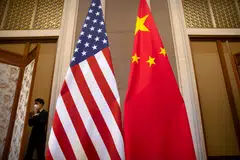


“China’s biggest export destinations remain the rest of Asia-Pacific and Europe, driven by either real demands that are directly consumer-facing or demands embedded in supply chains,” she said.
European companies seem less concerned about trading with China than their US counterparts: 39 per cent in Germany and Spain and 33 per cent in France expect to expand their footprint in China, compared with 27 per cent in the US.
EV under the spotlight
While acknowledging that Europe is a less attractive market for Chinese exports compared with the US due to stagnant economic growth, Huang noted that China is countering weak demand by capturing market share in Europe, particularly in sectors such as electric vehicles (EVs).
The European Union (EU) is planning to impose import duties on Chinese EVs. Huang expects the restrictions to be less harsh relative to the US, more so given China’s ability to retaliate.
“Bilateral trade, especially in the automotive and the EV sector, is on a much larger scale between China and the EU as compared to between China and the US,” she elaborated.
For example, China is the biggest source of EV imports in Germany. Reciprocally, it is also the most important foreign market for automotive products from Germany, Europe’s largest automobile manufacturing country.
Huang added that the EU is committed to green transition targets, and the reality is that Chinese EVs are more popular and cheaper than other brands with consumers. She explained: “It may be a bit difficult for the EU to push consumers to become greener without allowing them access to the best cost value products available on the market.”
Not walking the relocating talk
More than half (53 per cent) of the respondents say they are considering relocating parts of their supply chain due to increasing geopolitical risks.
Yet, Huang said that few are taking concrete steps in this direction. Relocating production sites does not rank among the top three out of 10 proposed actions to mitigate supply chain disruption.
Huang attributed the companies’ “not walking the talk” partially to the global critical dependency on China for various products, with the county accounting for over 50 per cent of imports and holding a global market share exceeding 50 per cent for specific items.
The intensity of importers’ dependency on China varies, with the US being among the most exposed: China is a critical supplier for around 45 per cent of total US imports from China. For the UK, the share is 29 per cent, and it is even lower for other European countries covered in the survey.
Huang noted that critical dependency on China has been rising over the years, including during the pandemic and the Trump administration, with data spanning 2003 to 2022.
Improving supply chain risk management is ranked as the top action to mitigate supply chain disruption while increasing environmental, social, and governance (ESG) due diligence on suppliers is ranked as the second most common.
The survey found a notable overlap between supply chain management and ESG management, with 72 per cent of respondents saying they have decision-making responsibilities in both areas. This suggests that “supply chains are at the heart of corporates’ ESG strategies,” said the report.
Decoding Asia newsletter: your guide to navigating Asia in a new global order. Sign up here to get Decoding Asia newsletter. Delivered to your inbox. Free.
Copyright SPH Media. All rights reserved.