Global Enterprise logo
BROUGHT TO YOU BYsc logo

Gold, silver hit fresh highs as Trump’s Greenland tariffs rattle European markets

In contrast, the US dollar – another traditional safe-haven asset – weakens

Summarise
Renald Yeo
Published Mon, Jan 19, 2026 · 08:33 PM
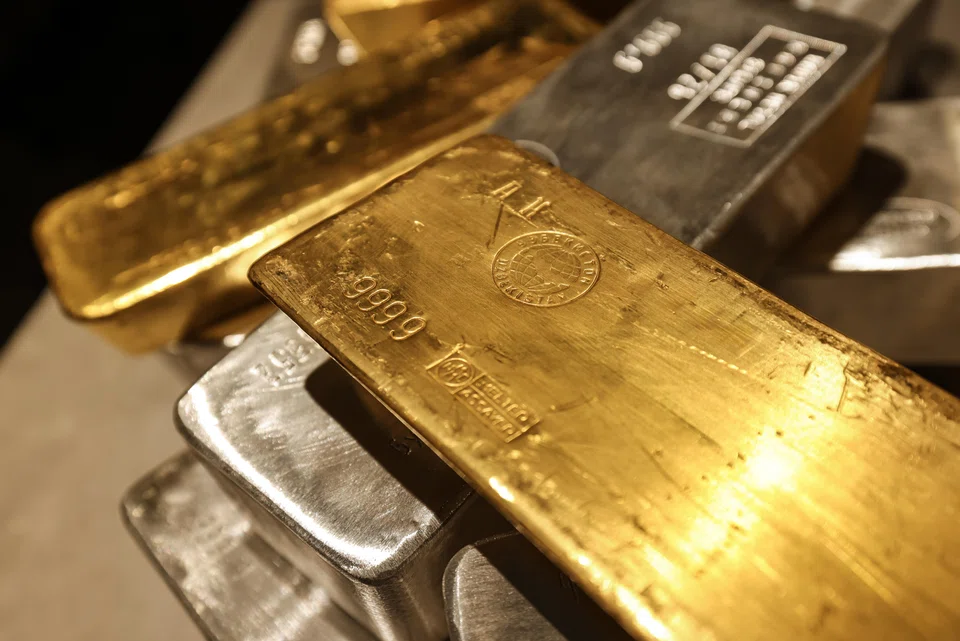
    • Precious metals are traditionally viewed as a safe-haven asset class during periods of geopolitical or market uncertainty.
    • Precious metals are traditionally viewed as a safe-haven asset class during periods of geopolitical or market uncertainty. PHOTO: YEN MENG JIIN, BT

    GOLD and silver scaled new all-time highs on Monday (Jan 19), as investors continued to pour money into safe-haven assets following the Trump administration’s latest tariff salvo – this time linked to Greenland.

    Spot gold prices climbed 1.4 per cent to trade at US$4,662.57 an ounce as at 7.57 pm Singapore time, after reaching a record of US$4,690.59 earlier, Bloomberg data showed. Spot silver prices rose 4.4 per cent to US$94.12 an ounce, also an all-time high.

    The rally in precious metals – traditionally viewed as a safe-haven asset class during periods of geopolitical or market uncertainty – was fuelled by fresh tariff measures announced by US President Donald Trump over the weekend, analysts observed.

    In contrast, the US dollar – another traditional safe-haven asset – weakened. The US dollar index, which tracks the greenback’s strength against a basket of six major currencies, had slipped to 99.19 points as at 7.57 pm. The euro rose 0.3 per cent against the American currency over the same period.

    The divergence between the greenback and precious metals suggests that “investors are treating this as a geopolitical and institutional shock as much as a pure growth shock”, said Charu Chanana, chief investment strategist at Saxo Markets, in a Monday note.

    “Longer term, you (would) think the more this kind of stuff goes on – plus the (US Federal Reserve) independence question – the more negative it is for the US dollar,” added Neil Wilson, UK investment strategist at the same firm.

    Asean Intelligence

    Get insights into businesses across South-east Asia

    Get the free report

    He was referring to the US Supreme Court’s scheduled hearing on Wednesday, which will consider arguments over whether Trump can fire Fed board member Lisa Cook – a case that could have implications for the central bank’s independence from the executive branch.

    “In the current environment, investor positioning ‘often shifts towards real assets and ballast rather than a single-currency safe haven, and investors typically lean into quality defensives and selective defence or security exposure as a hedge against a more fragile global backdrop’.”

    Charu Chanana, chief investment strategist at Saxo Markets

    On Saturday, Trump announced on social media platform Truth Social that the US would impose new tariffs on eight European countries unless an agreement was reached on the “complete and total purchase of Greenland”, a Danish territory.

    Under the measures, a 10 per cent tariff rate is set to take effect on Feb 1, rising to 25 per cent on Jun 1. The eight countries named were Denmark, Finland, France, Germany, the Netherlands, Norway, Sweden and the United Kingdom.

    European markets opened lower on Monday in response to the announcement, paring gains from last week. The benchmark Stoxx 600 was down 1.3 per cent at 606.23 points as at 8.02 pm. The index had closed at a record high of 611.56 points on Wednesday, prior to the tariff news.

    European carmakers led the decline, with BMW (-3.9 per cent), Ferrari (-2.4 per cent), Mercedes-Benz (-3.5 per cent), Porsche (-3.5 per cent) and Volkswagen (-3 per cent) all lower as at 8.02 pm.

    Large luxury groups were also hit, with Dior (-3.5 per cent), Hermes (-3.1 per cent) and LVMH (-3.8 per cent) retreating in the sell-off.

    These losses were partially offset by gains among some European defence contractors, amid the heightened geopolitical tensions. Rheinmetall (2.3 per cent), BAE Systems (1.2 per cent) and Thales (1.5 per cent) all advanced.

    In the current environment, investor positioning “often shifts towards real assets and ballast rather than a single-currency safe haven, and investors typically lean into quality defensives and selective defence or security exposure as a hedge against a more fragile global backdrop”, Chanana said.

    European leaders have criticised Trump’s latest move as “blackmail”. French President Emmanuel Macron, in particular, called for the use of a never-before-invoked “anti-coercion instrument” – a tool that could restrict American companies’ access to the European Union.

    At an emergency meeting on Sunday, European leaders also discussed reviving plans to levy tariffs on 93 billion euros (S$138.9 billion) of US goods. These measures were suspended after a trade deal was reached with the country last August.

    “The potential implications of Greenland will be felt intensely,” said Ipek Ozkardeskaya, senior analyst at Swissquote, in a Monday note. “Europe could manage the tariff crisis with relative calm, but the security dimension may provoke a different reaction.”

    There was no trading in US markets on Monday due to the Martin Luther King Jr Day federal holiday. However, US futures pointed to a broadly lower session on Tuesday, with Dow, S&P 500 and Nasdaq futures down 0.9 per cent, 1.1 per cent and 1.6 per cent, respectively, as at 8.02 pm.

    In Singapore, the benchmark Straits Times Index closed 14.22 points, or 0.3 per cent, lower at 4,834.88 on Monday.

    Decoding Asia newsletter: your guide to navigating Asia in a new global order. Sign up here to get Decoding Asia newsletter. Delivered to your inbox. Free.

    Copyright SPH Media. All rights reserved.