Hong Kong budget plans for real estate and finance sectors disappoint investors
The Hang Seng Index rises 3.3% or 753.91 points to close at 23,787.93.
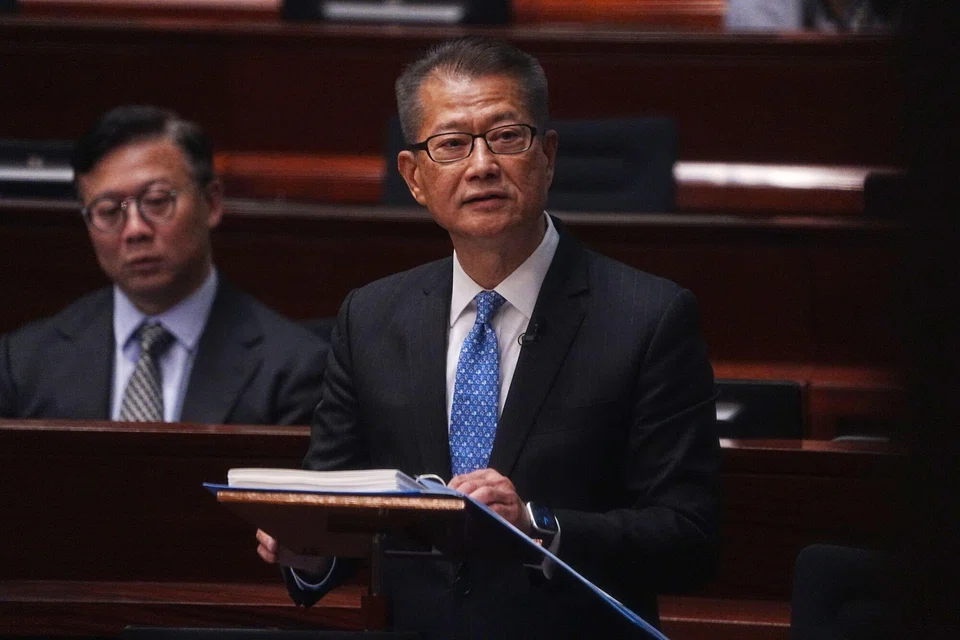
THE Hong Kong Budget announced on Wednesday (Feb 26) by Financial Secretary Paul Chan is unlikely to sustain gains in the markets as investors hoped for more support for the finance and real estate markets, analysts said.
The Hang Seng Index rose 3.3 per cent or 753.91 points to close at 23,787.93.
The surge was led by tech companies as the Hang Seng Tech Index rose 4.5 per cent after Chan emphasised artificial intelligence as a core industry and pledged HK$1 billion (S$172.4 million) to establish an artificial intelligence research and development institute.
Still, investors are likely to remain unmoved by the announcements, analysts said. “I don’t see a lot in the Hong Kong Budget that will excite the market and overall, I would classify this Budget as a ‘non-event’ for the stock market,” said Lorraine Tan, Singapore-based director of equity research for Asia at research provider and ratings company Morningstar.
The gross domestic product growth outlook of 2 to 3 per cent implies a continuation of activity rather than a boost, given that Hong Kong’s 2024 GDP growth was 2.5 per cent, she said.
“Support measures such as the tax relief of up to HK$1,500, while better than no relief particularly for lower income families, is unlikely to help spark a material consumption uptick,” she added.
The Hong Kong government forecasts real growth of 2.9 per cent on average from 2026 to 2029 with an underlying inflation rate forecast of 2.5 per cent a year on average.
The consolidated deficit for the 2024-2025 that ends on Mar 31, 2025, is expected to be HK$87.2 billion, bringing reserves to HK$647.3 billion and marking the third year of declines.
Total government revenue for the 2024-2025 year was revised to an estimate of HK$559.6 billion, down 11.6 per cent from the original estimate.


Chan attributed the revised estimate to a decline in land premium and stamp duties as the real estate market in Hong Kong continued to face downward pressure.
Rental prices for offices fell 8.6 per cent across the board in Hong Kong in 2024, with rents in the central area slumping 12 per cent due to new supply, a December report by real estate and investment management company JLL indicated.
The vacancy rate for Grade A office space rose to 13.1 per cent, a record high in 25 years, the report found.
The Hong Kong Budget included support measures for the real estate sector. This included rate concessions for properties in the first quarter of FY2025 and FY2026 with a HK$500 ceiling and the raising of the maximum value of properties that are charged a HK$100 stamp duty to HK$4 million from HK$3 million.
However, the plans for the housing and land sector are “somewhat disappointing”, Tan said.
“Purchasers are lacking confidence in the trajectory of property values rising, so a reduction in stamp duty of HK$100 on a HK$4 million purchase is not a factor,” she said.
“The government’s plans to add over 100,000 new home units in the next three to four years may exacerbate excess inventory,” she added. “Providing flexibility to convert commercial sites to other uses is probably positive, but we don’t see it having an immediate impact.”
The curtailment of commercial site land sales is also not expected to have much of an impact “because responses to land sales were already disappointing in 2024 and since the sites being offered are outside the central area, it won’t do much to address the vacancy rates in central,” she said.
Gary Ng, Hong Kong-based senior economist for Asia-Pacific at Natixis Corporate & Investment Bank said: “Investors will likely be indifferent to the Budget as there are no groundbreaking measures in finance and real estate.”
The Hong Kong government could bring a short-term boost to the real estate market if it “massively utilises debt for construction and infrastructure” but it will have to balance the risk and benefits of the decision, he said.
This year’s Budget conveys a message of long-term optimism, but “we must remain vigilant about the short-term challenges ahead,” said a spokesperson from Tiger Brokers (HK) Global, a subsidiary of the Nasdaq-listed Tiger Brokers.
“Given the current market volatility from global geopolitical tensions and uncertainties in the macroeconomic landscape, we’ll be keeping a close eye on how these policies play out in the coming months,” he said.
The Budget speech also said that there are plans to “formulate proposals on enhancing preferential tax regimes for funds and single family offices” and “propose measures to promote gold market development this year”, without providing further details.
The proposed tax incentives for funds and single family offices further strengthen Hong Kong’s momentum to attract international capital and solidify the city’s role as a wealth hub, the spokesperson said.
Decoding Asia newsletter: your guide to navigating Asia in a new global order. Sign up here to get Decoding Asia newsletter. Delivered to your inbox. Free.
Copyright SPH Media. All rights reserved.