



How Anil Ambani’s once-sprawling business empire landed in investigators’ crosshairs
Authorities allege Ambani’s companies misused bank loans to pay off other lenders, extend credit to related companies and funnel money to shell entities
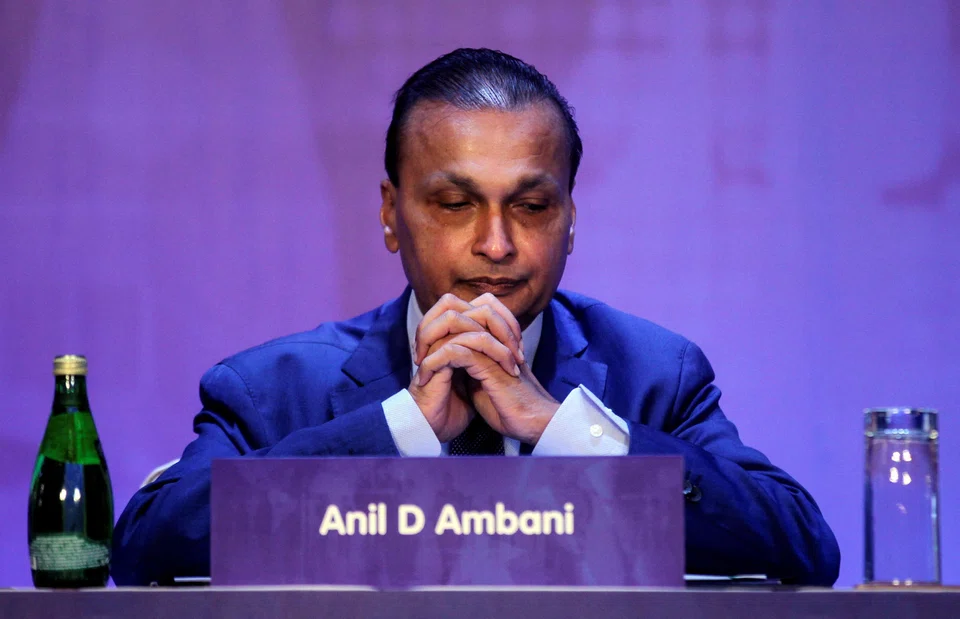
FORMER Indian billionaire Anil Ambani’s legal and financial woes are mounting as authorities widen investigations into several companies he once controlled, including allegations that 20.5 billion rupees (S$275.2 million) in corporate loans were misused.
The probes intensified in recent weeks after investigators arrested several former senior executives associated with his once-sprawling business empire. The next hearing in one of the key cases will be on July 13.
A member of one of India’s wealthiest families, Ambani is embroiled in a series of overlapping probes into Reliance Communications — once one of India’s largest telecommunications providers — and two financial-services companies, Reliance Commercial Finance and Reliance Home Finance.
These investigations mark the latest issues for the former tycoon, whose dwindling empire has for years been plagued by multibillion-dollar defaults and accusations of wrongdoing. Ambani has consistently distanced himself from the companies under investigation, saying he was not involved in their management or operations.
Ambani’s latest troubles began in mid-2025 when India’s largest lender, State Bank of India, declared Reliance Communications as a fraudulent account and lodged criminal complaints against both the company and him with the Central Bureau of Investigation, India’s federal investigation agency.
Reliance Communications was pushed into insolvency between 2018 and 2019, while the two lending arms and their parent, Reliance Capital, met the same fate two years later. In 2020, SBI filed a lawsuit to recover dues from personal guarantees Ambani had issued for loans taken out by the company — a case that has dragged on ever since.
Several other banks, as well as the Life Insurance Corporation of India, have since filed criminal complaints against Reliance Communications and the two lending companies. India’s Central Bureau of Investigation claims those business entities bear responsibility for some US$8 billion in wrongful losses to lenders.
Who is Anil Ambani?
Anil is the youngest son of Dhirubhai Ambani, the founder of one of India’s most valuable companies, Reliance Industries. The sprawling conglomerate began as a textiles and commodities trading business in the 1950s and later entered the petrochemicals, telecommunications and natural gas industries. It’s now the country’s largest private-sector enterprise by revenue and among the largest by market capitalisation.


After Reliance patriarch Dhirubhai died in 2002, his two sons — Anil and older brother Mukesh Ambani — battled over the ownership and management of the conglomerate. In 2005, the group was split, with Mukesh retaining the textiles, oil, gas and petrochemicals businesses under Reliance Industries, and Anil gaining control of the financial services, telecom and energy assets.
In 2008, he engineered a US$3 billion initial public offering for energy company Reliance Power, which went on to build some of India’s largest thermal power plants and was among the country’s early entrants into renewable energy.
Another of his companies, Reliance Infrastructure, became a major infrastructure developer that built roads and metro lines across India, operated power grids in Mumbai and New Delhi, and even expanded into defence manufacturing.
Ambani also expanded into media and entertainment, backing a filmmaking venture with Hollywood director Steven Spielberg and investing in radio stations, movie theatres, and animation, visual-effects and gaming companies.
Anil Ambani used to be one of the world’s richest people. But in the years since 2008, Ambani’s wealth has fallen spectacularly.
His net worth from stakes in multiple listed companies stood at US$3.7 billion a decade ago. Today the family’s shares in the two remaining listed companies — Reliance Infrastructure and Reliance Power — have fallen to under US$360 million. His brother Mukesh, on the other hand, ranks as Asia’s third-wealthiest businessperson with a net worth of US$87 billion, according to the Bloomberg Billionaires Index.
How did Anil Ambani’s business empire begin to unravel?
In the years after his father’s death, Anil expanded his businesses aggressively, funded by significant debt, leaving his companies exposed when the global financial crisis struck.
The collective value of his debt-saddled listed companies dropped from US$70 billion in April 2008 to just US$20.5 billion a year later. While his companies kept borrowing and posting revenue gains, his personal wealth shrank in the years that followed, and by 2015 he was worth less than US$4 billion, according to the Bloomberg Billionaires Index.
Troubles mounted in 2016 when his brother Mukesh launched a rival telecommunications venture — Reliance Jio Infocomm — which rapidly won over mobile phone customers with rock-bottom prices.
By 2018, the situation at Anil’s own cellular operator — Reliance Communications, known locally as RCom — had deteriorated to the point that Swedish telecom giant Ericsson AB’s Indian unit — a major equipment supplier to Reliance Communications — filed an insolvency suit over unpaid bills.
Mukesh stepped in to bail out his younger brother by making an US$80 million payment to Ericsson on his behalf. Anil said at the time that he and his family were “grateful we have moved beyond the past” and described the gesture as one they were “deeply touched” by.
Even so, Reliance Communications slipped into insolvency in 2019 due to an unmanageable debt load and high operating expenses.
Lawsuits from creditors followed and Chinese lenders even sued Ambani in the UK claiming he had personally guaranteed loans made to the company. That case remains formally open but hasn’t had any hearings since 2020, according to UK court records.
Mukesh Ambani’s group later acquired many of RCom’s assets, including a mobile tower and fiber-optic infrastructure, through insolvency proceedings.
Around the same time, Reliance Capital — a non-banking financial company that could invest and lend money — also ran into trouble. The company defaulted after the collapse of one of India’s largest non-bank lenders triggered a broader crisis in the sector that caused funding to dry up.
In 2021, the Reserve Bank of India took control of the company, citing a failure to meet payment obligations and “serious governance concerns” that it said the board failed to remedy.
As defaults piled up, India’s banks commissioned forensic audits into Reliance Communications, Reliance Commercial Finance and Reliance Home Finance.
The auditors alleged loan funds had been misused and that Reliance Group companies may have engaged in loan evergreening — the practice of using new loans to repay existing debt.
They also flagged accounting irregularities, loans disbursed to related and privately held companies, and borrowed funds channeled into financial investments. Bloomberg News has seen copies of the forensic audit reports that were included in court filings.
What is Anil Ambani accused of?
Authorities allege that Ambani’s companies misused bank loans to pay off other lenders, extend credit to related companies and funnel money to shell entities, bypassing due diligence, according to two asset seizure documents issued by India’s anti-money laundering agency, the Enforcement Directorate. Such practices are prohibited under the Indian central bank’s rules.
The ED says the Ambani’s immediate family created private trusts to help Ambani “wriggle out” of personal guarantees he had given to banks and safeguard the family’s wealth.
His 17-story Abode residence, which is valued at about US$410 million, was seized by authorities in late February. The agency said that the home in the upmarket neighborhood of Pali Hill in Mumbai was restructured under a private family trust to ensure “wealth preservation” for the family.
In April, the ED froze most of Reliance Infrastructure’s 77.1 million founder shares held by Ambani’s family holding company, saying the move was necessary to prevent the dissipation of assets and to protect the interests of banks and the public.
Altogether, the ED has seized over US$2 billion in assets, bank accounts, real estate and shares as part of its investigation to date. The agency is also probing whether Reliance Group influenced insolvency proceedings of some of its companies.
What does Ambani say about the allegations?
In 2025, Ambani challenged the State Bank of India’s fraud tag before the Bombay High Court, but the court rejected his pleas.
In recent months, he has filed defamation suits against three media organisations over their reporting on the federal probes. He alleges that their coverage was designed to cause “panic in the market” and push the sale of his companies at “distressed prices,” according to one lawsuit seen by Bloomberg News.
Ambani’s lawyers have offered a settlement to lenders through a phased repayment plan, but a court said in March that criminal cases cannot be settled through a civil agreement. Ambani also wrote to India’s Finance Minister seeking an out-of-court resolution.
In response to queries sent by Bloomberg News, a Reliance Group spokesperson pointed to internal communication published on a group company website.
In a communique to employees, senior management denied wrongdoing and said that the group had repaid 3.44 trillion rupees (S$46.2 billion) to lenders over the last 20 years. It also said Reliance Infrastructure had sold assets worth 234.8 billion rupees to reduce debt.
The group publicly maintains that Reliance Communications was “swept into a broader, acknowledged systemic collapse driven by regulatory shifts, spectrum costs, and hyper-competitive pricing,” while the collapse of Reliance Capital and its two lending arms was a “direct victim” of a sector-wide crisis.
What has happened to Anil Ambani’s two listed companies?
The Ambani family still owns the flagship listed companies, Reliance Infrastructure and Reliance Power, which continue to operate and are not part of the bank-default investigations. Reliance Infrastructure reported revenue of over US$2 billion and net profit of about US$505 million for the financial year ending March 2026.
In recent years, Ambani has sought to reposition both companies as part of a broader turnaround effort.
Reliance Power has increased its focus on renewable energy, while Reliance Infrastructure has pivoted toward defense manufacturing. In 2025, Reliance Infrastructure expanded its partnership with Germany’s Diehl Defence to manufacture guided munitions in India and announced plans to co-manufacture Falcon 2000 business jets.
Despite those efforts, the stocks have come under significant pressure. Shares of Reliance Power have dropped 56 per cent since last June, while Reliance Infrastructure shares are down 80 per cent.
Several global asset managers such as Blackrock, Vanguard Group and State Street Corp. hold minor stakes in both listed companies, according to Bloomberg data as of late March, while New York-based investment firm Varde Partners holds a 4.6 per cent stake in Reliance Power. BLOOMBERG
Decoding Asia newsletter: your guide to navigating Asia in a new global order. Sign up here to get Decoding Asia newsletter. Delivered to your inbox. Free.
Share with us your feedback on BT's products and services






