How China’s export surge left the shipping industry with a hangover
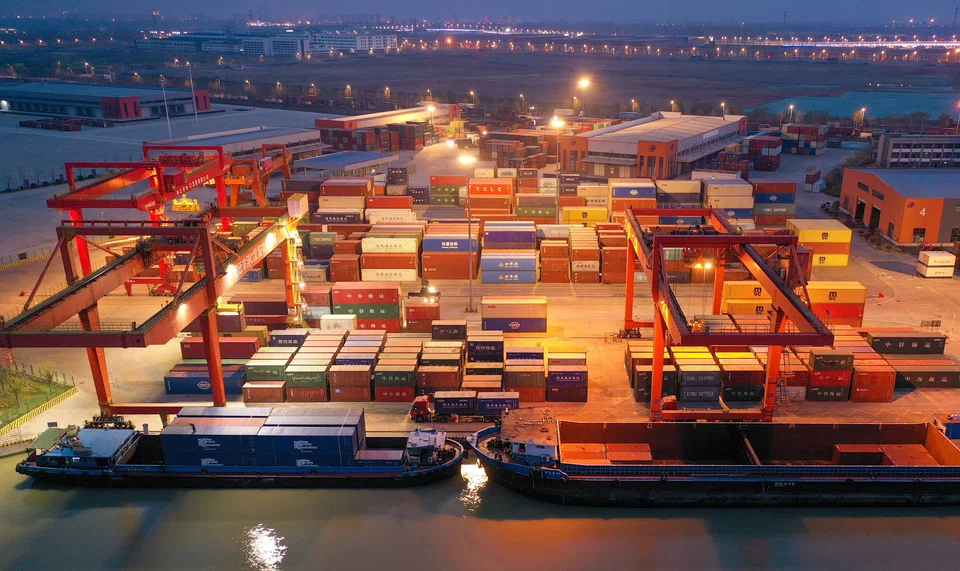
SINCE early March, two of China’s largest container truck yards near the major port city of Ningbo in Zhejiang province have been filled with nearly 3,000 idle vehicles with no cargo to haul.
Traffic at the Hengpu and Beilun parking lots, which primarily serve the port, has dropped dramatically over the last two years, several truck drivers told Caixin. During the shipping boom in 2021, some drivers would make 27 cargo deliveries per month on average, they said. Now, they are happy if they can do two a week.
The change only becomes more apparent in the port, where there are so many idle cargo containers that workers have nearly run out of places to stack them. “This area is almost full now, and many of the empty containers are being moved out,” said one terminal operator.
A combination of factors has led to these mountains of metal boxes piling up at Chinese ports — the low cost of storing containers in China, a surge in their supply during the pandemic export boom, and the immense number of them returning home once the boom faded, Yu Jianhua, head of the General Administration of Customs, said at a Mar 21 press briefing.
The container pile-up in China is one of the more visible symptoms of the problems in the shipping industry caused by a downshift in foreign trade amid weakened consumer demand and slowing global growth.
The situation could get even worse with the delivery of new vessels, leaving analysts concerned that the overcapacity in the industry could lead to a price war that will weigh heavily on the bottom line of some freight carriers.
Demand sinks
In Shanghai, more containers 40-foot container have come into the port than have departed each week since the beginning of the year, according to monitoring platform Container xChange.
Container xChange’s Container Availability Index has remained elevated at more than 0.6 compared with readings over the last three years in ports across China, including those in Ningbo and Tianjin, according to a report the platform put out in early February. A reading over 0.5 means that more containers have entered a port than departed over a given period.


Globally, about 6 per cent of container capacity is idle, with a large number of ships filled with empty containers sitting anchored at sea, a person working at a large freight forwarder previously told Caixin in February.
For China, the problem is with its exports, whose growth began slowing in mid-2021 due to shrinking demand from its major trade partners and the recovery of supply chains elsewhere that has met some of the demand for goods.
In the first two months of this year, China’s goods exports fell 6.8 per cent in dollar terms from the same period of 2022, customs data show. While that figure beat estimates and narrowed from December’s 9.9 per cent year-on-year decline, it’s far from a sign that a trade recovery is around the corner.
Exports to the US slid 21.8 per cent year-on-year and those to the European Union fell 12.2 per cent. In the US, high inflation cut into household purchasing power, while packed warehouses have forced retailers to cancel orders. In Europe, rocketing energy prices have spurred inflation that has discouraged consumers from opening their wallets.
The slowdown in demand has led to a collapse of ocean freight rates, which are primarily determined by changes in ship utilization, according to Sea-Intelligence, a research firm.
The China Containeried Freight Index, which tracks spot and contractual freight rates leaving major Chinese container ports on 12 shipping routes, began falling in August. The index, released by the Shanghai Shipping Exchange, declined 8.5% per cent month-on-month in February following a steeper 11.2 per cent drop in January.
As of Mar 30, the cost of sending a container from Shanghai to New York was down 78 per cent from a year earlier, while the figure for Shanghai to Los Angeles had plunged 81 per cent, according to data published by Drewry Shipping Consultants, a maritime research consultancy.
Recipe for a glut
In less than two years, the ocean freight market went from one extreme to the other, as resources including ships, containers, trucks and warehouses went from shortage to glut, said Zhang Huafeng, Los Angeles chief representative at Transfar Shipping.
The speed of that shift has only made things worse. During the boom of 2021, ocean carriers ordered a record number of shipping containers while retiring fewer aging ones, Drewry Shipping said in a July 2022 report. In 2021, the global supply of containers grew by 13 per cent — three times the previous trend — to almost 50 million twenty-foot equivalent units, or TEUs, a standard for cargo capacity in the shipping industry.
However, new container demand has been falling since the fourth quarter in 2021, said one worker at a large container manufacturer, who said that inventory has been piling up at his factory and others.
The situation is only going to get worse as new ships get delivered, Zhang said.
Ship owners have found themselves in a predicament that is similar to that of container buyers. When freight rates were surging during the export boom, they spent a lot of their profits on new ships.
That has led to some 2.6 million TEUs worth of newly built capacity expected to hit the water in 2023, Drewry analysts said in an October report. “By over-ordering in the boom years, carriers have set themselves an enormous challenge to shuffle and make capacity magically disappear,” they said.
As freight rates have dropped, some carriers have been trying a number of measures to reduce their capacity such idling vessels and canceling voyages, said DHL Global Forwarding in a late January report.
A total of 366 container ships were left inactive as of Feb. 13, according to DHL in a March 14 report, citing figures from shipping research firm Alphaliner. That figure is equivalent to 6.2% of the global fleet and up from 5.7% two weeks earlier.
However, these measures may not be enough because more shipping capacity is in the pipeline.
Some carriers did not adjust their business to the drop-off in demand last year, Container xChange said in a February report this year. “This can only be seen as a choice on the part of the carriers, Sea-Intelligence CEO Alan Murphy was quoted as saying. “A choice to allow overcapacity to persist is also a choice to allow for low utilisation, and thus to allow for freight rates to continue to drop. This is a behaviour we know by a different word: A price war.”
Container xChange saw margins tightening for freight forwarders and traders and predicted a period of market consolidation on the horizon.
Some industry observers were also worried that the market downturn could trigger a price war similar to the one that occurred in 2015-2016, which led to the bankruptcy of South Korea’s Hanjin Shipping Co. Ltd., once the world’s seventh-largest container shipper.
New players, who entered the market when freight rates were high during the pandemic, could get squeezed out, leading to a further consolidation of the container shipping sector, said Xu Kai, chief of the Shipping Informatization Research Department at the Shanghai International Shipping Institute.
However, major shipping companies are better positioned to fend off any price war that might occur over the next few years, due to their larger shipping capacity and greater economies of scale, said Wu Di, an associate professor at Dalian Maritime University’s College of Transportation Engineering.
Hope on the horizon?
However, some analysts see things getting better as China’s export outlook recovers.
The world economy is recovering, wrote Li Zongguang, chief economist at China Renaissance Holdings in an opinion piece last month.
In February, the global manufacturing purchasing managers’ index (PMI) rose to 50 — a dividing line between expansion and contraction. But China’s official manufacturing PMI survey, new export orders started growing in February again for the first time in nearly two years, with the reading reaching 52.4, he said.
Xu also believes that global trade demand is set to recover in 2023, and the turmoil seen in the shipping industry will not worsen. Global inflation and interest rate hikes will not intensify, while product inventories in the US and Europe will gradually be consumed, leading to a steady recovery in Chinese exports, he said.
“Compared with the second half of 2022, the shipping market in 2023 will improve,” Dalian Maritime University’s Wu said. According to him, the recovery could be expected in the third quarter of this year, when exports usually tend to rise in anticipation of the Christmas season. CAIXIN GLOBAL
Decoding Asia newsletter: your guide to navigating Asia in a new global order. Sign up here to get Decoding Asia newsletter. Delivered to your inbox. Free.
Share with us your feedback on BT's products and services