



Investments in China's 3 core growth engines hint at rising recessionary pressures
Goldman Sachs economist sees soft start to Q2; Nomura economist says high-frequency data suggests sharp decline in activity due to ongoing Omicron waves, lockdowns

Angela Tan
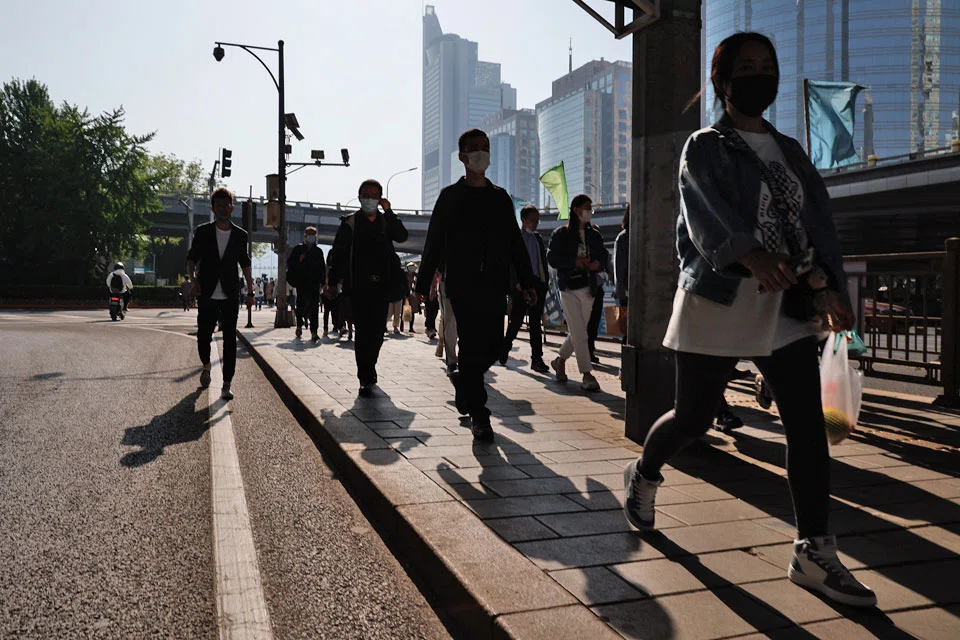
CHINA'S first-quarter economic growth turned out better than expected, but analysts say investments in the 3 core growth engines - infrastructure, manufacturing and real estate development - tell a less-sanguine story and hint at rising recessionary pressures.
On Wed (Apr 20), China and Hong Kong markets continued their second consecutive day of decline, even though Beijing reported on Monday that China's Q1 gross domestic product (GDP) grew 4.8 per cent on year, exceeding median street expectations of 4.2 per cent.
Sentiment took a hit after the International Monetary Fund (IMF) affirmed expectations that China will miss its official growth target of about 5.5 per cent this year. It cut China's 2022 GDP growth estimate to 4.4 per cent, from 4.8 per cent on concerns that Beijing's strict zero-Covid policy could continue to hamper economic activity.
A deeper look at the Q1 data showed that the Omicron outbreaks and the lockdown of Shanghai, China's largest city, have started to take a toll on core activities: retail sales were down 3.5 per cent on year in March; the Purchasing Managers' Index (PMI) - which reflects the health of the manufacturing and service sectors - was at its second lowest on record; the property market remains very weak, and jobless rate rose to 5.8 per cent in March, well above seasonal norms.
Covid measures, including the testing of truck drivers, have led to an acute shortage of drivers and are stressing supply chains. Many electronics components manufacturers are shutting down in Kunshan, a centre for electronics production for companies like Tesla and Apple.
Infrastructure investment growth accelerated 12.5 per cent on year in March, but this is largely due thanks to the government's faster bond issuance and fiscal spending to offset growth headwinds.

Goldman Sachs economist, Andrew Tilton, said: "This suggests a soft start to Q2, and this year's official GDP growth target of 5.5 per cent clearly will require more policy easing." Goldman is maintaining its full-year GDP growth forecast of 4.5 per cent.
Lu Ting, Nomura's chief China economist, also echoed similar concerns: "The real picture does not look that sanguine, as March activity data worsened across the board and high-frequency data suggests a sharp decline in activity due to the ongoing Omicron waves and lockdowns."
Over the past week, Omicron caseloads in the mainland remained elevated. Beijing has given no indication that it would moderate its zero-Covid strategy.
Nomura's own survey to better assess the status of lockdowns in China and their impact on the economy showed 44 cities are under full or partial lockdowns, or some form of district-based control measures. The 44 cities account for 25.3 per cent of China's population and 38.4 per cent of China's GDP.
The Japanese house said the figures may underestimate the full impact of China's zero-Covid policy. This is because many other cities have been carrying out mass testing on a district-by-district basis, even without explicit lockdown, and mobility has been restricted.
Lu added: "Amid expansive lockdowns, logistics disruptions, contracting property sector and slowing exports, we expect April activity data to tumble and gauge that the risk of recession has been rising in Q2, which we define as negative year-on-year real GDP growth."
Aninda Mitra, head of Asia macro and investment strategy at BNY Mellon Investment Management, believes the slowdown in China's economy is becoming more entrenched. "Chinese yearly growth remains below potential... and the change in its credit impulse has yet to recover back to positive territory. With just over 6 months to go before the Party Congress and stiff headwinds from the Omicron-led spread of the Covid virus, policy easing has been reticent and market confidence remains fragile," said Mitra, who prefers local bonds to equities.
UBS were among the banks which downgraded the full-year 2022 GDP growth forecast for China to 4.2 per cent from 5 per cent in light of the intensified downward pressure on the economy. Barclays too cut its projection to 4.3 per cent on concerns of prolonged Covid disruptions. Bank of America shaved its forecast to 4.2 per cent from 4.8 per cent, while Standard Chartered lowered its projection to 5 per cent from 5.3 per cent. Beijing's growth projection remains around 5.5 per cent.
Dampening sentiment further was the decision to leave the medium-term lending facility (MLF) rate unchanged, and the implementation of a smaller-than-expected cut of 25 basis points in Chinese banks' required reserve ratios, which potentially releases 530 billion yuan (113 billion yuan) - or 0.5 per cent of GDP - of additional liquidity.
Mitra said the central bank seems to have grown more hesitant about using up its policy space too soon: "It could also be that it does not want to signal a very abrupt about-turn in stabilising the country's macro-credit leverage. What's more, the People's Bank of China may also have become more wary about a sharp widening of interest rate differentials, amid rapidly rising US rates, which could raise foreign exchange and financial stability concerns."
Decoding Asia newsletter: your guide to navigating Asia in a new global order. Sign up here to get Decoding Asia newsletter. Delivered to your inbox. Free.
Copyright SPH Media. All rights reserved.
TRENDING NOW

Indonesia’s coal tycoon Low Tuck Kwong replaced as Bayan Resources president-director

OCBC names Ang Eng Siong as global corporate banking head in rejig of wholesale banking business

Consider lowering homeownership barriers for some non-resident foreigners

DBS opens flagship investment strategy to retail investors with new fund

