Kevin Warsh kicks off US Fed chief tenure with sweeping review as rates remain unchanged
New projections show inflation slowing sharply next year, allowing rates to return to where they are now by the end of 2027
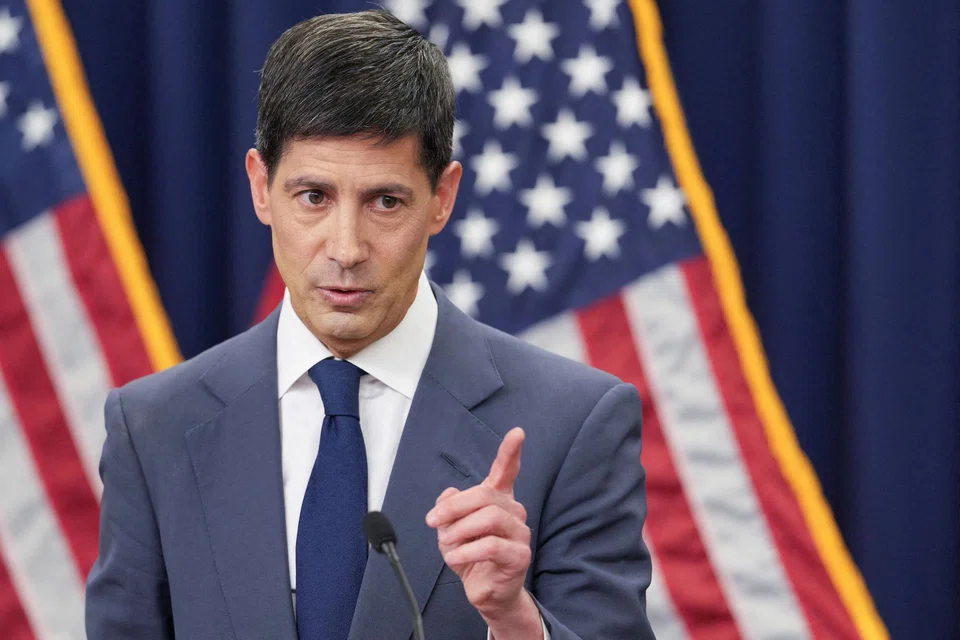
[WASHINGTON] US Federal Reserve chairman Kevin Warsh opened a new era on Wednesday (Jun 17), with officials agreeing to leave interest rates unchanged despite inflation stuck well above their target but also launching an ambitious reform agenda to reshape how the US central bank conducts and communicates monetary policy.
Warsh, who took over as Fed chief in May, made an immediate imprint in organising a unanimous consensus around a stripped-down policy statement that jettisoned any forward guidance on what actions the central bank might take in the near term, although new quarterly projections, eschewed by Warsh himself, showed nine of 19 policymakers now anticipate a rate hike by the end of 2026.
Indeed, the shortened document issued by the central bank’s Federal Open Market Committee (FOMC) heralded a return to a format similar to that used by former Fed chairman Alan Greenspan and clearly reflected Warsh’s disdain for expansive communication about what’s to come.
Forward guidance, Warsh said at his debut press conference, was not “well suited” to the current economic moment.
“I cannot give you any forward guidance about what we are going to do next,” he said. “The good news is we will be meeting in six weeks.”
The statement’s description of the economy touched on issues Warsh has emphasised, mentioning that “productivity growth and capital investment are strong.” While acknowledging inflation was “elevated relative to the Committee’s 2 per cent goal”, that development was assigned in part to “supply shocks that have driven price increases in certain sectors, including energy”.
The statement marks a turning point not just in leadership at the central bank but in a monetary policy outlook that since the fall of 2024 had been geared to lower borrowing costs from the elevated rates used to help tame inflation that hit 40-year highs during the Covid-19 pandemic.
Fed observers took immediate note of the shift.
“The changes to the policy statement were profound,” Thomas Simons, chief US economist at Jefferies, wrote in a note. “The word count dropped substantially and the modest amount of forward guidance present showed two-way risks to the next move for policy. Policy statements became much wordier after the GFC (Global Financial Crisis), so this is a return to a more Greenspan-era style of post-meeting communications.”
SEE ALSO

Big changes set in motion
The decision to leave rates unchanged, and the outlook for a possible rate hike from nearly half of the Fed policymakers, means there is very little prospect for Warsh to be able to deliver the rate cuts that US President Donald Trump, who appointed him, has been expecting the new central bank chief to deliver.
New projections show inflation slowing sharply next year, allowing rates to return to where they are now by the end of 2027 and easing modestly further in 2028.
“The Committee will deliver price stability,” the statement said.
Warsh also cautioned against reading too much into the dots. “I reviewed the dot plots, and when I saw the submissions, I noted that all the submissions were coming in with pencils, you know, those kinds with the big erasers,” he said.
Still, bond and stock markets fell sharply as investors digested the hawkish shift among so many of Warsh’s colleagues, and interest rate futures markets now reflect expectations for a rate hike as soon as September, three months earlier than prior to this week’s meeting.
Warsh, meanwhile, used his press conference to announce a sweeping review of how the central bank conducts its business in critical policy areas including its balance sheet, communications, data sources, productivity and jobs, and its inflation framework.
All are areas that Warsh has been critical of since leaving the Fed more than a decade ago and signal an interest in returning the central bank to being a leaner – and possibly more opaque – institution.
“What typically does happen is people take the path the central bank already travels and say where do you move from there?” said Vince Reinhart, chief economist for BNY Investments. “He is saying ‘let’s walk back the path and consider some of the earlier junctions,’ which is a strategy if you think you are lost in the woods. You walk back and reconsider some of the turns you made.”
Projections among officials showed the policy interest rate, which has been set in the 3.5 to 3.75 per cent range since last December, would rise slightly by the end of this year.
The outlook for inflation for the end of 2026 was marked up to 3.6 per cent from 2.7 per cent, before it was seen falling to 2.3 per cent next year, consistent with the statement language attributing high prices to supply disruptions that would typically be expected to pass.
Economic growth was marked down slightly, with the unemployment rate expected to end the year at 4.3 per cent, compared to 4.4 per cent in the Fed’s March projections. REUTERS
Decoding Asia newsletter: your guide to navigating Asia in a new global order. Sign up here to get Decoding Asia newsletter. Delivered to your inbox. Free.
Share with us your feedback on BT's products and services