



A large family fortune starts a risky transition
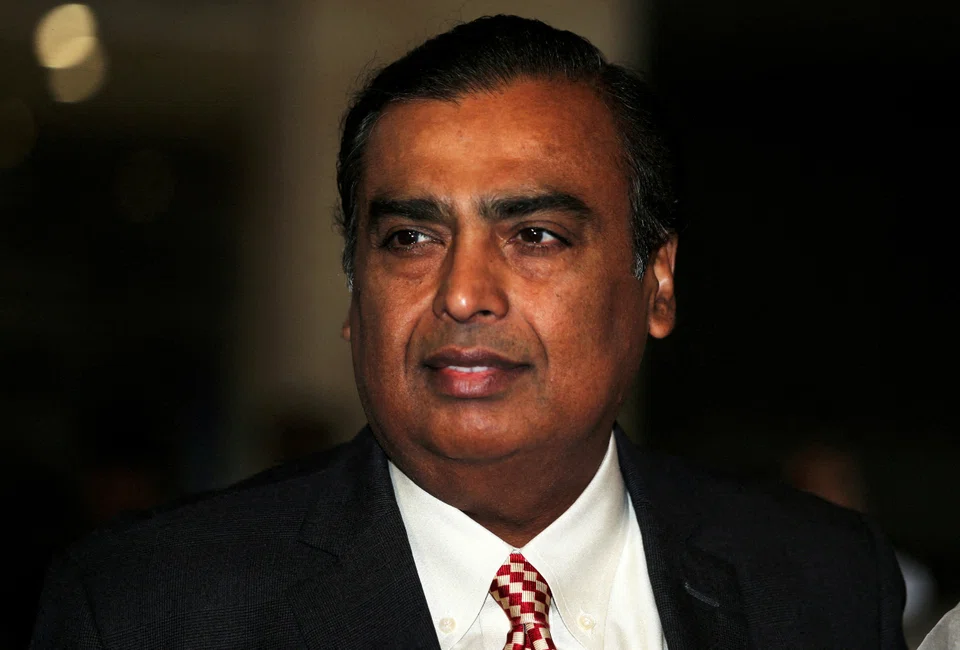
THE flagship of Asia’s richest tycoon is looking a tad overburdened with businesses that are mature enough to be cast off on their own. Successful public floats of telecom and retail units will do more than make Mukesh Ambani a centi-billionaire – they may well determine the hold of the family-run conglomerate on India’s broader economy when control passes to the next generation.
That transition could arrive by 2028. At Reliance Industries’ annual general meeting on Monday (Aug 28), the 66-year-old announced that his three children would be joining the board, even as he continues as chairman and managing director for five more years.
Reliance’s sway has grown following a US$150 billion investment spree over the past decade. It now controls 15 per cent of the total fixed capital deployed at India’s top 300 non-financial firms, employs 7 per cent of the workforce and garners 10 per cent of their combined earnings before interest, tax, depreciation and amortisation (ebitda). Reliance is no longer just a corporate, but “a precious Indian institution”, Ambani said.
The market, however, wants to see some of that preciousness translate into a higher share price. After recently spinning off a new consumer-finance venture worth US$16 billion, the enterprise is valued at US$232 billion, including net debt. Macquarie Group analysts downgraded the stock to “underperform” last month. A premium for retail and telecom may already be embedded in the share price, and investors may be assessing new energy – the group’s next big bet – at around US$20 billion, they wrote.
That is already rich for an unproven thesis. Reliance wants to put up gigafactories to manufacture solar modules from sand, low-cost wind turbines using carbon fibre from its own plants, batteries powered by lithium and sodium ions, and electrolyzers to split water into hydrogen and oxygen. Considering that these plans are still in progress, the US$20 billion implied valuation carries a lot of respect for Ambani’s reputation for project execution, chops the younger generation is yet to demonstrate.
In his address, Ambani promised “a new and virtuous multi-decade value-creation cycle defined by faster growth, higher revenues, better margins and increased ebitda”, significantly enhancing the earnings multiples of each of Reliance’s businesses. This is where the market seems to be less sanguine than the billionaire. The price-to-earnings ratio dipped below 25 after the chairman’s speech. It had soared well past 30 when Ambani was raising billions of dollars of equity from global investors including Google’s parent Alphabet Inc and Meta Platforms (then Facebook) during the Covid-19 lockdown.
The focus on leadership succession cannot detract from the need to validate bets that Ambani has himself made so far, particularly in telecom and retail. Through those two capital-guzzling gambles (and renewable energy, more recently), he has sought to transform the petrochemicals empire his dad, Dhirubhai, left him.
However, instead of indicating a timeframe for much-awaited initial public offerings, the tycoon talked of things that will cost yet more money. The plans include 2,000 megawatts of artificial-intelligence-ready computing capacity, fixed-wireless broadband for 200 million Indian homes, expansion of a fledgeling consumer-goods franchise to other parts of Asia and Africa, global leadership in carbon fibre, and more investment in gas exploration. These are in addition to capital required for 100 gigawatts of clean-energy generation by 2030 and a nationwide 5G rollout by December.
For now, India’s most valuable public firm is trying to establish the success of its makeover in the private market; such as by getting Qatar’s sovereign wealth fund to cough up US$1 billion for 1 per cent of Reliance Retail recently. A US$100 billion price tag is nearly double what private equity paid for it during the September 2020 fundraising round. Had it been listed, Reliance Retail would have ranked among the top four companies in India and top 10 retailers globally, Ambani said at the annul general meeting. Investors, however, are too hungry to be satisfied only by the aroma. Instead of taking the lid off the pot only to stir it some more, why not serve them the dish?

That way, the stock market also gets a chance to weigh the next generation. At 31, the twins Akash and Isha Ambani are a decade older than their dad when he joined the Reliance board in 1977. They are no longer too young to be helming publicly traded digital and retail enterprises, respectively. The complex new-energy unit, overseen by Anant, their 28-year-old sibling, will need five to 10 years before it is IPO-ready. At least for the next five years, the millennial leaders will have their father’s stewardship of Reliance’s investment-grade Baa2 credit rating, which is a notch higher than Moody’s Investors Service’s assessment for the Indian government. There is plenty of room for youthful mistakes.
It helps the group that rival Gautam Adani, who had overtaken Ambani last year in global wealth rankings, has lost his footing after a massive short-seller attack in January. While Adani is still highly acquisitive, he may be narrowing the field of his ambition to infrastructure and utilities, leaving the Ambani family free to grow in areas that have more to do with consumer demand in the world’s most-populous nation. From telecom and media to retailing and owning brands, these opportunities are large in both number and scope.
Then there is the whole new area of payments, lending, asset management and insurance. Jio Financial Services’ recent stock-market listing has not unlocked value – it has simply given Reliance shareholders a stake in a shadow bank that will now get created from scratch. Until its strategies pan out, a large part of the financial venture’s market capitalisation will come from its stake in the main firm, where it may be subject to a typical, 20 per cent holding-company discount.
A smooth transition to the next generation is important. It will help preserve family wealth and the conglomerate’s clout in India. But the telecom and retail IPOs need to arrive soon. Otherwise, excess baggage on the mothership could riddle it with a permanent drag. BLOOMBERG
Decoding Asia newsletter: your guide to navigating Asia in a new global order. Sign up here to get Decoding Asia newsletter. Delivered to your inbox. Free.
Share with us your feedback on BT's products and services
TRENDING NOW

Two Singapore-listed palm oil firms named in Greenpeace report on Indonesian plantation fires

Singapore Airlines flight returns to San Francisco after ‘unruly’ passenger incident

Singapore looking into which companies responsible for haze-causing fires: PM Wong

Deluge IPO 3.86 times subscribed ahead of SGX debut

