



Macron urges Xi to step up efforts on Ukraine, rebalancing global trade
A large business delegation is accompanying Macron on his fourth state visit to China
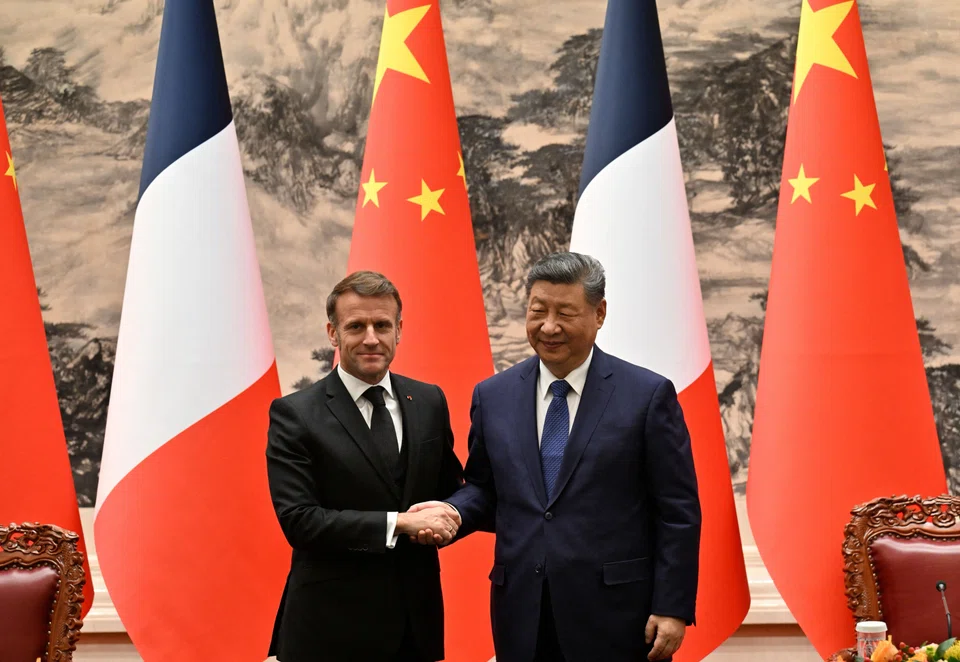
[BEIJING] French President Emmanuel Macron urged Chinese President Xi Jinping to boost cooperation on geopolitics, trade and the environment, as the European Union seeks China’s help in ending the war in Ukraine and Beijing looks for diplomatic wins from the US tariffs.
A large business delegation is accompanying Macron on his fourth state visit to the world’s second-largest economy, as he seeks to bolster his foreign policy credentials and secure commercial deals for French industry in a bid to revitalise his political legacy in the final years of his term after a tumultuous summer, and ahead of the 2027 presidential election.
China, for its part, wants to ease trade frictions with the 27-strong EU over its heavily subsidised electric vehicle industry, while presenting itself as a reliable trading partner and an alternative market to the US as global economies face recession risks resulting from President Donald Trump’s tariffs.
“Now, more than ever, dialogue between China and France is vital,” Macron told his host during their Thursday (Dec 4) meeting at Beijing’s Great Hall of the People. “I propose a positive threefold agenda for our relations, one of geopolitical stability, of economic rebalancing, and of environmental sustainability.”
“We have to continue to rally in favour of peace and stability in the world,” he added, referring to the conflict in Ukraine. “Our ability to work together is decisive.”
Economic opportunities face political constraints
Xi on Friday will accompany Macron to southwestern China’s Sichuan province, lavish treatment considering Xi seldom joins visiting world leaders once they leave Beijing.
But despite the apparent bonhomie between the two men, analysts say significant political constraints weigh on their partnership. The Chinese leader is not expected to approve a long-anticipated 500-jet Airbus order, as that would weaken Beijing’s leverage during trade talks with the US, which is pressing for new Boeing purchase commitments.
Similarly, Xi is unlikely to lift the minimum prices that most of France’s cognac industry must meet to sell to Chinese consumers, given that the preceding anti-dumping probe was launched in response to the wider EU’s decision to impose import tariffs on Chinese EVs.
An easing of Chinese duties on EU pork shipments is also not expected, as Beijing seeks to pressure Brussels into agreeing to a minimum price plan for its EVs. France voted in favour of the EV tariffs in the October 2024 vote. And any overtures on Ukraine Xi might make to Macron would follow recent Chinese assurances to Russia of China’s continued support.
The EU on Wednesday also announced new economic security policies to reduce the bloc’s reliance on China.
“No matter how the external environment changes, our two countries should always demonstrate the independence and strategic vision of major powers,” Xi told Macron, adding that China remained committed to promoting peace in Ukraine and Gaza.
Xi used Macron’s visit to announce China would provide a further US$100 million in aid to the Palestinians for reconstruction, although far below the 1.6 billion euros (S$2.4 billion) the EU pledged in April for the next three years.
China’s top leader also encouraged Macron to deepen cooperation in aerospace and nuclear energy, as well as in artificial intelligence, the green economy and biopharmaceuticals.
The two leaders signed 12 cooperation agreements following their talks, covering population ageing, bilateral investment, nuclear energy, and panda conservation.
Big business
Macron in the past has sought to project a robust European front in dealing with China, while being careful not to antagonise Beijing, with China a key export market for many of France’s most prominent companies.
Top executives from Airbus, France’s largest bank BNP Paribas, electrical giant Schneider and train maker Alstom, along with leaders of the French dairy and poultry industry groups, have joined Macron in China.
The EU’s goods trade deficit with China has ballooned by nearly 60 per cent since 2019, while France’s trade balance with the US$19 trillion economy continues to widen.
“Our two countries have a role to play in laying out, with other partners, the foundations for rebalanced economic governance,” Macron told Xi, calling for rules that were fairer and stronger, rather than based on “survival of the fittest.”
“It is essential to create an environment of trust and to deal with every instability risk in supply chains,” he added.
China is France’s seventh-largest trading partner, buying around US$35 billion in goods each year, according to Chinese customs data. About 10 per cent of those products are cosmetics, with aircraft parts and alcoholic spirits among other key exports.
For its part, France takes some US$45 billion worth of Chinese products, mostly low-value parcels through online platforms like Shein of cheap clothes, accessories and gadgets direct from Chinese factories, thanks to an EU customs waiver on purchases below 150 euros. REUTERS
Decoding Asia newsletter: your guide to navigating Asia in a new global order. Sign up here to get Decoding Asia newsletter. Delivered to your inbox. Free.
Share with us your feedback on BT's products and services






