


No rapid rebound for China’s economy, but stimulus may lift sentiment: economists

Megan Cheah
INVESTORS should not expect an acceleration in China’s economic recovery, nor a pop in markets, even if talked-about stimulus measures are implemented, economists and analysts said.
This is because the government is still dealing with concerns about excessive leverage, financial stability and overheating.
“For instance, property-easing measures are intended to defuse the property crisis rather than to reinflate the housing market, and therefore cannot be expected to power a rapid housing recovery,” said Maybank Investment Banking economist Brian Lee.
Nearly six months after the country ended its strict Covid-19 social controls, China’s economy is flagging.
Its property market, previously a key contributor to economic growth, remains in a downturn. Retail sales growth has been slow, and industrial production sluggish.
These weaknesses have weighed on investor sentiment. The Shanghai Composite Index is up 3.2 per cent since the start of the year, as at Wednesday (Jun 28), while the Shenzhen Stock Exchange Component Index has risen 2.3 per cent over the same period.

In comparison, the S&P 500 Index has soared 14 per cent year to date as at Tuesday. Meanwhile, the MSCI All Countries World Index traded up 12.2 per cent when it closed on Tuesday.
Expectations are rising that the Chinese government will announce stimulus measures at its Politburo meeting next month.
Yet, market watchers said investors would be wise to temper their expectations. Those expecting a big bounce in China’s economy or markets were probably overly optimistic to begin with.
“In reality, the recovery after a major downturn is always going to be uneven and gradual,” said DBS senior economist Nathan Chow.
Analysts at Barclays said the government is more likely to stabilise growth not far above its target, rather than significantly boost growth, with a shift in focus to “quality growth” rather than sheer numbers.
Fiscal measures on the way?
Chinese state media reported that the State Council considered a batch of macroeconomic policies at a meeting on Jun 16.
“In response to the changing economic landscape, it is imperative to introduce policies that are more powerful,” the council said in a statement published by state news agency Xinhua.
“Policies that meet the necessary conditions should be promptly unveiled and implemented without delay,” the article indicated.
Morgan Stanley economists said in a note on Jun 16 that they expect measures to stabilise investment, which has been a key drag on second-quarter gross domestic product growth.
These measures, which should arrive in the coming weeks, include relaxing property purchase restrictions in tier-one and two cities, higher infrastructure support to offset land sales’ shortfall and consumption subsidies.
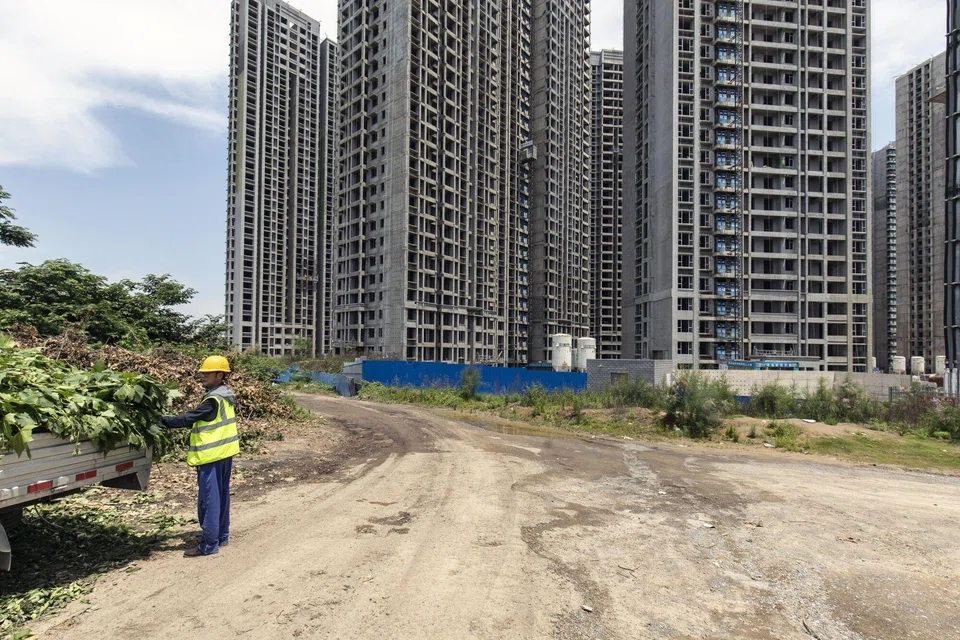
China’s property sector is a key growth driver, accounting for about 30 per cent of its economic output. The sector is facing strong headwinds.
New home growth was in the red in May this year, dropping to -2.7 per cent year on year (yoy). It had been temporarily positive in April at 4.6 per cent. Property funds for developments fell 7.4 per cent yoy from 3.2 per cent in April.
The sector’s weakness was a key factor in Goldman Sachs’ slashing of its China GDP growth forecast to 5.4 per cent from 6 per cent – still higher than the modest “around 5 per cent” growth expected by the Chinese government.
In a client note, the US investment bank said: “No reopening boosts have faded as quickly as in China.”
Various other data points have also disappointed. In May, fixed-asset investment dipped 2.2 per cent yoy – extending a 3.9 per cent decline in April. Retail sales growth fell to 12.7 per cent, below the consensus expectation of 13.7 per cent.
DBS’ Chow said consumption has “underperformed” against market expectations.
“It slowed after the initial spike as ordinary households grappled with the debt overhang and negative wealth effects,” he said. “Although retail traffic has improved recently, this has not translated into corresponding gains in sales.”
Little impact from interest rate cuts
In a bid to revive the economy, Beijing has delivered a series of policy rate cuts – its first in 10 months.
The central bank cut its open market operation (OMO) seven-day reverse repurchase rate by 10 basis points from 2 per cent to 1.9 per cent on Jun 13. It quickly followed up with a 10-basis-point cut to medium-term lending facility (MLF) rates two days later, to 2.65 per cent from 2.75 per cent.
One-year and five-year loan prime rates were also slashed by 10 basis points each on Jun 20.
Nomura analysts said the impact of the cut to medium-term loan rates is limited. Banks had already adjusted rates for new lending, existing loans will not be affected by the cut until next year, and private developers would not react to these cuts as “they are paying down debt to survive the downturn”, they said in a report.
Vishnu Varathan, Asia head of economics and strategy at Mizuho Bank, noted meanwhile that the 10-basis-point cut to five-year loan prime rates had disappointed the market which had expectations of a 15-basis-point reduction.
Further rate cuts are anticipated. Barclays, for one, said policy rates such as the seven-day OMO rate and the MLF rate should receive three 10-basis-point cuts for each quarter up to Q1 2024, to lower real borrowing costs.
A further 25-basis-point cut to the reserve requirement ratio for banks is also on the books in Q3 2023, as more MLF loans mature from August onwards, said Barclays and Maybank economists.
Yet, Maybank also noted that interest cuts and higher credit supply have a limited impact on domestic demand, amid muted household and business confidence.
Meanwhile, Barclays said there is room for fiscal stimulus given “the conservative central-government budget, hawkish Ministry of Finance, deteriorating local government finances and rising (local-government financing vehicle) default risks”.
Some respite ahead
A stimulus package would lift sentiment, said Maybank’s Lee.
DBS’ Chow added: “A stimulus package provides a signal to the market that the government is serious about putting a floor under economic growth.”
He sees high-end manufacturing companies benefiting if there are tax breaks for industries such as new materials, chips, artificial intelligence and biopharmaceutics.
Maybank’s Lee also highlighted renewable energy generation as an area to which the central government may funnel its infrastructure investments.
Paul Chew, head of research at Phillip Securities Research, said hospitality is a “sweet spot, with outbound travel in China only 15 per cent of pre-pandemic levels”. Singapore-listed stocks that would benefit from a recovering China include CapitaLand Investment and Sasseur Reit , he added.
Michael Kelly, global head of multi-asset at PineBridge Investments, is far more positive. “By year’s end, we expect China to be viewed as the least-dirty shirt of the major global economies,” said Kelly, who believes China’s recovery is “poised to re-accelerate” as the government steps up deregulatory and monetary stimulus.
Decoding Asia newsletter: your guide to navigating Asia in a new global order. Sign up here to get Decoding Asia newsletter. Delivered to your inbox. Free.
Copyright SPH Media. All rights reserved.

