



One of China’s richest battery tycoons builds US$50 billion empire
Sungrow has the second-biggest market value among all mainland-listed firms seeking H-share listings
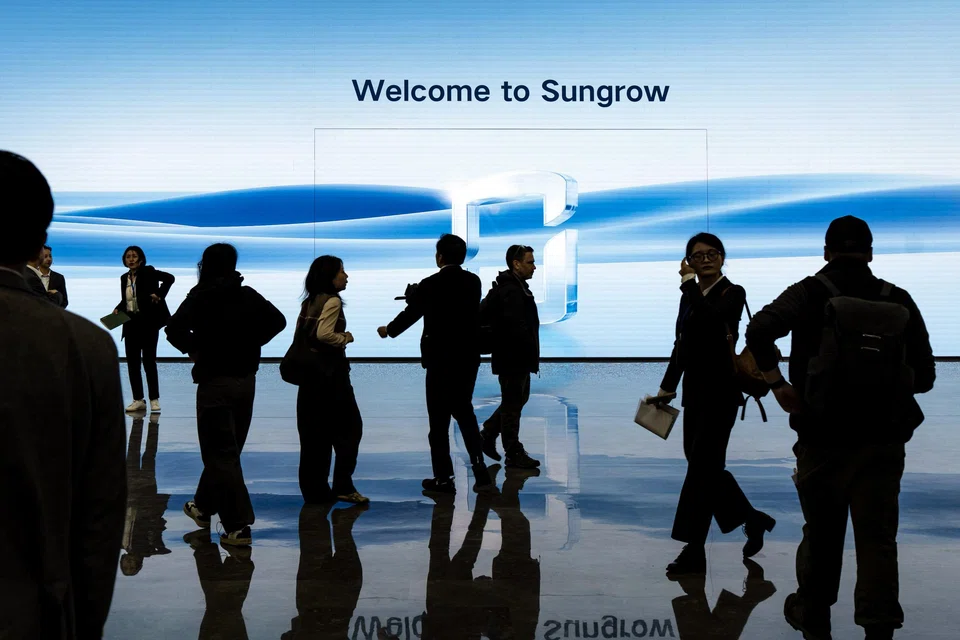
CAO Renxian is one of China’s richest men in an industry the world cannot live without, yet almost no one outside the business knows his name. That obscurity may not last much longer.
The 57-year-old founder of Sungrow Power Supply has built a dominant position in the global energy transition, occupying an unglamourous corner of renewable power: industrial-scale batteries that make it possible for grids to cope with high volumes of clean energy. After shares surged about 112 per cent in the past year in Shenzhen, Cao’s fortune more than doubled to US$15 billion, making him one of the wealthiest alternative-energy titans in China, according to calculations by Bloomberg Billionaires.
Now a Hong Kong listing, expected as early as the first quarter and projected by Bloomberg Intelligence analysts to raise HK$15 billion (S$2.4 billion), may turn Sungrow into one of the world’s largest renewable-energy offerings of the year. The company’s equity value, which is riding on a global battery boom driven by power demand from artificial intelligence (AI) data centres, is estimated to reach almost US$50 billion when including its mainland China-listed shares.
The initial public offering (IPO) will expose the company to global investors and push Cao, who has maintained a low public profile, onto the world stage for the first time.
Cao’s rising status “is not the result of personal branding, capital manoeuvring, or visibility-driven entrepreneurship”, said Harry Yu, senior partner at Fung, Yu & Co, a family office advisory based in Hong Kong.
He is also an honorary director at the Chinese University of Hong Kong’s Center for Family Business where he studies Chinese billionaires. “His influence and personal wealth expanded because the industrial platform he built reached a scale where the market could no longer ignore it.”
Unlike China’s higher-profile tycoons such as Alibaba Group Holding co-founder Jack Ma or Tencent Holdings co-founder Pony Ma, Cao has kept largely anonymous. An engineer by training, he spent four years as a professor of renewable power at Hefei University of Technology before quitting in 1997 to start Sungrow.
Initially, the company focused on making inverters that make it possible for solar panels to provide power in homes. It was a gamble at a time when solar power barely existed in China.
“No one supported my idea,” he later recalled in a 2023 interview with a local media outlet, one of less than a handful he has given in the past half decade. He declined interview requests for this article.
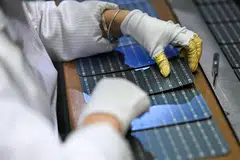
Nevertheless, convinced that renewable energy was the future, Cao started the company with roughly 500,000 yuan (S$90,838). Today, it’s worth roughly 315 billion yuan, employs about 17,000 people, and spans batteries, solar power inverters, EV chargers and hydrogen equipment.
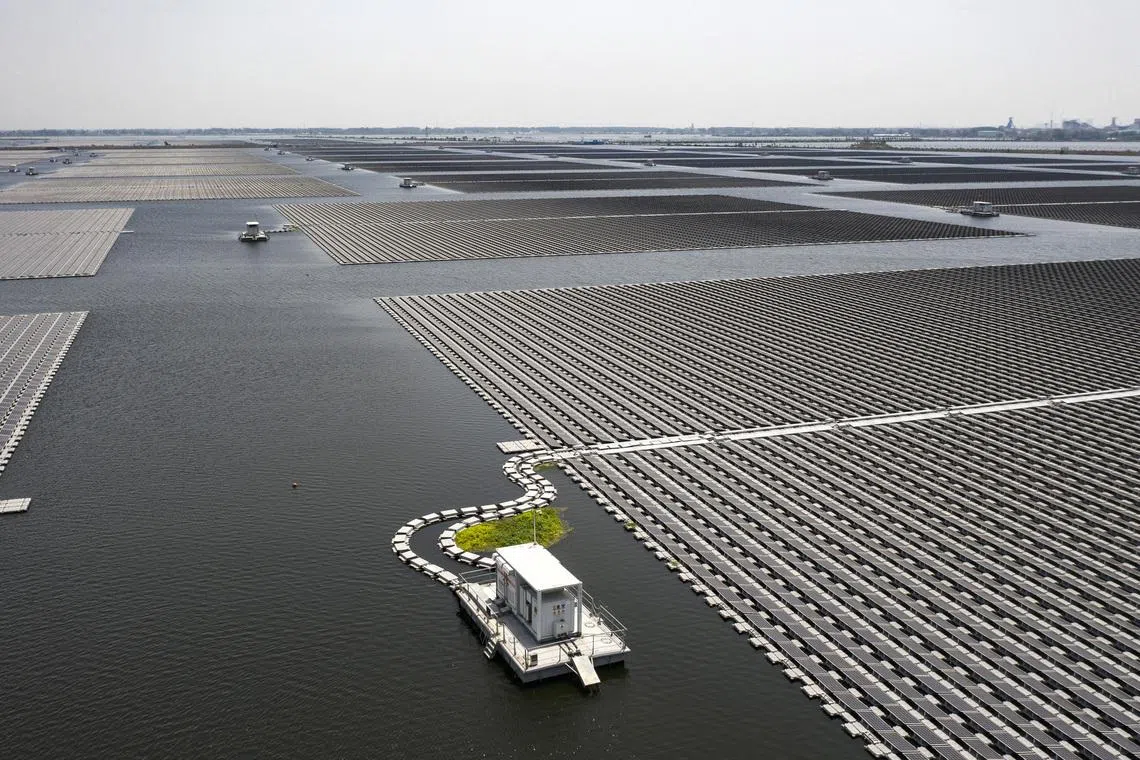
Such growth in wealth has a familiar feel in China’s clean-energy economy. The country’s renewable boom once produced billionaires at industrial speed. Solar panel makers, polysilicon refiners and equipment suppliers rode years of explosive growth. Then the market turned, swiftly and brutally.
Overcapacity and price wars hollowed out profits across the solar supply chain, eroding the fortunes of company founders who once ranked among the country’s richest. Li Zhenguo of Longi Green Energy Technology has seen his net worth fall nearly 80 per cent from its 2021 peak to about US$3.4 billion. Liu Hanyuan, chairman of Tongwei Group, has lost more than half of his wealth since 2022. Others slid down the rankings as margins vanished.
Cao’s Sungrow has avoided the worst of that wreckage, but not because it escaped the cycle entirely. Its profit growth slowed to a modest 17 per cent in 2024, following a more than doubling of net income the previous year. What spared it, analysts say, was timing: it was already positioned in energy storage at the start of the AI boom, when data centres’ demand for power surged and batteries stopped being optional.
In the first half of 2025, Sungrow’s net income jumped almost 56 per cent. Energy storage overtook solar inverters as the company’s primary growth engine in a shift investors greeted as evidence of strategic foresight by Cao.
Cao had pushed Sungrow into energy storage in 2015, years before batteries became a global obsession. Large, containerised battery systems prop up renewable-heavy grids and buffer power-hungry AI data centres. Demand is rising fast. BloombergNEF (BNEF) estimates global energy storage additions hit a record in 2025, almost a quarter more than in 2024, with China responsible for more than half. By 2035, BNEF projects global demand to reach two terawatts, or 7.3 terawatt hours, eight times current levels.
In the first half of last year, energy storage generated 41 per cent of Sungrow’s revenue, up from 25 per cent a year earlier. Revenue from the segment more than doubled.
“Timing is crucial,” Cao said in the 2023 interview. “Starting too early risks failing just before dawn, but entering too late may leave no room at all. Determining the precise moment to launch a new business truly tests a leader’s judgment.”
But energy storage, like solar before it, is capital-intensive, price-sensitive and increasingly crowded. Chinese rivals are expanding capacity aggressively and Western utilities, burned once by supply-chain dependence, are pressing for localisation. Analysts warn that energy storage may follow solar’s post-2021 collapse, when rapid expansion overwhelmed demand.
“The pattern now emerging in the battery industry mirrors the solar industry’s post-2021 cycle – where healthy margins, relentless competition, and seemingly endless future demand fuelled such an aggressive investment spree,” according to consultancy Trivium China.
Despite the risks, foreign investors have begun to circle. In November, JPMorgan Chase upgraded Sungrow’s shares to overweight and raised its earnings forecasts to 2027, pointing to cost advantages and interest from US cloud-computing customers.
Its Hong Kong IPO is also likely to heighten the attention. Sungrow has the second-biggest market value among all mainland-listed firms seeking H-share listings, ranking after Apple supplier Luxshare Precision Industry and followed by pork producer Muyuan Foods, according to data compiled by Bloomberg Intelligence.
But international exposure introduces risks Cao has largely avoided. A Hong Kong listing will open the firm up to a broader shareholder base, including global asset managers and hedge funds, and will require the company to comply with more regular disclosures in English. Analyst coverage will widen, and governance scrutiny will likely intensify.
A higher profile may also draw more focus from overseas regulators. Under the Foreign Entity of Concern rules rolled-out by the Trump administration, Chinese-linked companies face restrictions on access to US clean-energy subsidies.
Starting in 2026, energy storage projects must meet domestic-content thresholds, forcing companies such as Sungrow to localise manufacturing or source non-Chinese battery cells.
US President Donald Trump’s tariffs may be another headwind, with current levies at a combined 48.4 per cent on Chinese energy storage products.
Navigating his business through China’s geopolitical tensions with the US poses a huge challenge for Cao, according to Bloomberg Intelligence analyst Chia Chen.
“In the near term, Sungrow can withstand US tariffs as higher market prices in the US should allow it to remain profitable,” said Chen. “But to mitigate against long-term trade risks, the company may leverage a Hong Kong IPO to accelerate the offshoring of manufacturing to tariff-friendly regions.”
Inside Sungrow, Cao has cultivated an image of egalitarianism, according to interviews with two company employees who asked not to be named as they are not authorised to speak publicly. The 25-storey headquarters in Hefei has lecture-hall-style conference rooms but, unusually for a Chinese firm, has no exclusive dining areas for senior executives. He circulates reading lists and employees can chat to him directly.
These habits have earned him the nickname Cao Laoshi, or Teacher Cao, and a reputation for discipline and transparency that stands out in Chinese corporate life.
They also serve another purpose: continuity. Sungrow remains heavily shaped by its founder, who still attends earnings calls personally and apologises when results disappoint. That founder-centric model has worked well during its ascent.
“While figures like Jack Ma captured the imagination of the consumer Internet era, Cao Renxian represents a new guard of Chinese industrial leaders: technocratic, highly specialised, and quietly dominant,” said Jeremy Cheng, principal of Lansberg Gersick Advisors, a family office advisory.
Last April, at the end of a three-day summit for overseas partners, Cao allowed himself a brief turn in the spotlight.
More than a thousand guests gathered in a luxury Hefei ballroom. Two bottles of Moutai sat on every table. Cao walked onstage with a saxophone and played Red River Valley, a cowboy love song made popular by Western movies.
It was an unusual flourish from a man who so far has received little attention. With a Hong Kong listing looming and scrutiny intensifying, Sungrow’s run may soon depend less on instinct and timing, and more on whether this cycle in batteries will last. BLOOMBERG
Decoding Asia newsletter: your guide to navigating Asia in a new global order. Sign up here to get Decoding Asia newsletter. Delivered to your inbox. Free.
Share with us your feedback on BT's products and services
TRENDING NOW

Grab CEO’s wife Chloe Tong on life with Anthony Tan and finding her purpose
US trade chief to consider trade deal tariff caps in excess capacity probe
Bee Cheng Hiang customers’ e-mail addresses exposed in Singapore’s first case of AI-related data breach
DFI Retail to take over Starbucks business in Asia from Maxim’s Caterers

