



Orban’s loss in Hungary is a big moment for the EU. Here’s why
Magyar’s win might finally curb Budapest’s defiance, though major change remains a long shot
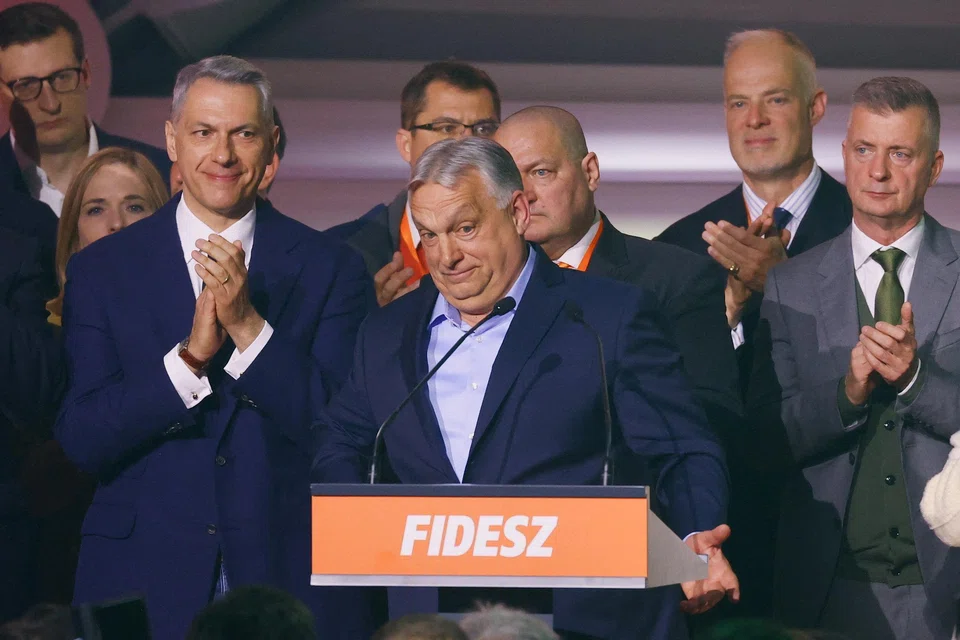
[BRUSSELS] Viktor Orban has long been a challenge and a frustration for the European Union, and his concession in Sunday’s (Apr 12) Hungarian election was greeted by top EU leaders as a potential moment for sea change after years of clashes between Brussels and Budapest.
“Europe’s heart is beating stronger in Hungary tonight,” President of the European Commission Ursula von der Leyen posted on social media as the votes came in.
Orban has often stood in the way of critical policy goals for the EU, including blocking a loan to Ukraine and sanctions packages targeting Russia. His administration has long been viewed as a security risk at sensitive meetings because of its comparatively cosy ties to the Kremlin.
With the victory of Hungary’s opposition party, led by Peter Magyar, that could begin to change.
Magyar and his Tisza party have struck a friendlier tone towards the EU and Nato alike. As voting was under way, he pointed out that it was taking place on the anniversary of a 2003 vote in favour of Hungary joining the EU – a potential signal that he wanted to break with Orban’s animosity towards Brussels.
Most immediately, the new leadership is widely expected to clear the path for a 90 billion euro (S$134.2 billion) loan to Ukraine that has been frozen for weeks because of Orban’s objections.
“The election result is a game changer for Europe,” said Mujtaba Rahman, managing director for Europe at the Eurasia Group, a political risk consultancy.
But Magyar also takes a sceptical view towards certain European policies.
At a time when the bloc is trying to cut its energy ties to Russia, he has indicated that while Hungary should wean itself from dependence, Russian imports need to remain an option. His party has also opposed some approaching changes to migration policies.

And there are many areas in which Hungary was just one divisive voice. Now other disagreements between member states on thorny issues that require unanimity – including EU expansion – may come into the open.
“It makes things easier: You don’t have the systematic blackmail,” said Eric Maurice, a policy analyst at the European Policy Center, referring to the frequent obstacles that Orban has mounted. “But it doesn’t make things easy.”
End of a difficult era
The Orban government has been complicated for European officials to navigate, as with the 90 billion euro loan to Ukraine.
European leaders agreed to make the loan late in 2025, and Hungary allowed the plan to pass. But Orban and his party shocked Brussels by stopping the loan in February, citing Ukraine’s slowness in fixing a pipeline that crosses Ukrainian territory before delivering Russian fuel to Hungary and Slovakia.
The holdup was seen as positioning before the Hungarian election, in which Orban’s party, Fidesz, took an openly anti-Ukraine and anti-EU line. Fidesz plastered unflattering images of President Volodymyr Zelenskiy of Ukraine on billboards across Hungary, blaming him and the European Union for rising unemployment and stagnant growth, and accusing them of trying to take Hungarian money.
Orban has also posed a regular hurdle to efforts to cripple the Russian economy with sanctions, often using Hungary’s veto as leverage to gain carveouts or access to funding from Brussels.
The Orban government has been a challenge for EU officials in other ways, as well, as when it decided to ban a Pride parade in 2025.
Most recently, Orban’s Fidesz party has become the subject of intense scrutiny and censure over leaks to Russia. The European media reported that members of Orban’s government had been sharing information from EU meetings with the Kremlin.
Working more seamlessly with Brussels could prove lucrative for Hungary.
Magyar is likely to try to unlock billions of euros worth of funding that have been frozen by Brussels, including a roughly 10 billion euro grant package that requires action by the end of August. Hungary is also working towards 16 billion euros in rearmament loans.
Orban’s defeat also means that the European Union is losing perhaps its most ardent internal critic.
In the run-up to the election, Orban’s camp had insisted that the EU was meddling in the vote, often making claims with little evidence.
The administration of US President Donald Trump embraced that line, with Vice-President JD Vance accusing Brussels of “one of the worst examples of election interference I have ever seen or ever even read about” during a visit to Budapest last week.
EU officials denied the accusations. As voting took place, they avoided commenting on the election, wary of playing into the narrative of interference.
“I always find it strange that a vice-president of the European Commission cannot comment on elections, while the US vice-president will comment on the election and the campaign,” Stephane Sejourne, vice-president of the European Commission, said last week.
As news of Magyar’s victory broke on Sunday night, EU leaders embraced the change.
“Hungary’s place is at the heart of Europe,” Roberta Metsola, president of the European parliament, wrote on social media Sunday night. NYTIMES
Decoding Asia newsletter: your guide to navigating Asia in a new global order. Sign up here to get Decoding Asia newsletter. Delivered to your inbox. Free.
Share with us your feedback on BT's products and services
TRENDING NOW

Once staunchly pro-China, Malaysian Chinese businesses are now distancing themselves from Beijing

Looking beyond looming CEO succession, should UOB potentially pursue a transformative merger?

Could stablecoins be the future of money?

Grab CEO’s wife Chloe Tong on life with Anthony Tan and finding her purpose

