



PIL earnings drop 21.7% to US$1 billion in 2025 amid lower freight rates
But its principal business of container shipping posts a 1.2% marginally higher revenue of US$3.8 billion

[SINGAPORE] Pacific International Lines (PIL) reported on Wednesday (Apr 29) a 21.7 per cent drop in net profit to about US$1 billion for 2025, amid lower freight rates.
Revenue was US$4.3 billion, 0.8 per cent lower year on year.
However, its principal business of container shipping posted a 1.2 per cent marginally higher revenue of US$3.8 billion.
This was supported by a 17 per cent year-on-year increase in volumes to about 2.6 million 20-foot-equivalent units, and a high vessel utilisation rate in key trade corridors.
Container shipping posted lower earnings before interest and tax (Ebit) of about US$1 billion, down 21.7 per cent from US$1.3 billion in 2024, with Ebit margin moderating to 27 per cent from 35 per cent.
In comparison, Danish logistics heavyweight Maersk’s shipping Ebit margin was 4 per cent in 2025, according to data provider Alphaliner.
Taiwan’s Wan Hai’s was 23.7 per cent and Yang Ming’s, 9.1 per cent. South Korea’s HMM’s was 14 per cent, Japan’s Ocean Network Express’ was 2.7 per cent and Israel’s Zim’s was 12.8 per cent.
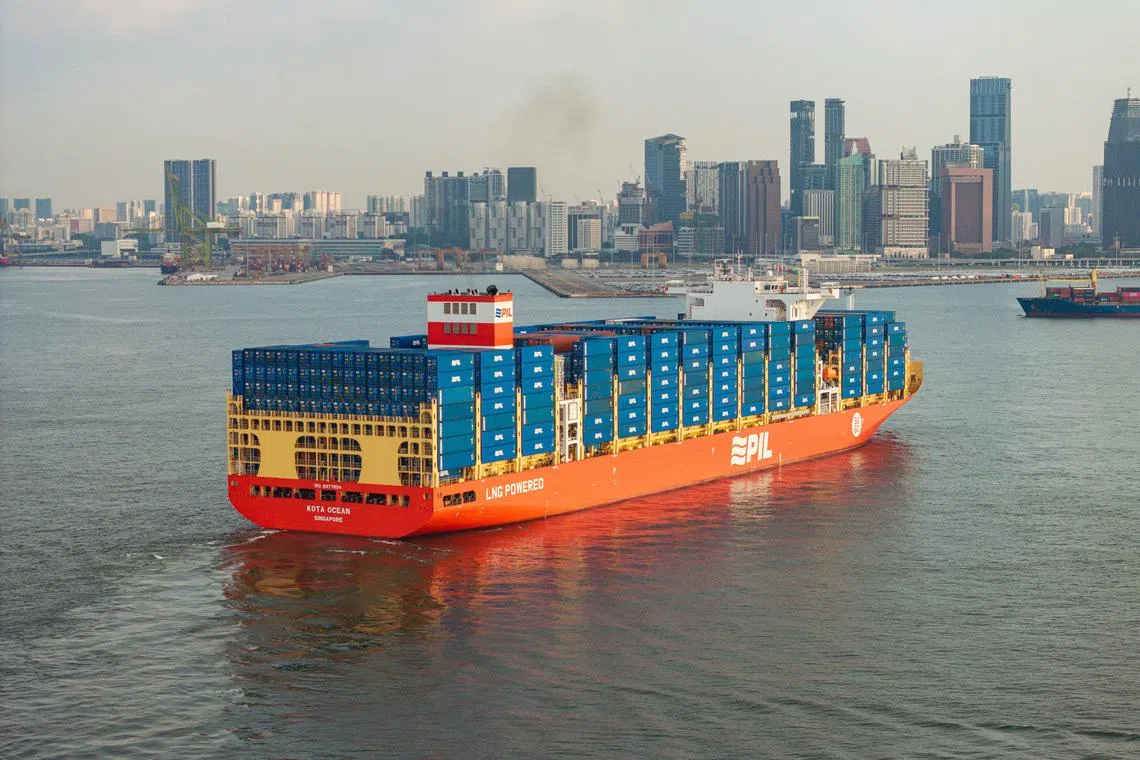
PIL is the world’s 12th-largest container shipping line, operating a fleet of more than 100 container vessels. Small and medium-sized shippers and forwarders are its typical customers.
It serves Asia, Africa, the Middle East, Latin America, Oceania and the Pacific Islands with a variety of products, including dry, refrigerated, breakbulk and special cargo.


Breakbulk is a maritime shipping method for transporting oversized, heavy, or specialised cargo that cannot fit into standard shipping containers.
The privately held, Temasek-backed PIL also owns a 41.7 per cent controlling stake in Hong Kong-listed container manufacturer-seller-lessor Singamas Container.
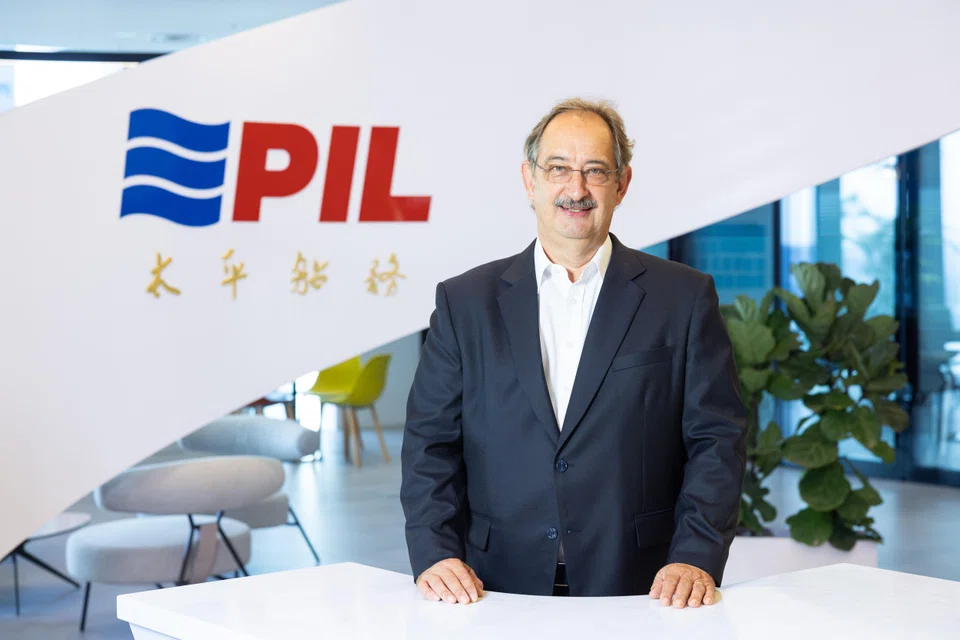
Lars Kastrup, CEO of PIL, told The Business Times in an exclusive interview that its strong cost discipline and flexible deployment of vessels contributed to the 2025 financial performance of the home-grown company that was founded 59 years ago.
Upsizing its ships helped improve economies of scale for both cost and fuel, he said.
Going direct from one port to another is another way to control costs as this helps to reduce additional feeding and handling charges associated with transhipping. “Customers also prefer that,” Kastrup added.
Transhipping is transferring cargo from one ship to another, often via an intermediate hub, to reach its final destination.
In addition, adjusting the deployment of vessels to market developments such as to routes where demand and freight rates are more favourable allows PIL to optimise vessel utilisation in the most profitable manner.
All of PIL ships were deployed in 2025 and each was completely filled up, he noted.
PIL is expanding its presence from China to South-east Asia and from Asia to South Africa, with new services added or to be added.
“We are taking delivery of bigger ships, and then we can cascade some of the smaller ships into Asia and Africa,” said the CEO.
PIL has 20 vessels on its order book, which will be delivered through to 2028. It will fund these new liquefied natural gas dual-fuel vessels by internal resources and bank loans.
“Acquiring our new ships... allows us to ensure that we continue to be (on a) par with our competitors (in terms of) economies of scale... which is critical for our competitiveness.”
Geopolitics and challenges
Although PIL was not directly affected by US President Donald Trump’s tariffs that were unveiled in April 2025 as it does not serve the US market, Kastrup said there was a temporary impact arising from higher supply when some of the vessels plying the Asia-US lanes diverted to those that PIL serves.
Carriers that ply the Asia-US and Asia-Europe trade lanes, meanwhile, have mostly chosen to continue to reroute via South Africa, as the threat of Yemen’s Houthi militants attacking merchant ships in the Red Sea persists.
This and congestion in some ports took out about 15 per cent of capacity from the industry.
Capacity has dropped by a further 5 or 6 per cent now that some vessels are stuck in the Gulf due to the US-Israel attacks on Iran beginning from Feb 28. For example, PIL’s feeder ship that plied the Dubai to Iraq route has halted operations and is now idling at a safe place.
Consequently, about 20 per cent of global capacity is inactive due to these disruptions, which mitigates the oversupply imbalance and helps to support freight rates.
Cost of fuel constitutes 50 per cent of PIL’s total cost now – up from 30 per cent – after fuel prices doubled, when compared with the first quarter.
Globally, fuel prices have surged after the de facto closure of the Strait of Hormuz, which upended 20 per cent of global oil volume that would normally flow through it.
Asia is hard hit as the region is highly dependent on Gulf imports. PIL does 60 per cent of its refuelling in Singapore.
Although PIL does not hedge, it buys 50 per cent of its expected fuel usage for a month or two ahead. It has also been able to recover the surge in fuel cost from customers for April and May.
Kastrup is confident that Singapore, the world’s largest marine refuelling hub, will not see a dry spell in fuel supply. However, he flagged the possibility of the industry having to take some ships out of service. The measure of cutting capacity is one that some airlines have already taken in response to higher jet fuel prices.
“We haven’t done that, but then eventually the shipping lines would have to start thinking like the airlines, but we’re not there yet. We don’t expect to be there for... the foreseeable future, but who knows.”
He also flagged an oversupply in the industry in the years ahead as new ships roll off the yard, but explained the need for the orders.
“As an industry, we are taking care of our own destiny by continuing to invest in new tonnage to be able to deliver decarbonisation and fuel economy.”
Decoding Asia newsletter: your guide to navigating Asia in a new global order. Sign up here to get Decoding Asia newsletter. Delivered to your inbox. Free.
Copyright SPH Media. All rights reserved.
TRENDING NOW

Britain’s mansion tax shows the difficulty of targeting wealth

Once staunchly pro-China, Malaysian Chinese businesses are now distancing themselves from Beijing

The only common thing in S-E Asia is that we all eat rice: Cisco’s Asean president

Singapore data centre operator DayOne opts for US IPO at likely US$20 billion valuation

