Prolonged lockdown in China will exacerbate already volatile supply chains
With workers confined to homes or quarantine facilities, disruptions are inevitable

Singapore
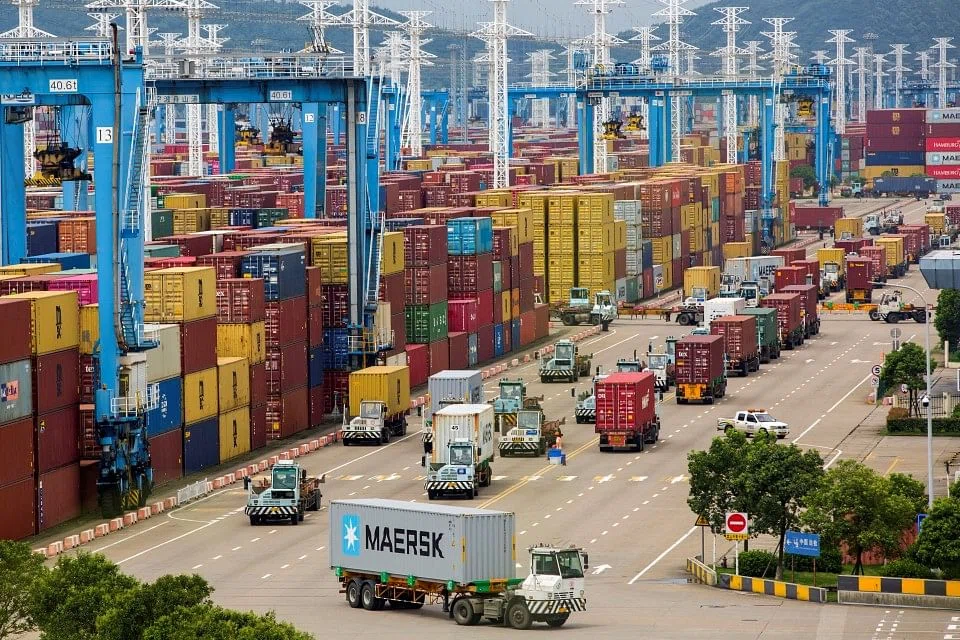
POTENTIAL price hikes and delays are on the cards for already-battered supply chains even as China keeps its ports open, eases lockdown rules and initiates bubbles to allow production to continue.
A key chokepoint is the manpower shortage, as residents are redirected to quarantine facilities or confined to homes as part of lockdown measures.
The Shenzhen Daily reported on Mar 18 that some residents in a Shatou subdistrict in Futian District were relocated for centralised quarantine and health monitoring for 14 days. This is even as a handful of districts achieved "community-wide Covid-19 dynamic clearance" and were allowed to resume work and public transport.
"Ocean freight ports and terminals are currently still operating but ports can't operate with just ships coming in. They need workers and truck drivers to move products out of warehouses. With workers being confined to their homes, disruptions are imminent," said Henry Ko, managing director, Asia, for freight forwarder Flexport.
The air freight front is seeing "less immediate impact" but "with staffing becoming a growing concern, that's expected to change soon," said Ko.
He added that many factories are closed. Of those that are open, many are unable to operate fully as their industrial parks may bar third-party truckers from outside of their home city to enter and pick up goods.
Some companies, such as iPhone maker Foxconn Technology, had earlier opted for isolation bubbles, similar to those used at the Winter Olympics in Beijing.
Meanwhile, Reuters reported that other firms such as US chip firm and Apple Inc supplier ON Semiconductor was closing its manufacturing facility in Shenzhen from Mar 14 to 20.
Maersk said in an advisory on March 17 that while trucking service is still available "for now" - provided that drivers hold a negative Nucleic Acid Test (NAT) report requested by local governments - they foresee trucking service between Shenzhen and nearby cities to be severely impacted by 40 per cent due to stricter road control and frequent testing.
"Consequently, there will be longer delivery time and possible rise in transport costs such as detour fee and highway fee," it said.
Ko added: "It's fair to assume that cargo originating in Shenzhen will remain in place for at least 1 week. We may see further worsening of supply chains issues, with even more price hikes and delays."
Meanwhile, Ng Yi Ying, founder & chief executive officer (CEO) of AllSome, an e-commerce fulfilment and logistics platform for online sellers, said they are expecting delays of between 2 to 4 weeks, "more or less the same compared to previous lockdowns".
"Customers are experiencing delays from the manufacturing and logistics fronts," said Ng. "Some clients have started to reroute fulfilment from China to Malaysia - this is applicable for clients who have already distributed their inventory before the lockdown. (But) this is not the first time, so the experience has been painful but customers are relatively calmer."
Online container marketplace Container xChange expects the lockdowns in China to further reduce capacity and cause a surge in already inflated shipping prices. For now, the impact on container prices has been limited.
According to their data, average prices for a 40-foot high cube (HC) container fell from US$5,930 on Feb 14 to US$5,170 on Mar 16 at the port of Ningbo. Average prices at the port of Qingdao fell from US$5,420 on Feb 26 to US$4,884 on Mar 16.
"For the next few weeks, it really depends on how the pandemic lockdowns pan out. The rising prices are a confluence of so many factors that it has become a challenge to attribute it to one single cause," said Container xChange's co-founder and CEO, Dr Johannes Schlingmeier.
"There is an impact of the pandemic, which has caused greater volatility in the market. Not just this, the war (between Russia and Ukraine) has also posed a geopolitical challenge for forecasting."
He pointed out that while only 2 per cent of goods shipped between Asia and Europe go by train, these are high-margin goods such as car parts and computers. "Now, many corporations and logistics companies have stopped using the popular rail network that moves through Russia to get goods from China to Europe.
"The burden of which will fall back upon sea transportation. This might cause a little more chaos to the already tight, zero-capacity shipping scenario."
Decoding Asia newsletter: your guide to navigating Asia in a new global order. Sign up here to get Decoding Asia newsletter. Delivered to your inbox. Free.
Copyright SPH Media. All rights reserved.
TRENDING NOW
He built the Vingroup empire. Now South-east Asia’s richest man is handing some key roles to his sons
Quarter of Singtel special discounted shares sold ahead of CPF Board transfer
Why Tan Aik Keong of digital solutions specialist Agmo wants to make himself less indispensable
Asia needs new energy security architecture