



Resilient aluminium prices set to boost Asia’s smelters over global rivals: analysts
Cheaper power and easier access to raw materials can benefit low-cost producers in China, India, Indonesia
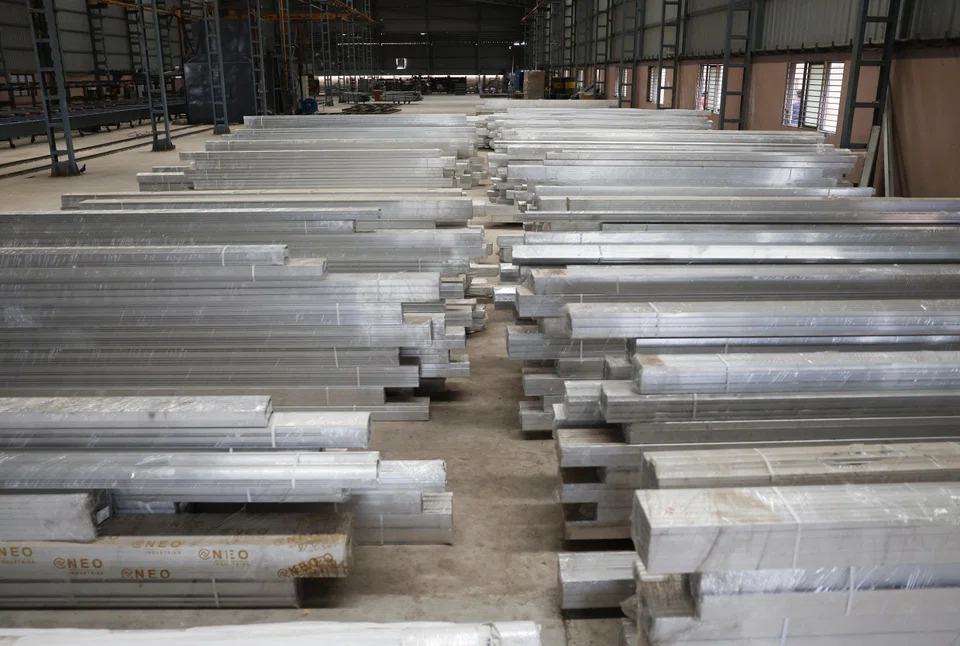
[SINGAPORE] Higher aluminium prices could position low-cost smelters in China, India and Indonesia to sustain stronger margins than their global counterparts, industry observers told The Business Times. This is given that cheaper power and relatively competitive raw material sourcing in these Asian countries present these companies an advantage.
That could strengthen Asia’s grip on the supply of aluminium to industries such as construction, electric vehicles and renewable energy, and better enable its low-cost producers to expand and forge long-term customer relationships, they added.
Although the industrial metal’s price has retreated from a four-year high on the expected return of Middle Eastern supply, analysts noted that prices are likely to remain elevated in the near term.
The metal’s roller-coaster ride
Between Feb 27 – the day before the US launched strikes on Iran – and Jun 2, London Metal Exchange aluminium prices advanced 19.5 per cent to a four-year high of US$3,752.50 per tonne. Since then, the metal has shed 17.6 per cent to US$3,091.50 per tonne on Thursday (Jul 2).
Aluminium’s breakneck rally was largely driven by supply concerns amid the US-Iran war.
While the Middle East accounted for around 9 per cent of global aluminium supply last year, exports hit a decade-low in April following damaged smelting facilities and the closure of the Strait of Hormuz.
Disruptions linked to the conflict have removed an estimated three million tonnes of production from the market, noted Ewa Manthey, a commodities strategist at ING.
Meanwhile, China’s ability to further increase supply also appears limited, she added.
Manthey pointed out that the country’s annualised production is already running at around 46.7 million tonnes, exceeding the government’s 45 million tonne capacity cap.


Thus, she forecasts a 1.8 million tonne global aluminium deficit this year.
Oriano Lizza, sales trader at CMC Markets Singapore, expects aluminium prices to stay elevated, averaging near US$3,500 per tonne through the second half of this year.
Who benefits from elevated prices?
Analysts noted that higher aluminium prices favour low-cost smelters in the Asia-Pacific that can maintain their output while managing expenses.
“Apac producers are better-positioned than many global peers because their cost bases are less exposed to imported gas and spot raw-material volatility,” said Fitch Ratings in a research note.
Nitin Soni, head of natural resources for South and South-east Asia at Fitch Ratings, pointed out that the margins of South-east Asia’s aluminium smelters seem “reasonably resilient at least in the near term, given structurally lower power costs and relatively competitive alumina sourcing”.
He added that producers are unlikely to voluntarily lower prices on higher margins for consumers, as pricing is largely determined by global benchmarks and not by an individual company’s cost position.
However, advantages could flow towards major downstream manufacturers.
Lizza noted that cash-rich producers would be able to offer better long-term contract terms and invest in higher-value products, catered to high-volume customers.
He expects demand to be supported by electric vehicle and automotive makers, who use around 5.5 million tonnes a year, as well as “politically favoured” renewable-energy and grid developers, in China and India.
Construction remains the largest aluminium-consuming sector, using around 12 million tonnes annually, and any recovery in the China property market would provide a further lift to demand, he added.
Strong margins for Asia’s smelters
Aluminium is produced by first refining bauxite ore into alumina, a white, crystalline powder. This alumina is then smelted via electrolysis to extract the metal.
Ian Roper, commodity strategist at Marex, said that the main differentiator in aluminium smelter margins nowadays are “power costs and, to some degree, raw materials integration”. The latter includes companies owning their own low-cost bauxite or alumina supply.
“Indian smelters are generally well-positioned on both fronts, benefiting from relatively competitive power costs and integrated raw material supply,” noted Roper. “Chinese smelters are more variable, with some very low cost but others at the higher end of the cost curve.”
He added: “The new Indonesia smelters, once fully operational in the coming years, are likely to be very low-cost; hence the push to expand capacity there.”
Karen Norton, associate director for aluminium and non-ferrous markets research at S&P Global Energy, similarly said that the integrated nature and typical access to abundant and low-cost power are competitive advantages for aluminium smelters in India, China and, increasingly, Indonesia.
“This puts them at an advantage relative to not just regional peer Australia, with its high-cost operations that have been threatened with closure, but also Europe and the United States where swathes of smelter capacity have remained idle for many years due to high energy costs,” she added.
CMC Markets Singapore’s Lizza concurred. “What sets Apac apart is the cost stack: captive bauxite, alumina, and power that European and Gulf rivals cannot quickly rebuild,” he said.
But, Soni noted that stronger margins could normalise from recent highs if raw material costs rise faster than aluminium prices.
Spillover effects
Robust margins for Asia’s aluminium producers could attract new investments to increase smelting capacity and accelerate decarbonisation initiatives, noted analysts.
Fitch Ratings said that the power mix of smelters such as China Hongqiao and the Aluminum Corporation of China, which consists of around 40 per cent and 55 per cent of renewable energy, respectively, supports competitiveness.
Lizza added that this positions Apac producers to capture the emerging low-carbon aluminium premium.
Norton of S&P Global Energy said: “The end result could be a supply glut, although this would put greater pressure on smelters at the high end of the cost curve, and in many cases that would mean closures in other regions.”
Fitch Rating’s Soni highlighted that decarbonisation initiatives are being implemented in Indonesia, where several companies such as Inalum, the country’s largest state-owned aluminium smelting company, are investing in building new capacities.
“However, the pace of (increasing) aluminum smelting capacity has been slower than expected,” he said.
Ultimately, demand continues to outpace aluminium supply. “There are many demand drivers for aluminium,” noted Roper.
“While EV production in China is showing some weakness this year, power grid investment, renewable energy investment and storage batteries continue to see strong growth.”
He added that even as aluminium demand may lag behind copper, it is still growing at a “much faster pace” than other construction-oriented metals such as steel and zinc.
Decoding Asia newsletter: your guide to navigating Asia in a new global order. Sign up here to get Decoding Asia newsletter. Delivered to your inbox. Free.
Copyright SPH Media. All rights reserved.






