



Seeking shelter from war and stagflation? Take a look at China’s bond market
Chinese debt markets have drawn US$2.5 billion of foreign inflows in March
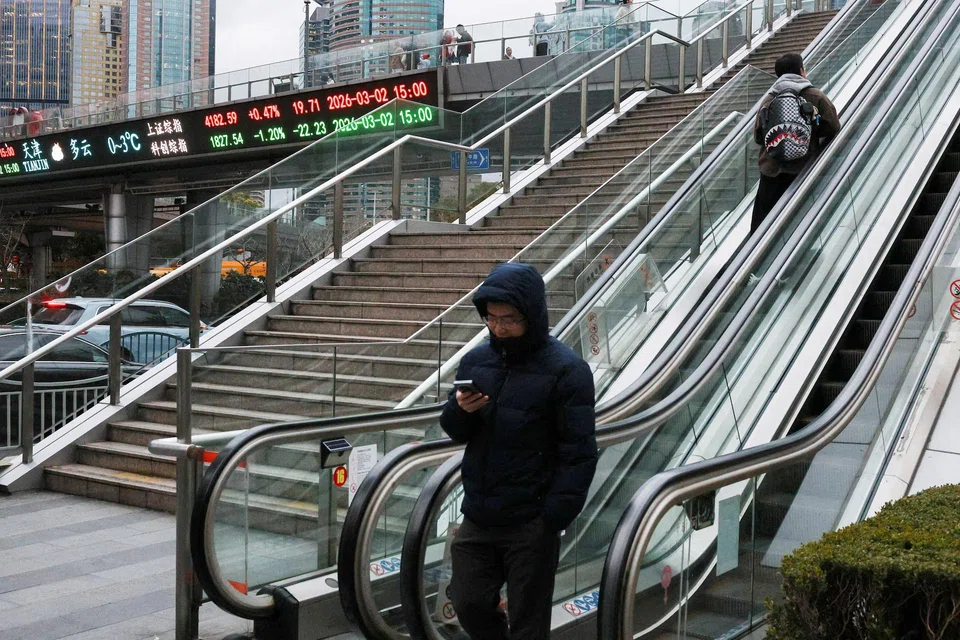
[SHANGHAI/HONG KONG] Investors are scooping up Chinese debt, which has stood tall in sliding bond markets globally, betting that China’s low inflation and preparedness for an oil shock allow it to resist raising interest rates.
It is driving inflows where there is selling in other emerging markets and a steeper yield curve that contrasts with flattening in the US and other major economies, where surging energy prices have stoked rate-hike speculation.
“If you look at other economies, people are trading stagflation,” said Zheng Lianghai, bond fund manager at Fuanda Fund Management, pointing to spikes in US and Japanese treasury yields. “This is not happening in China.”
Instead, investors see soft consumption keeping a lid on inflation expectations through the crisis while oil reserves and a power grid run on coal and renewables shelter industries and consumers from spiking fuel prices.
Chinese debt markets drew US$2.5 billion of foreign inflows in March despite the US and Israeli war on Iran, a sharp contrast from the US$16.7 billion in outflows from other emerging markets, according to the Institute of International Finance.
The phenomenon is reflected in yields, which move inversely to prices, with one-year Chinese government bond yields down to a 15-month low, while the rise in short-term yields in markets from Australia to Europe and the US was the steepest in years.
In money markets, China’s overnight pledged repo rate – a key gauge of liquidity – dropped to its lowest level in 2½ years.
China’s stocks and currency have also drawn investor attention in recent weeks, as they have also held up well where other assets have suffered.
“(Chinese government debt) is a safe haven in the current environment – a unique combination of global energy supply shock and China’s domestic resilience,” said Louis Luo, deputy head of macro investments at Aberdeen Investments.
SEE ALSO




Steepening yield curve
The flipside of short-dated buying has been a pause in a yearslong rally at the longer end, meaning the yield curve – the difference between short and long rates – has gotten steeper.
“In the short term, we can bear the impact better than others, but if oil stays very high for long it will still lift inflation,” said Lin Sheng, chief investment officer at Shenzhen-based Wish Fund.
“If the war doesn’t end soon, avoid long-dated bonds.”
It would be natural for large fund managers to “buy mainly three- to five-year bonds and stay cautious on 30-year tenors,” bond trader Wang Hongfei said.
The yield spread between China’s 30-year and one-year bonds widened to 1.16 percentage points last week, the biggest gap since August 2023. In other markets, traders have been racing to sell short-dated debt as bets on steady or lower rates are priced out in favour of hikes, while fears of a hit to longer-run growth has weighed on longer-dated debt.
The gap between 10-year and two-year US Treasury yields actually narrowed slightly in March.
To be sure, China is not immune from the inflationary wave that has been unleashed by higher fuel costs. Factory gate inflation turned positive in March after three years in negative territory and investment banks have scaled back small rate-cut expectations.
And, relative to the rest of the world, Chinese yields are very low, meaning the income paid to investors is small.
But many in the market believe China’s subdued housing sector and soft consumption are keeping downward pressure on yields and short-term rates long after the oil shock subsides.
“There’s no sign of monetary tightening ... and expectation is low for the PBOC (People’s Bank of China) to turn hawkish,” said Ji Yu, a strategist at AllianceBernstein.
And for some, stability is reason enough to invest.
“China’s bond market is relatively stable and lowly correlated with global markets,” said Zhu He, a research fellow at the CF40 Institute, a think tank.
“The trend of yuan appreciation also lures some global capital into China’s bond market, increasing its safe-haven appeal.” REUTERS
Decoding Asia newsletter: your guide to navigating Asia in a new global order. Sign up here to get Decoding Asia newsletter. Delivered to your inbox. Free.
Share with us your feedback on BT's products and services
TRENDING NOW

Britain’s mansion tax shows the difficulty of targeting wealth

Once staunchly pro-China, Malaysian Chinese businesses are now distancing themselves from Beijing

The only common thing in S-E Asia is that we all eat rice: Cisco’s Asean president

Singapore data centre operator DayOne opts for US IPO at likely US$20 billion valuation

