
Serving up Singaporean flavours in London
Singapulah and Old Chang Kee UK bring Singapore classics to the UK

[LONDON] Since opening in February, London restaurant Singapulah has not just brought a taste of Singapore to the British capital, but also helped its ingredient suppliers strike deals.
The three-storey, 100-seat restaurant serves classics such as nasi lemak and char kway teow. Mosaic tiles, dioramas and photos of the city-state decorate the space, while a chessboard-topped table evokes those in public housing void decks.
In the basement, shelves laden with tins of Milo, classic sweets, old-school games and other memorabilia slide open to reveal more seating space.
“South-east Asians should walk in and feel at home,” said Jay Sim, business development director of restaurant group Chew On This, which owns Singapulah.
But the decor hopefully stirs curiosity in those new to Singapore too, he added.
Sim and Ellen Chew, founder of Chew On This, aim to elevate representation of Singapore’s culture and cuisine, and to be a bridge between UK distributors and Singaporean food manufacturers.
Bringing brands abroad
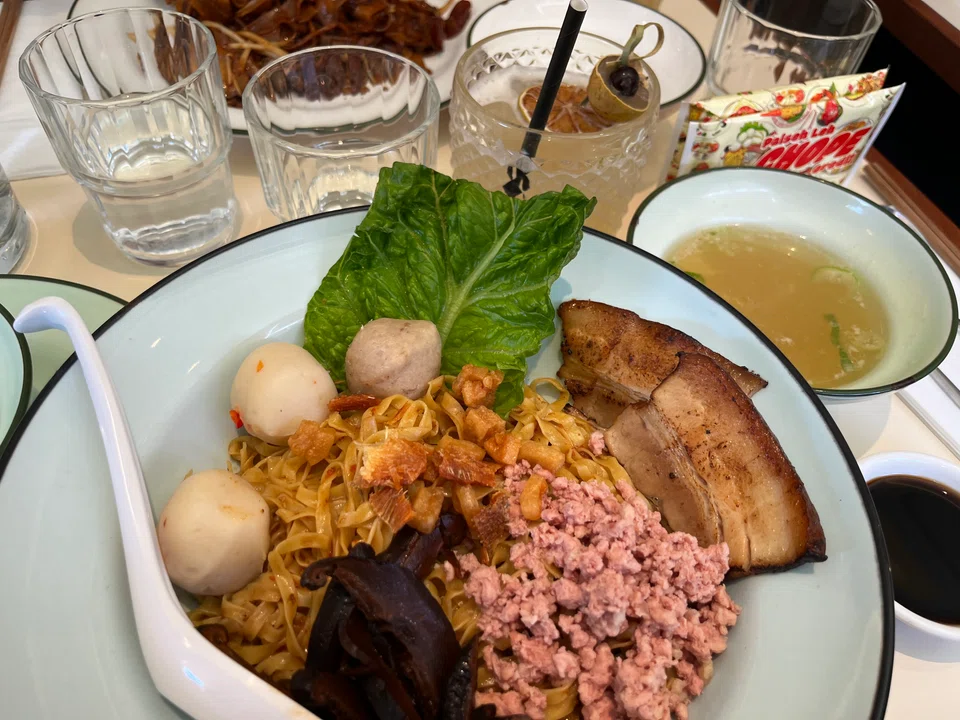
Singapulah’s menu highlights the food manufacturers whose ingredients feature in each dish. For example, its bak chor mee is made with mee pok from Hiap Giap, sauces from Kwong Cheong Thye and fishballs from DoDo.
Inspiration struck in September 2023 when Chew and Sim were at a Singapore trade show, shopping for produce for Rasa Sayang, Chew On This’ restaurant serving cuisine from Malaysia and Singapore.
They saw bare-bones preparations – “noodles and soya sauce” – and took brochures, but believed that there was a better way to showcase such products. Learning that many food manufacturers were interested in expanding into Europe, they decided to provide a platform for them in Singapulah.
Singapulah’s menu will change every six months, apart from a few permanent dishes. This gives a longer period of exposure for manufacturers, in contrast to days-long trade shows.
Said Sim: “(We) then bring down the buyers and distributors, to sit down and eat the food, and talk them through the menu and the products.”
Singapulah has already facilitated over 20 connections between food manufacturers and four distributors in the UK. From March to May, these distributors placed 10 trial orders for 11 products.
Singapulah’s first menu features 13 food manufacturers. Its next is planned for September, with eight to 10 new manufacturers.
On top of business deals, some of these products can also be bought off the restaurant’s shelves. Singapulah also features several Singapore retail brands in-store. Currently, there are a total of 44 Singapore products on its menu and its shelves.
Finding its place
Singapulah is located where Chinatown, Soho and the West End meet, on what Sim calls “the busiest high street, possibly, in London”. Its dishes are priced to be competitive with other eateries in the area, with mains between £14.95 (S$26) and £16.95.
Said Chew: “I want people to understand that there is a premium product here we’re selling, but at the same time, it’s still affordable.”
Its early customers were Singaporeans who missed the taste of home, and later brought their Western friends. An interview with a Hong Kong food vlogger brought in tourists from that market, while marketing efforts on social media app Xiaohongshu attracted Chinese diners.
From its opening in mid-February to April, Singapulah saw more than 19,000 diners, averaging 7,600 a month.
Yet it has also faced challenges. To meet customs regulations in the UK, some manufacturers had to tweak their recipes to omit banned ingredients or change to approved sources.
Crises such as the Russia-Ukraine War and the Red Sea conflict continue to affect shipments from Asia, causing two to three-week delays, said Chew. “Some things we actually have to air freight here, because we know that without these ingredients, there’s no way you can call this a Singaporean restaurant.”
As shipping costs rise, air freight has become a viable alternative for certain items, she noted. While it previously cost about £1,500 to ship one container, this has trebled to £4,500 in the wake of ongoing conflicts.
Familiar, yet new
Just a 10-minute walk from Singapulah is hometown staple Old Chang Kee, with its familiar yellow facade and a small seating area.
Old Chang Kee outlets in Singapore are ubiquitous and positioned as kiosks for quick snacks – but not in the UK, said Sandra Leong, director at Old Chang Kee UK.
“From the outset, I think we’re very clear that people’s habits here are different,” she said. “People here don’t really snack.”
Old Chang Kee UK – a joint venture between Leong and Old Chang Kee Singapore – was therefore established as a quick-service meal concept.
Its first outlet opened at Covent Garden in June 2018, followed by a second at Goodge Street in December 2019. Both offer “the best of” Old Chang Kee’s Singapore selection alongside dishes from subsidiary Curry Times, such as chicken curry.
“It’s geared very much for high volume, in-and-out,” explained Leong, with most customers getting their food to go.
Leong’s motivation to bring Old Chang Kee to London was two-fold. She believed that the curry puff would take off as it combines pastries and curry, two things the British already know and love. Operationally, Old Chang Kee also had both the means and intention to enter more overseas markets.
Key ingredients, such as rempah for the curry puff fillings, are manufactured in Singapore and imported.
Said Leong: “Those are the most important parts. And actually, those are the ingredients that you probably will struggle to find here, because you might not get the same quality of chillies and South-east Asian spices.”
Importing these components means that for many dishes, about 70 per cent of the work is already done, making the business easier to run, she added.
Old Chang Kee UK has adapted its offerings for the UK palate without “stray(ing) from the classic flavours”. Curry puffs are bigger to account for larger appetites, and most customers order one alongside a main, or two as a meal.
There are also UK-only creations such as the beef rendang puff, a “good entry point” for those familiar with the cornish pasty, a similar British pastry; and satay noodle salad with chicken, inspired by the common British meal of chicken salad.
The Covent Garden outlet sees consistent footfall from tourists, shoppers and theatre-goers. At Goodge Street, in contrast, demand peaks at weekday meal times due to surrounding offices. By the end of this year, Leong hopes to open a third branch in a financial district.
Ahead of further expansion, Old Chang Kee UK partnered a central production facility in the first quarter of this year, where much of the food preparation is done before being finished at its two outlets.
“That’s the way that we see we have to go in order to scale up,” said Leong.
Diversified revenue streams
Old Chang Kee UK is also tapping the office segment. Office catering orders are growing post-Covid, as businesses order lunches to reward working from the office.
“Monday to Friday, before we even open our doors, we’re already sending out hundreds of portions of meals,” said Leong.
At its next outlet in a financial district, Leong hopes that the recognition created through office catering will also lead to walk-in orders from office workers.
For now, Leong has no plans to open outlets beyond London, where there are “lots more opportunities”.
During the pandemic, however, Old Chang Kee dishes made it to other parts of the UK in the form of at-home meal kits. This remains a revenue stream, though demand has tapered off, said Leong. “But it’s worth the brand-building that we can achieve, by extending our reach.”
About 70 per cent of Old Chang Kee UK’s revenue is from walk-in customers, 20 per cent from delivery orders, and 10 per cent from catering and meal kits.
To grow its customer base, Old Chang Kee UK recently launched its own delivery service and loyalty programme.
Besides marketing through newsletters and social media, it has collaborated with other brands. In one such tie-up, London ramen chain Bone Daddies used Old Chang Kee’s laksa broth as a ramen base, and Old Chang Kee incorporated the noodle joint’s katsu curry into a puff.
Revenue for Old Chang Kee UK grew 20 per cent year on year for the latest financial year which ended in March, despite industry-wide challenges such as the Suez Canal disruptions.
“Shipping costs have gone up, shipping time has gone up,” Leong said. She estimates that prices are up at least 20 per cent and transit times have risen to 40 to 45 days “if you’re lucky”, from 28 days before.
Most affected are items not commonly used in the UK, such as ikan bilis and dried shrimp, which need to be shipped from places such as Thailand and Vietnam. “Sometimes, even if you want to pay those prices, you cannot get the product.”
Fortunately, having a central kitchen means more space in which to stockpile ingredients. A compact menu also leaves it less exposed to supply chain disruptions.
The question of manpower, however, may curtail growth. The company currently employs about 20 staff in the UK.
“There has been so much chopping and changing of immigration rules in the UK due to instability in political leadership, which means the talent pool keeps changing as well,” said Leong. “It makes planning difficult.”
Even as Old Chang Kee UK retains its Singaporean heritage, Leong hopes it can go beyond being a “novel” cuisine, and simply be seen as a reliable option for hot, savoury food in London’s cold climate.
“That would be a mark of our success, because it means that we’ve actually properly embedded ourselves into the food culture here.”
Enterprise Singapore sees opportunities for Singapore companies in the UK’s food and beverage (F&B) industry, which has turnover of about US$310 billion and US$150 billion in value-add each year.
It has a vibrant and international food scene, and there has been a desire – especially post-Covid – to be adventurous and try new things, said the agency’s director for Europe, Alan Yeo.
The agency has been helping businesses navigate regulations, find partners and secure premises.
For Singapulah, it offered joint funding support with the Singapore Brand Office, identified interested food partners, and supported it to set up. The agency also provided market contacts for Old Chang Kee to enter the UK, and is supporting its further expansion.
“We think it is the right time for our Singapore F&B and food manufacturers… to come and tap this need and want,” Yeo said.
Decoding Asia newsletter: your guide to navigating Asia in a new global order. Sign up here to get Decoding Asia newsletter. Delivered to your inbox. Free.
Copyright SPH Media. All rights reserved.
TRENDING NOW
Grab CEO’s wife Chloe Tong on life with Anthony Tan and finding her purpose
HDB reviewing ‘jumbo’ flat scheme after Telok Blangah unit listed for sale at S$2.18m
He built the Vingroup empire. Now South-east Asia’s richest man is handing some key roles to his sons
Singapore judge raises doubts iron ore trader Radiant World is owed US$1 billion