



Should investors ‘buy the dip’? How to invest as volatility rises amid Iran crisis
Analysts say it’s too early to do so, and recommend blue chips, gold, safe-haven currencies and selected industries

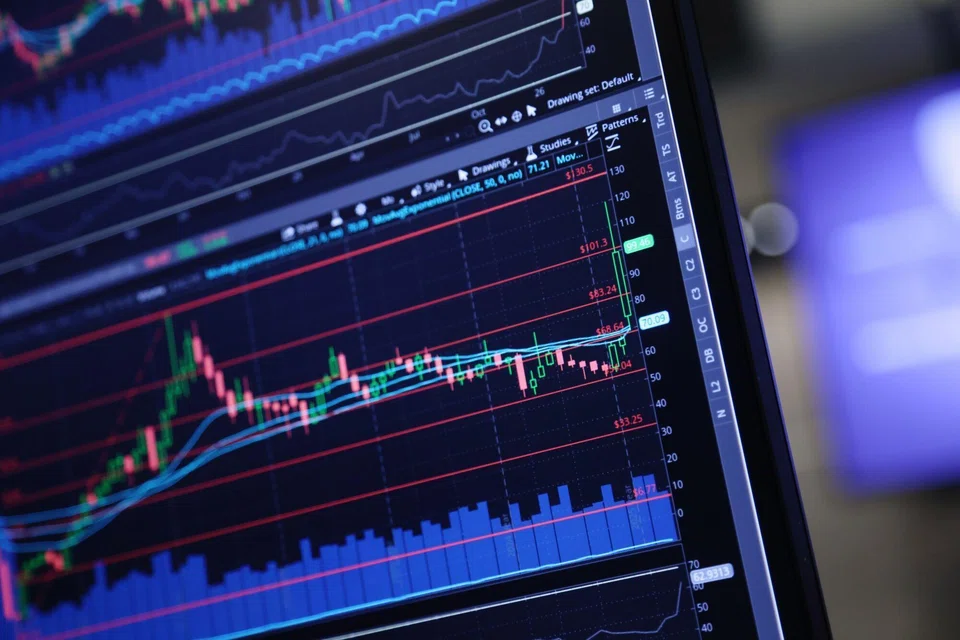
[SINGAPORE] Volatility has seized global markets amid ongoing military strikes and spikes in oil prices from the outbreak of the Iran war.
Stock markets everywhere have been upended by wild swings, and oil prices hit highs and then retreated to below US$100 a barrel in reaction to US President Donald Trump’s comment that the war could end “very soon”.
On Thursday (Mar 12), Brent oil surged past US$100 again when the announcement by the International Energy Agency on a record release of reserves failed to rein prices in. The US dollar has appreciated as well, with the USD/SGD pair at 1.2758 as at Thursday.
But military strikes are continuing in the Middle East; Iran fired back at Israel and other targets on Wednesday, even as at least three ships took hits in the Gulf.
In such unpredictable circumstances, how should investors navigate extreme fluctuations in present markets? Here is what industry players say.
Market dips
Across the globe, markets tumbled after US and Israel attacked Iran on Feb 28. In Asia, Singapore’s Straits Times Index, Japan’s Nikkei 225 and Hong Kong’s Hang Seng index are still significantly down compared to before the war.
The desire or reflex to buy the dip remains “strong” among investors, noted CGS International analyst Lim Siew Khee. “However, we think current macro conditions (such as an oil shock, combined with weak employment and sticky inflation) suggest caution until there is a genuine resumption of oil supply,” she said in a note on Tuesday.
This sentiment was echoed by Maurice Meijers, high-yield client portfolio manager at Robeco, who said it is “too early” to ascertain whether market dips are worth “buying into” right now.
“We will need to see a real repricing … (on top of) understanding how long the Strait of Hormuz will be closed,” he told The Business Times.

Around 85 per cent of the crude oil supply passing through the Strait of Hormuz now travels to Asian markets, noted CGS International’s Lim.
“This suggests that a US/China deal is also important to the war in Iran,” she said.
Chez Anbu, head of wealth advisory from OCBC, said that portfolio investors could pick up blue chips on dips – and increase exposure over time, under their drive for long-term growth.
He noted that investors with significant exposures to US tech plays could use this opportunity to undertake sectoral rotation and bolster this portfolio with cyclicals, such as energy and materials and defensives such as utilities.
“Investors can consider strategies to allocate to blue chips, focus on defensible dividends. At the same time, small and mid-caps may benefit from recent government initiatives,” he said.
Singapore, Asia markets
However, even amid the conflict, he still holds a “favourable view” of Asia ex-Japan markets, and in particular, that of Singapore’s.
“Singapore (markets) have outperformed global equities in the past five years, and it is seen as a regional safe haven backed by policy stability, a resilient economy and a steady currency,” he said on Wednesday.
CGS International analysts paint a more nuanced picture, one with varied consequences among industries in Singapore.
They wrote on Tuesday: “Sectors that could see increased demand arising from the conflict include aerospace and defence, energy producers and commodity players and logistics warehouse operators or landlords; supply-chain operators, hospitality players with exposure to the Middle East markets and e-commerce players could be adversely affected.”
Agribusiness and capital goods stocks such as Yangzijiang Shipbuilding , Sembcorp Industries and China Aviation Oil could face earnings upside risks on higher energy prices, or increased defence spending – if the situation is long-drawn.
“On the flipside, air and land transport stocks such as Singapore Airlines and SATS could be impacted negatively by higher fuel prices and cargo logistics disruptions,” the analysts said.
“Tech manufacturing counters such as Nanofilm , as well as Internet services, could be impacted by a stronger US dollar – on translation, or weaker demand.”
Gold
Observers said that gold’s strong, traditional quality as a safe-haven asset continues to be a significant draw to investors at this time.
Anthony Naab, investment strategist at Standard Chartered, is “overweight” on gold, with a three-month forecast at US$5,250 an ounce.
“While gold is currently benefiting from its tactical role as a geopolitical hedge, our base case remains that the conflict will be relatively short-lived,” he wrote in a Mar 6 report. “In that scenario, we would expect gold to be driven primarily by its structural trends, including portfolio diversification and central bank buying.”
This builds a case to buy gold on dips, given its position as “a structural hedge”, other analysts from the bank said.
Pullbacks from gold do not undermine its role as a hedge during geopolitical disruption, said Robin Tsui, Asia-Pacific gold strategist at State Street Investment Management. “The short-term gold price moves often reflect profit-taking, US dollar strength, or shifts in interest-rate expectations, even as underlying uncertainty remains elevated.”
However, Antonio Di Giacomo, senior market analyst at XS.com, said the gains by the precious metal may have been “limited” amid the strengthening of the US dollar and rising US Treasury yields.
“A stronger dollar typically acts as a negative factor for gold, as it makes the metal more expensive for investors holding other currencies and reduces its appeal as an investment asset,” he said on Wednesday.
The metal may therefore experience “limited upside” amid the strengthening of such US assets during the war.
“As investors await clearer signals on the evolution of the conflict and the trajectory of US inflation, the precious metal’s behaviour is likely to remain closely tied to movements in the dollar and expectations for the Fed’s monetary policy,” Di Giacomo said.
Safe-haven currencies
For defensive investors, the Singapore dollar is a “standout regional anchor,” said Isaac Lim, chief market strategist at moomoo Singapore.
“While the Singapore dollar has softened slightly against the US dollar amid global risk-off sentiment, some investors may view this as an opportunity to gradually build exposure to a stable, investment-grade currency over the longer term,” he told BT.
Other traditional safe-haven currencies such as the US dollar and the Japanese yen eyed by investors have drawn mixed views from analysts.
Lim from moomoo Singapore said: “The US dollar remains the world’s primary reserve currency and typically strengthens during global uncertainty as investors seek liquidity and safety.
“In addition, the US’ status as a major energy producer can provide some resilience during periods of elevated oil prices.”
Iris Yuen, investment strategist from Standard Chartered, said that the yen is unlikely to be the most reliable safe-haven currency in the current environment, given the region’s current volatility.
“Japan is among the world’s largest crude oil importers, sourcing around 95 per cent of its crude oil and 11 per cent of its liquefied natural gas from the Middle East,” she noted.
Considering that roughly 70 per cent of this oil passes through the Strait of Hormuz, the Asian country is particularly vulnerable to transit and supply risks.
The USD/JPY pulled back to 157.64 at one point, a note by Maybank Group Research said on Tuesday, following the dip in oil prices.
“(This) was driven by Trump ’s comments that the conflict would end ‘very soon’, with the operation “very far ahead” of its four to five-week schedule,” the analysts wrote.
Meanwhile, the USD/CHF pair has taken the spotlight, with the Swiss franc emerging as one of the more resilient currencies.
“Initially the pair strengthened after the US and Israel struck Iran, highlighting the safe-haven qualities of the CHF,” the Maybank analysts noted. “Given prevailing uncertainty, CHF resilience should persist as a safe-haven play.”
“One-sided CHF appreciation, however – especially against the euro – could very well be moderated by intervention from the Swiss National Bank,” they added.
Decoding Asia newsletter: your guide to navigating Asia in a new global order. Sign up here to get Decoding Asia newsletter. Delivered to your inbox. Free.
Copyright SPH Media. All rights reserved.
TRENDING NOW

Once staunchly pro-China, Malaysian Chinese businesses are now distancing themselves from Beijing

Grab CEO’s wife Chloe Tong on life with Anthony Tan and finding her purpose

Could stablecoins be the future of money?
ST Engineering opens tech-focused aircraft maintenance facility in Changi; to create over 500 jobs

