



Singapore, China should deepen cooperation in green transition, AI and ageing: Chee Hong Tat
He says closer collaboration could benefit both countries and the wider region

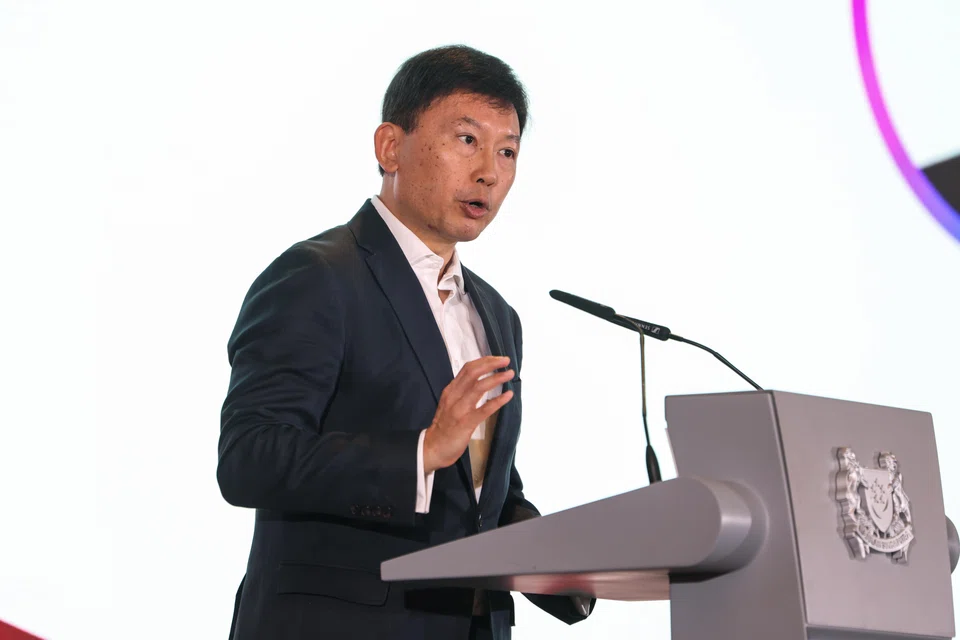
[SINGAPORE] The Republic and China should deepen cooperation in three areas to address the shared global challenges of climate change, technological advances and demographic shifts, Minister for National Development Chee Hong Tat said on Monday (Jul 6).
Speaking at the Lianhe Zaobao Singapore-China Forum, he said that these areas were in the green transition, artificial intelligence and robotics, as well as ageing.
He added that “no country has all the answers, nor the capacity and resources to act alone”.
In this spirit, Singapore and China can “look forward to continuing to expand and deepen our collaboration”, building on the strong foundation laid by previous generations.
“These bilateral partnerships need not stop at our borders – the lessons learnt and the solutions developed can ripple outward, benefiting the wider region and the world,” said the minister.
On the green transition, he called it “one of the most pressing tasks of our time as a global community”, noting that climate change affects all countries regardless of their geography, resources or stage of development.
“We thus share a common responsibility – to one another and to the generations that come after us – to build a more sustainable world,” Chee said, adding that accelerating the transition would also strengthen energy resilience.
He stressed that such efforts are not just national endeavours, as international cooperation will become increasingly important as demand for reliable and sustainable energy grows. Therefore, he said that there is much Singapore can learn from China in this field.
China, said Chee, has not only established itself as a global leader in renewable and clean energy technologies, but is also at the forefront of nuclear energy, including small modular reactors.

China’s capabilities in solar, wind and battery energy storage systems could also help strengthen regional energy resilience and advance decarbonisation through initiatives such as the Asean Power Grid, the minister noted.
At the same time, he said that Singapore can contribute its expertise in sustainable urban planning and integrated development.
This allows both countries to develop practical solutions that support their climate ambitions while contributing to a more sustainable future for the wider region.
Turning to AI and robotics, Chee explained that the focus should not be solely on whether AI will displace workers, but also on how it can create new jobs, improve productivity and prepare workers for emerging roles.
He pointed to Singapore’s built environment sector, where firms are using robotics and AI to boost productivity, reduce costs and free workers for higher-value tasks, while creating new specialist roles and opportunities for startups and technology companies.
Describing China as a “world leader in AI, robotics, and intelligent manufacturing”, Chee said that it has deployed these technologies at scale, across construction, logistics, and urban infrastructure.
Such experiences, he added, offer valuable insights which Singapore can learn from.
Chee noted that deeper exchanges between governments, industry and academia would enable Singapore and China to turn innovative ideas into practical solutions while ensuring technological progress improves lives and creates opportunities for their people.
And as AI requires not only technological capabilities, but the right regulatory, economic and social frameworks, he said that it also presents another area for Singapore and China to collaborate.
As for the elderly, Chee pointed out that by 2030, one in four Singaporeans and one in five Chinese citizens will be aged 65 and above, placing both societies within the super-aged category.
Chee said that both Singapore and China deeply value the contributions their seniors have made in shaping their nations, underscoring the urgency of taking deliberate action to “enable as many of our seniors as possible to have good health and peace of mind to enjoy their golden years”.
He then highlighted how Singapore has made efforts to help seniors age in place through housing, neighbourhood upgrades and community care initiatives, while noting China’s push to scale up mutual-aid eldercare, where younger seniors support older ones.
To that end, Chee said that there is “much potential for Singapore and China to exchange experiences and learn from each other”, particularly in designing environments that help seniors age well.
Once developed, he felt that these solutions can also benefit other countries which are experiencing ageing to different degrees in their populations.
China’s next chapter
In his speech, Chee also highlighted three areas where China’s ongoing efforts and forward-looking policies would be significant not only for its own development, but also for the global economy.
The first, he said, was the continued expansion of domestic consumption, which would support a more balanced and sustainable growth model centred on a stronger services sector.
The minister noted that stronger domestic consumption would not only meet the aspirations of China’s growing middle class and create jobs, but also contribute to a more balanced global trading environment.
The second area, he shared, was the continued stabilisation of China’s property market, which he saw as a priority for maintaining social harmony and long-term economic confidence.
Chee said that the Chinese government could repurpose some existing housing stock into affordable homes for young families, young people and migrant workers.
He noted that housing subsidies could also incorporate marriage and procreation incentives to help address China’s low fertility rate.
Such an approach, he felt, would support the healthy adjustment of the property market while improving intergenerational mobility and advancing China’s goal of common prosperity.
The final area, Chee said, was the importance of people-to-people and cultural exchanges among the younger generation.
He added that the “foundation of peaceful and prosperous global development lies in building mutual understanding between the citizens of different countries through direct face to face interactions and friendships”. He also pointed out that such ties would become even more important as AI becomes more pervasive.
As such, Chee said that young people should be encouraged to experience different countries and cultures first-hand, so they can develop the understanding and perspective that “no social media platform or online content can fully replicate”.
He added that in a world of growing complexity, these exchanges “serve as bridges of trust and goodwill”.
Earlier in his speech, Chee explained that while US-China relations remain complex, recent developments suggest ties have become more stable, with both sides showing a greater willingness to manage their differences through communication and practical cooperation.
Against this backdrop, he said that it was important for young people from China and the US to get to know one another, spend time in each other’s countries where possible, and build friendships.
“We must avoid a situation where our young become inward-looking and lose their curiosity in understanding a different society and culture,” he added. “Or worse, if they start to view the other side as an enemy or a threat, instead of just a competitor that we can co-exist with, and even collaborate with on certain issues, when interests are aligned.”
Decoding Asia newsletter: your guide to navigating Asia in a new global order. Sign up here to get Decoding Asia newsletter. Delivered to your inbox. Free.
Copyright SPH Media. All rights reserved.
TRENDING NOW

Once staunchly pro-China, Malaysian Chinese businesses are now distancing themselves from Beijing

Looking beyond looming CEO succession, should UOB potentially pursue a transformative merger?

Could stablecoins be the future of money?

Grab CEO’s wife Chloe Tong on life with Anthony Tan and finding her purpose

