


Crypto giants moved billions in illegal funds despite crackdown
Regulators and law enforcement have tried to push crypto exchanges to implement anti-money laundering safeguards
WHEN US President Donald Trump pardoned Zhao Changpeng in October, the White House press secretary painted the founder of the world’s largest cryptocurrency exchange as the victim of a political witch hunt.
“The Biden administration’s war on crypto is over,” declared Karoline Leavitt.
Zhao and his company, Binance, had both pleaded guilty in November 2023 to operating without basic safeguards to prevent money laundering. Authorities alleged that the company authorised transactions bound for “terrorists, cybercriminals, and child abusers”.
Following the pleas, Zhao agreed to step down as CEO, and Binance pledged to change its ways.
Between the guilty pleas and Zhao’s pardon, Binance continued to profit from hundreds of millions of US dollars in cryptocurrency transactions linked to some of the world’s most notorious organised crime groups, according to an analysis by the International Consortium of Investigative Journalists (ICIJ).
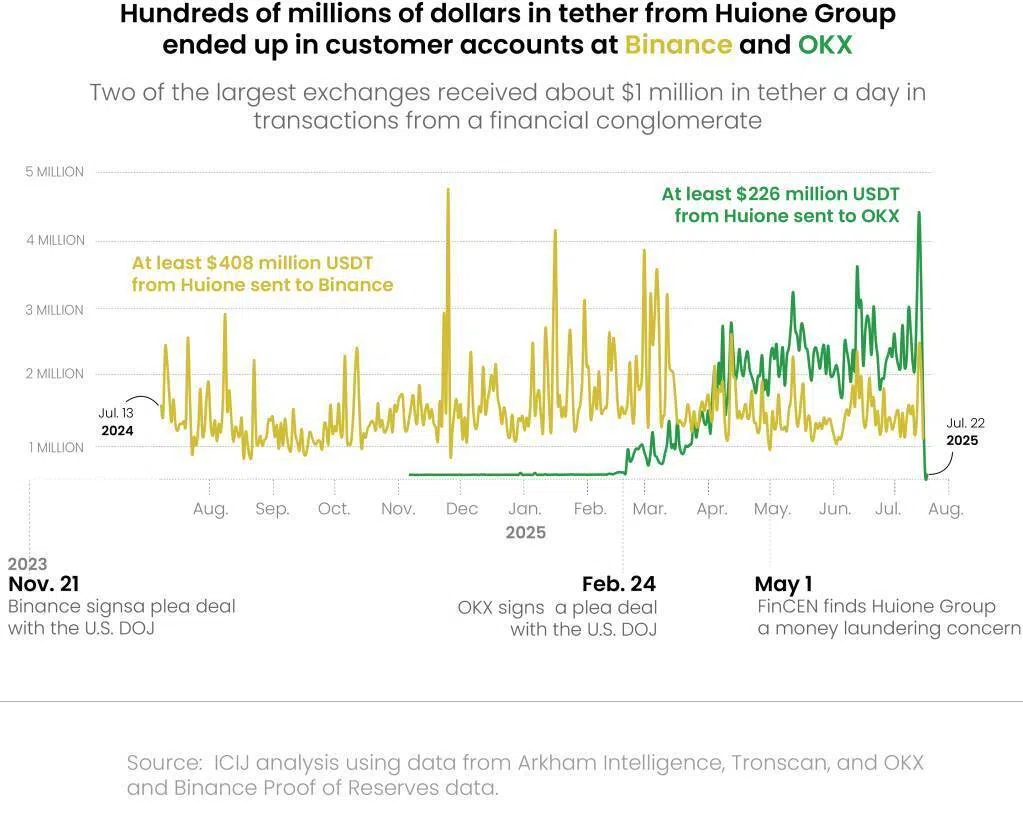
While Binance was under the supervision of court-appointed monitors, at least US$408 million worth of digital currency flowed to the company’s accounts from the Huione Group, a Cambodia-based financial firm used by Chinese crime gangs to launder proceeds from human trafficking and industrial-scale scam operations, ICIJ’s analysis showed.
Binance was not the only crypto exchange involved in these transactions. In February, Seychelles-based OKX pleaded guilty in the US to operating as an illegal money transmitter and agreed to retain a court-mandated compliance consultant.
Despite that oversight, customer accounts at OKX continued to receive hundreds of millions of US dollars from Huione, including more than US$161 million after the US Treasury Department labelled Huione a “primary money laundering concern” in May, ICIJ found.
“Normally, that halts everything,” said Ross Delston, a lawyer and anti-money laundering specialist. “If the federal government just told you that this entity is a high risk for money laundering or terrorist financing, you’d be crazy to continue any financial dealings with them.”



In response to ICIJ’s questions about the Huione transactions, Binance said it works closely with global law enforcement and is an industry leader in identifying and reacting to suspicious deposits.
“Users who transact with this service are subject to investigation by our compliance department, and appropriate action will be taken if any potential illicit activities are identified,” the firm said in a statement. Binance added that crypto technology does not allow it to block deposits into its system.
However, the company did not provide details in response to ICIJ’s questions about whether it froze funds or closed accounts related to the Huione fund flows.
OKX told ICIJ that it invests heavily in compliance and that it “took proactive steps to restrict relevant accounts” even before Huione was labelled a money-laundering concern. The crypto firm added that it has been working with the US government on the matter, sometimes even initiating engagement.
The investigation
Over the past 10 months, ICIJ and its partners have collected hundreds of crypto wallet addresses associated with North Korean cyber thieves, Russian money launderers, and large-scale scam operations. ICIJ also found that a Binance-hosted address has received more than US$700,000 from Mexico’s Sinaloa drug cartel through accounts at Coinbase, a US-based cryptocurrency exchange.
Using the wallet addresses, reporters traced tens of thousands of cryptocurrency transactions and found that illicit actors had either set up accounts or sent tainted funds to some of the world’s biggest exchanges.
Exchanges are important in the crypto financial system because they allow customers to set up accounts, store funds, and make payments – analogous to traditional banks.
These trading platforms also play a key role in facilitating illicit activity because they offer a fast way to convert crypto assets into standard currency.
Regulators and law enforcement have tried to push crypto exchanges to implement anti-money laundering safeguards. Such actions could eat into the exchanges’ revenues, which are largely derived from transaction fees.
“If they kick criminal actors off the platform, then that’s a big revenue source that they lose, so they have an incentive to allow this activity to continue,” said John Griffin, a blockchain data expert at the University of Texas in Austin. He has analysed how funds from sophisticated impersonation scams flow through Binance, OKX, and HTX.
Formerly registered in the Seychelles, HTX is affiliated with Justin Sun, a billionaire who has invested heavily in a crypto venture by the Trump family.
Binance did not respond to specific questions about its hosting of a Sinaloa cartel account. Coinbase told ICIJ that it was aware of the transactions relating to the cartel, and “through communications with the US government, it resulted in the wallet address being sanctioned.”
In response to questions about the drug trafficking wallets, OKX said that it had “proactively worked with law enforcement on this matter”. HTX did not respond to ICIJ’s requests for comment.
The impact of illegal crypto
The US Federal Bureau of Investigation estimates that Americans lost US$9.3 billion to crypto crimes in 2024, a 67 per cent increase from the previous year. That’s roughly half the amount collected by criminal financier Bernie Madoff from investors in his Ponzi scheme over four decades.
Despite industry claims that cryptocurrency is easier to monitor than standard currency, police often struggle to act on illicit crypto movements because the assets frequently pass through numerous anonymous wallets.
Automated swapping services that let users switch cryptocurrencies can also help obscure the origins of coins or tokens before they reach exchanges.
To ensure the accuracy of findings across the investigation, ICIJ relied on more than two dozen individual blockchain analysts, including industry experts and academics, as well as an array of analytics firms such as Crystal Intelligence and ChainArgos. To trace Huione’s activity, ICIJ developed its own methods for analysing transactions done in the stablecoin Tether.
The resources required to accurately track crypto transactions make the task more difficult for both the exchanges and law enforcement. More than a dozen former compliance workers at OKX, Binance, and other major trading platforms told ICIJ and its partner Toronto Star that they could hardly keep pace with savvy criminals.
“The main way to catch criminals would be waiting for them to mess up something,” Alessio Della Santa, a blockchain expert and former employee of Binance and Kraken, told ICIJ.
In theory, regulators around the world are supposed to be looking over an exchange’s shoulders to make sure the company is complying with the law. But in practice, a patchwork of laws and fragmented enforcement efforts can mean less government oversight.
New consumer protection and transparency requirements took effect in Europe at the end of 2024. But in the US, Trump has overseen a rollback of enforcement actions against the crypto industry.
US regulators dropped civil lawsuits against Coinbase, Kraken, and Binance, although the Department of Justice continued criminal cases against OKX and Tornado Cash, a service used to obscure the origin of funds by mixing cryptocurrencies from different sources.
Even before that, the US held crypto firms to lower standards for preventing money laundering than it does banks. The country’s regulators classify crypto exchanges in the same category as money transmitters like Western Union.
As a result, while multiple agencies supervise anti-money laundering practices at banks, crypto exchanges are overseen solely by the Internal Revenue Service’s (IRS) small-business and self-employed division.
The IRS office has struggled in recent years to adequately oversee cryptocurrency operations, according to the agency’s inspector general.
“Law enforcement can’t cope with the overwhelming amount of illicit activity in the space,” said Julia Hardy, co-founder of blockchain investigations firm zeroShadow. “It can’t go on like this.”
The pushback
Since its inception, cryptocurrency has evolved from a niche technology designed to free people from traditional financial institutions into a global industry valued at US$3 trillion to US$4 trillion.
Countries have taken different approaches to regulating crypto firms. For instance, China and Algeria have banned crypto trading. Others, such as Singapore and countries in the European Union, require companies to be licensed and comply with anti-money laundering laws.
As part of his November 2023 plea deal, Binance’s Zhao paid a US$50 million fine and was later sentenced to four months in prison. Binance was required to keep standard know-your-customer records – which include name, address and date of birth – to keep track of the sources of funds and to report suspicious activity to authorities.
But in 2024, the crypto industry pushed back against both government enforcement and the prospect of new regulation by throwing their support behind then-presidential candidate Trump.
Tyler and Cameron Winklevoss, co-founders of the Gemini exchange, publicly endorsed Trump and each gave US$1 million in bitcoin (15.47 bitcoins in 2024) to support his campaign. Kraken, Crypto.com, and Coinbase also contributed US$1 million each to Trump’s inaugural committee.
Trump, who in 2021 had called bitcoin a “scam”, became the industry’s most fervent political booster, promising to make the US the “crypto capital of the world”. In September 2024, he and his sons launched their own crypto venture, World Liberty Financial.
He also disbanded a Department of Justice unit that investigated crypto-related crimes. In doing so, the department said it would still “pursue the illicit financing of these enterprises by the individuals and enterprises themselves, including when it involves digital assets, but will not pursue actions against the platforms that these enterprises utilise to conduct their illegal activities”.
Limited resources and incentive
But even compliance workers at some of the world’s largest exchanges are often overwhelmed and under-resourced, according to more than a dozen ex-employees who spoke with ICIJ and the Toronto Star.
“The volumes are insane,” said a former Coinbase employee who spoke on the condition of anonymity. “The number of cases in relation to the workforce is 100 per cent unbalanced.”
A former analyst in the anti-money laundering department at OKX said workers dealt with an endless stream of alerts and were expected to process each one within a few minutes. “For crypto, the customers are abundant, so they want quantity over quality, and the agents make a lot of mistakes.”
An OKX spokesperson told ICIJ that its global team uses “a combination of experienced compliance professionals and advanced AI-driven monitoring systems to ensure that every alert is reviewed efficiently and thoroughly”.
The ex-employees said a company’s commitment to compliance boils down to resources. Compliance work is expensive, and it does not generate revenue, meaning companies are often unwilling to invest the money needed to manage their compliance needs, the former employees added.
In April, The Wall Street Journal reported that Binance staff were “discussing changes to its anti-money laundering controls that were viewed by some employees as an effort to loosen its checks on riskier customers”. Binance denied this but decried the “inefficient and costly burdens” imposed by the monitors.
Coda
On a Tuesday in late October, a 14-foot-tall statue of Zhao appeared on a gravel pathway less than a mile from the US Capitol. The statue, made of dense foam and spray-painted gold, showed Zhao holding up four fingers, a reference to his 2023 New Year’s resolution that has become a symbol of defiance against crypto scepticism.
Trump pardoned him on Oct 21.
When a CNN reporter asked the president about the decision, Trump replied, “Are you talking about the crypto person? A lot of people say that he wasn’t guilty of anything. … And they said that what he did is not even a crime.”
Zhao, now promoting the Binance offshoot BNB Chain, expressed his thanks on X. “Deeply grateful for today’s pardon and to President Trump for upholding America’s commitment to fairness, innovation, and justice,” he wrote. “Will do everything we can to help make America the Capital of Crypto.”
By Oct 31, he had stopped posting about the pardon and was back to promoting BNB Chain.
“Happy Halloween,” Zhao wrote on X. “We are hiring.”
Primary reporters: Spencer Woodman, Agustin Armendariz, Miguel Fiandor Gutierrez and Sam Ellefson. Contributors: Lucy King (Australian Financial Review), Leo Sisti (L’Espresso), Hugo Joncas (La Presse), Dania Kamal Aryf and Hariz Mohd (Malaysiakini), Benedikt Strunz (NDR), Naoki Inoue (NTV), Maxime Tellier (Radio France), Joan Plancade and Sylvain Besson (Tamedia), Ritu Sarin (The Indian Express), David Yaffe-Bellany (The New York Times), Emma McIntosh and Sheila Wang (The Toronto Star), Petra Blum (WDR), Denise Ajiri, Scilla Alecci, Jelena Cosic, Isabella Cota, Ben Dooley, Brenda Medina, Delphine Reuter, Joanna Robin, David Rowell, Richard HP Sia, Fergus Shiel, Annys Shin, Dean Starkman, Tom Stites, and Angie Wu (ICIJ).
Editor’s note: The Coin Laundry is a cross-border investigation led by the International Consortium of Investigative Journalists that spanned 10 months of reporting with 37 media partners, including Tech in Asia, in 35 countries. This story was edited for length and clarity, in accordance with TIA’s standards.
Decoding Asia newsletter: your guide to navigating Asia in a new global order. Sign up here to get Decoding Asia newsletter. Delivered to your inbox. Free.
Share with us your feedback on BT's products and services
TRENDING NOW

Malaysian king buys stake in Singapore-listed mining firm expanding into rare earths

Grab CEO’s wife Chloe Tong on life with Anthony Tan and finding her purpose

Once staunchly pro-China, Malaysian Chinese businesses are now distancing themselves from Beijing
Longer wait times expected as S’pore healthcare institutions report system disruptions

