



Tesla, BYD, Li Auto to lead in China’s EV race as country becomes carmakers’ battleground

Tay Peck Gek
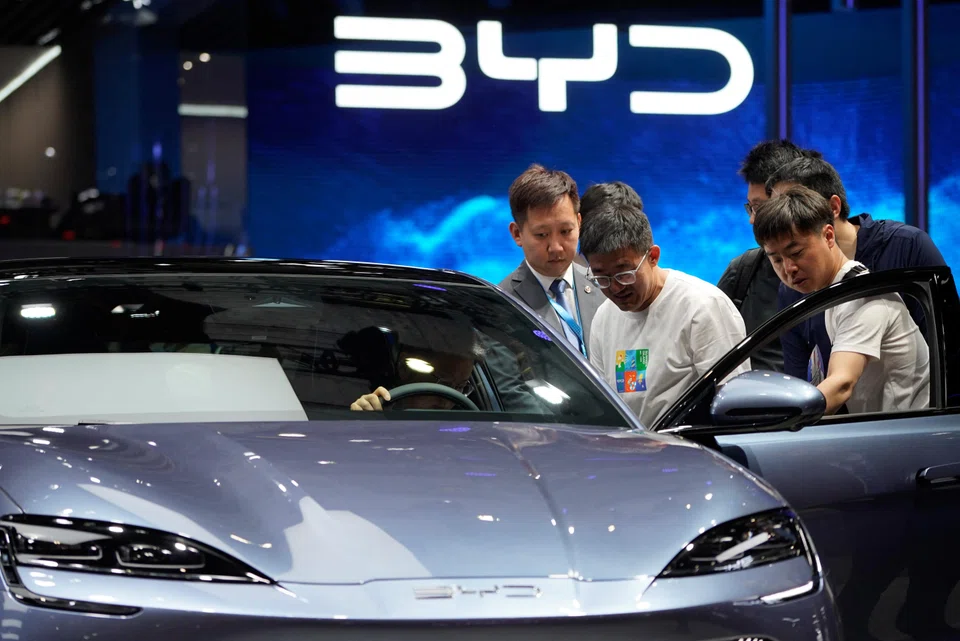
CHINA overtook Japan in the pole position for global vehicle exports in the first quarter of this year, driven by rising demand for electric vehicles (EVs). Investors wanting to ride this uptrend might consider the shares of Tesla, BYD and Li Auto, analysts said.
Competition in China – also the world’s largest auto market – has kicked into high gear since American EV maker Tesla cut its prices last October.
Other foreign brands are also sharpening their strategies for a bigger slice of the Chinese market. The battle for China may determine who wins in the global arena.
Some industry watchers have suggested that the stiff competition could drive some automakers out of business. An executive at XPeng, a Chinese carmaker, has suggested that there is room for only 10 players in the EV space.
S&P Global Ratings director Claire Yuan told The Business Times there is vast potential over the medium to long term for automakers, as vehicle ownership per capita in China is still low.
At the same time, the electrification trend has thrown up opportunities for upstarts to challenge the incumbents, especially since EVs are simpler in structure than those powered by internal combustion engines (ICEs).
Yuan noted that traditional automakers are ramping up their EV product portfolios, and companies without any carmaking experience are venturing into the EV business.
Domestic brands dominate China’s EV market, with a market share of roughly 70 per cent.
European brands constituted about 5 per cent of the market in 2022, US brands about 9 per cent (mostly due to Tesla, which accounted for 7.6 per cent), and Asian brands less than 2 per cent, according to DBS Group Research.
SEE ALSO


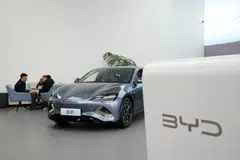
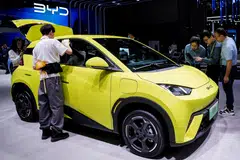
DBS analyst Rachel Miu noted that foreign brands are still relying on ICE vehicles for the bulk of their sales, but expects them to grow faster over the next few years.
Even as foreign marques make their way into China, the Chinese makers are venturing overseas. Most have taken the export routes, with Mexico, the Middle East and Europe the major destinations.
S&P’s Yuan thinks it will take time for Chinese automakers to build brand awareness and increase consumer acceptance in markets such as Europe.
Therefore, exports will account for only a small portion of their total sales in the next two to three years.
UOB Kay Hian (UOBKH) analyst Ken Lee said in a report that Nasdaq-listed Tesla, Shanghai Automotive Industry Corporation and BYD were the top three EV exporters from China from January to April this year.
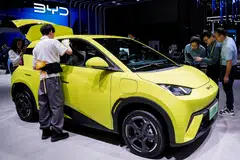
Tesla accounted for 41 per cent of total passenger EV volume exported, but BYD saw the biggest increase. Its export volume was 53,550 units in that period, or 17 times what it was in the comparable year-ago period, as it ramped up sales to Japan, Australia, South-east Asia and Europe.
In the domestic market, BYD’s market share reached 38.3 per cent in the first quarter of this year. Tesla came in second at 16 per cent.
The share of BYD has steadily risen from 11.2 per cent in Q1 2021, an increase of 27 percentage points in two years, CGS-CIMB analyst Ray Kwok noted.
This was primarily driven by the company’s diversification strategy, which helped it maintain a high level of stability in spite of production and supply challenges as well as pandemic-induced disruptions, said Kwok.
S&P’s Yuan said BYD could continue to be a winner in the EV space, owing to its good product offerings for both plug-in hybrid EVs (PHEVs) and battery EVs (BEVs).
A high level of vertical integration should help it keep costs under control. PHEVs use petrol and electricity as fuel sources, whereas BEVs are fully powered by rechargeable batteries.
DBS’ Miu also likes BYD, noting that it has outperformed peers such as Tesla in the first quarter. Tesla posted a decline of 22 per cent in earnings due to the multiple price cuts, whereas BYD’s earnings were four times their year-ago figure, at 4.1 billion yuan (S$785.3 million), on an 80 per cent improvement in turnover.
Tesla is expected to do well too. S&P’s Yuan said its robust cost controls, built on large sales volumes, should help the automaker remain a leader – alongside BYD – in the Chinese market over the next two years.
Tesla will most easily manage margin strains as the cost leader, even when shipments slow.
Among the upstarts, Yuan said Li Auto has shown the most resilient performance. The automaker has addressed consumers’ concern about range anxiety with its PHEVs, but she flagged the uncertainty about the success of its BEV products to be launched in the second half of this year.
Li Auto’s net profit for the first quarter of 1.4 billion yuan was three times what it was in the year-ago period and above Bloomberg’s consensus forecast, noted CGS-CIMB’s Kwok. Earnings were propelled by a 66 per cent year-on-year rise in shipments and about 20 per cent higher average selling prices.
Among pure EV players, the other two major ones being XPeng and Nio, Li Auto was the first to turn profitable, said DBS analyst Miu. The company has controlled its cost structure well, with both R&D costs and general expenses increasing at a slower pace than the improvement in turnover.
S&P’s Yuan warned that the electrification trend is weighing on automakers’ margins and leverage. Producing EVs is a capital-intensive venture: funds are required for both research and development and for capital expenditure. As such, the ability to ramp up volume, reduce costs and defend margins would be important.
He said: “For EV startups with less competitive products, they may burn cash quickly and be forced to exit the market. This paves the way for industry consolidation. For traditional carmakers, they may be more resilient in terms of margin, given the still-low EV sales.”
UOBKH’s Lee is underweight on the automotive sector as a whole, but is bullish about the EV segment because supportive state policies and improving EV features would underpin sales. His top counters are BYD, for its leading position; and Li Auto for being at “the inflection point of a turnaround”.
Decoding Asia newsletter: your guide to navigating Asia in a new global order. Sign up here to get Decoding Asia newsletter. Delivered to your inbox. Free.
Copyright SPH Media. All rights reserved.
TRENDING NOW

Could stablecoins be the future of money?

Philippine power giant First Gen rebuffs foreign offers, plans up to US$2.6 billion in expansion
GIC-backed Bank Jago sees wealth management as next growth engine as Indonesian investor base grows
The middle power moment arrives in South-east Asia – but not for Asean

