



Trump pageantry for Xi will mask feud over US-China AI race
Trump officials have downplayed expectations for discussions about AI
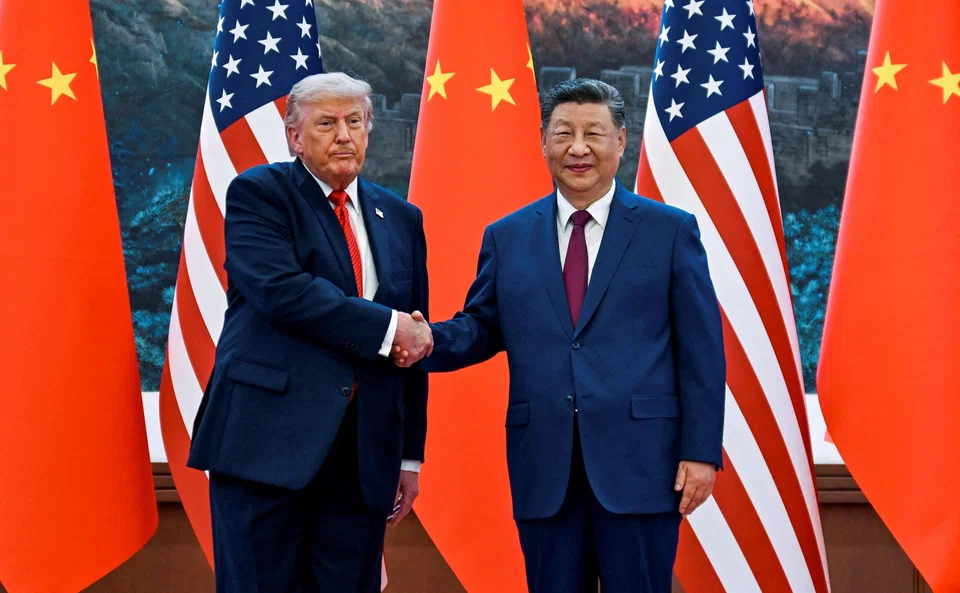
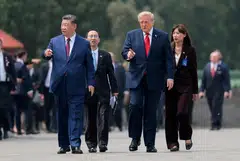
DONALD Trump welcomes Xi Jinping to Washington for a state visit focused more on pageantry than policy, looking beyond long-standing feuds between the world’s biggest economies.
Xi and his wife, former military singer Peng Liyuan, will be greeted by Trump on Wednesday (Sep 23) evening, marking the first time in recent memory that a US president has received his Chinese counterpart on an American airport tarmac.
Meetings spanning thorny issues including trade and Taiwan will follow, along with a state dinner — the second of Trump’s current term — before farewells on Friday.
The trip is Xi’s first to the US capital since 2015. Both sides have lowered expectations for either breakthroughs or bust-ups. Preliminary bilateral talks in New York on Sunday were hailed as positive, but failed to reach an agreement on extending a tariff truce expiring in November.
“The visit is the message,” said Edgard Kagan, a former US diplomat in Asia now at the Washington-based Centre for Strategic and International Studies. “There’s been a surprising lack of signalling by either the White House or China on major goals for the visit. I think the way they are framing it is very much — this is about managing the relationship.”
Signalling his desire for a smooth meeting, Trump mentioned China only once by name in his address on Tuesday to the UN General Assembly. He did discuss Xi’s visit with Japanese Prime Minister Sanae Takaichi, who has butted heads with Beijing.
Fault lines remain beneath the black-tie bonhomie.
The US is racing to loosen China’s grip on rare earths amid complaints Beijing is slow-walking shipments central to last year’s trade truce. US Treasury Secretary Scott Bessent has warned “there is no day after tomorrow if China wins” in artificial intelligence.
Chinese officials are focused on blocking a US$14 billion proposed US weapons package for Taiwan, the self-governing island the Communist Party sees as its own territory.
SEE ALSO
Generating a good message around the summit in both countries, tempering perceived US exaggerations of Chinese AI threats and upholding Beijing’s brightest red lines on Taiwan will be China’s main goals, said Zhu Feng, dean of the School of International Studies at Nanjing University.
“With US weapons manufacturing facing hurdles at home, a slowdown in arms sales to Taiwan — and reduction in quantity — seems achievable,” he added.
Domestic troubles
The tete-a-tete comes at a sensitive time for both men. Trump, 80, is bracing for his fellow Republicans to suffer defeats in the November midterm elections and faces the prospect of lame-duck status.
Senator Roger Wicker, the Mississipi Republican who chairs the Armed Services Committee lambasted Trump on Tuesday over the visit.
“Quite frankly, had the White House asked me for advice, I would have suggested the president not invite Xi Jinping to Washington for such a lavish welcome,” he said in a speech.
Meanwhile, Xi, 73, is powering toward a historic fourth term in power, but is grappling with sluggish economic growth and rising youth unemployment.
Other major questions will hang over the gathering. Trump has sent mixed signals on whether he would allow Chinese cars into the American market, a potentially explosive development for the industry.
He’s previously opened the door to allowing China to build US auto plants if they hire American workers. Any such deal would still have to satisfy national security rules in order to proceed, one of the US officials said.
As tensions heat up over AI, the US has banned imports of new humanoid robots and inverters from China, sanctioned Chinese companies over forced labour and added its major tech firms to a Pentagon blacklist. Beijing has barred US companies and tightened controls on drone exports. Yet neither side has escalated far enough to unravel their broader truce.
Trump administration officials have downplayed expectations for discussions around AI, though Bessent said the two sides agreed to establish a new dialogue on the topic.
As China’s leading AI companies race to catch Silicon Valley, the US has accused them of distilling capabilities from American frontier models — allegations Beijing has rejected.
“The reality is neither side really knows what can come from a dialogue at this specific political and technological moment,” said Brett Fetterly, managing principal at The Asia Group.
In a briefing call on Friday, US officials said they need China to do more to curb the flow of fentanyl and increase rare earth exports. The officials also said the US wasn’t interested in a fresh export control deal to gain access to metals Washington believes China already agreed to provide.
Chinese exports of rare-earth magnets to the US dropped 21 per cent in August from the previous month, according to customs data released on Sunday.
By contrast, China’s trade surplus with the US last month also surged almost 44 per cent from a year earlier to more than US$29 billion — the widest gap since Trump returned to the White House in January 2025.
And while Beijing remains vulnerable to US export curbs on advanced semiconductors and their manufacturing equipment, its domestic chip industry is making strides. China’s Huawei Technologies last week accelerated plans for its next-generation AI chip, a signal of defiance against US tech curbs.
Trump’s Washington
Xi arrives as Trump is challenges the limits of his powers in extraordinary ways. The president has banned three major news outlets from the White House, pressed to rewrite voting rules and complained about judges curbing his tariff authorities and efforts to eliminate birthright citizenship.
Banners with images of Trump hang from Cabinet buildings, including the Justice Department, imagery that critics say evokes that of authoritarian governments.
Trump has repeatedly lauded his relationship with Xi, and photos of their last meeting — in Beijing — hang prominently on the walls of the West Wing. That reverence could embolden Xi, and not just on Taiwan.
“The US is basically giving Xi Jinping a pass,” said Scott Kennedy, a China expert at the Center for Strategic and International Studies. “We’re not constraining the Chinese, really, in any significant way.” BLOOMBERG
Decoding Asia newsletter: your guide to navigating Asia in a new global order. Sign up here to get Decoding Asia newsletter. Delivered to your inbox. Free.
Share with us your feedback on BT's products and services
TRENDING NOW
Companies still in search of AI use cases with worthwhile ROI, says Broadcom’s CEO
Malaysian king buys stake in Singapore-listed mining firm expanding into rare earths

Once staunchly pro-China, Malaysian Chinese businesses are now distancing themselves from Beijing
Singapore’s wealth management success should extend to everyday families

