



UK has ‘laser’ focus on supporting tech firms expanding into South-east Asia
The number of British companies active in Singapore now stands at 5,700, up from 4,500 in 2019, says the UK’s top diplomat in Singapore Kara Owen.

Lee U-Wen
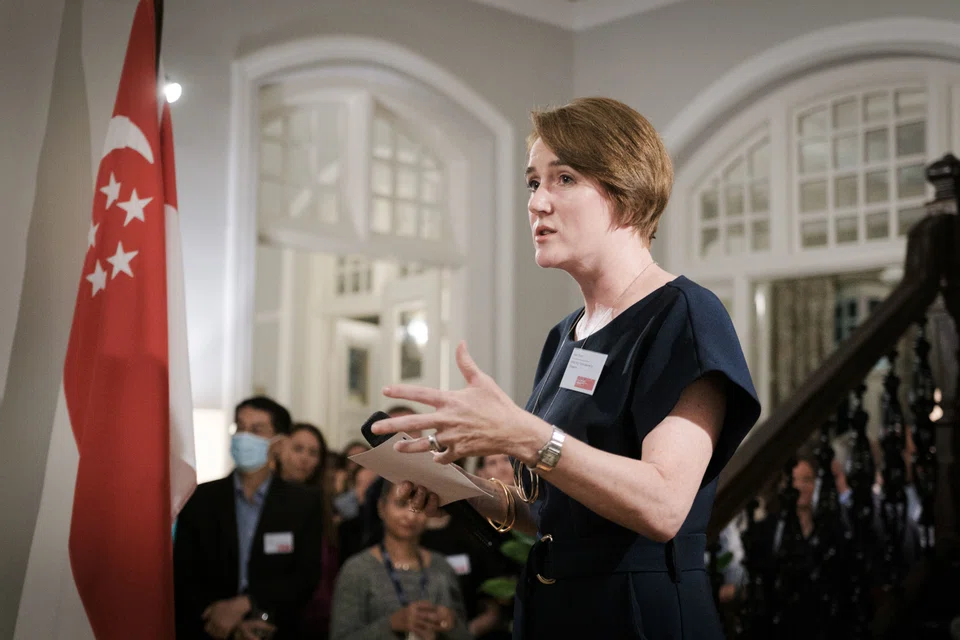
THE new year is fast shaping up to be an eventful one for Britain as it continues to deepen its involvement and presence in Singapore and across the Asia-Pacific region, especially on the trade front.
Negotiations are in the final stretch for the UK’s accession to the Comprehensive and Progressive Trans-Pacific Partnership, a massive free trade deal signed by 11 Pacific Rim countries including Singapore and the US in 2018.
The UK and India – the third-largest economy in Asia and the current president of the G20 – have already completed six rounds of talks for a free trade agreement, as officials from both sides look to finalise the pact that aims to double bilateral trade to US$100 billion by 2030.
Overall, the UK’s trading relationships with the Asia-Pacific today are worth over £109 billion (S$176.2 billion) and this figure continues to grow, said British High Commissioner to Singapore Kara Owen in an interview at Eden Hall, her official residence along Nassim Road.
In the 12 months to the end of June 2022, total UK exports to Asia-Pacific reached a record high of £58.4 billion – 10.6 per cent higher than the previous year. The UK currently exports more to Asia-Pacific than the Middle East, South Asia and Africa combined.
Trade between the UK and Singapore, specifically, stood at £18.5 billion in the 12 months up to July 2022, an 18.1 per cent increase on the same period the year before.
Foreign direct investment (FDI) from the UK to Singapore was £14.8 billion in 2020, while FDI in the other direction was £13.5 billion that same year.
The number of British companies active in Singapore have also grown by over 25 per cent in the last three years or so, from 4,500 in 2019 to 5,700 as at the last count.
“(This increase) is pretty amazing, (as the growth) took place during the pandemic. That just shows the strength of the interest among UK companies in doing business here, and there was already a big pipeline of interest, even before the pandemic,” she told The Business Times.



Aurrigo, a transport technology firm, inked an agreement with Changi Airport Group for the next phase of development of its baggage transportation system for airports. Changi Airport will trial this system on an aircraft stand for about six months.
Meanwhile, Skyports and Jurong Port have a new partnership to explore how drone delivery technology can be integrated into the existing logistics and cargo operations of Jurong Port. Skyports also recently secured US$3.13 million in investment from ST Engineering Ventures.
At the London Tech Week last June, the UK government hosted eight Singapore companies from sectors such as legal tech, artificial intelligence and e-commerce. Three of those firms have since registered an entity in the UK.
There was a reciprocal mission to the Singapore Week of Innovation and Technology in October involving seven British companies. During that visit, one of the firms – data and analytics specialist Kagool – opened its fifth global office in Singapore.
“We’ve got a laser-like focus on supporting UK tech companies to come to South-east Asia. For the companies that came (for Switch), none of them were speculative. They all came with serious intent already,” said Owen.
Owen, who is in her fourth year as the UK’s top diplomat in Singapore, said another main focus for 2023 is to help more companies make use of the UK-Singapore Digital Economy Agreement (DEA) that came into force in July.
With this deal in place, businesses and consumers benefit from open digital markets, including guaranteed tariff-free flow of digital content; a free flow of trusted data; protection for personal data and intellectual property; and cheaper trade through the adoption of digital trading systems.
“Seventy per cent of the services (that the UK) exports to Singapore is delivered digitally, so it’s really a big deal in terms of how our trade is made up. The approach that we are taking is constant communication (about the DEA), because we have to grow the number of people that know about it,” said Owen.
To help businesses make the most of the DEA and support their expansion into the Asia-Pacific, executives from 24 British tech companies came to Singapore for a week last September, including those working on driverless vehicles, lawtech and cybersecurity.
One key message that Owen wants to send to the companies in Singapore and elsewhere is that the UK is fully open for business, especially where its tech sector is concerned.
According to latest statistics, the UK’s tech sector is currently worth US$1 trillion, making it only the third country in the world to reach this landmark valuation.
“The UK is home to more fintech unicorns (122) than any other market in Europe, demonstrating our ability not only to innovate, but also to grow world-class businesses that succeed on the global stage,” said Owen.
Decoding Asia newsletter: your guide to navigating Asia in a new global order. Sign up here to get Decoding Asia newsletter. Delivered to your inbox. Free.
Copyright SPH Media. All rights reserved.
TRENDING NOW

First Resources blames El Nino, outside fires for Kalimantan hotspots amid haze scrutiny

High Court rules against Julius Baer’s Singapore trust arm in US$50 million family trust dispute

Singapore key exports jump by higher-than-expected 68.4% in September, led by non-electronics

MSCI proposes standalone status for Indonesia; Jakarta stocks plunge 8%

