

US-Iran peace talks end without agreement, delegations leave Pakistan
No change in Hormuz as long as US does not agree to a ‘reasonable deal’, Iran media quotes informed source as saying
 Add BT as a preferred source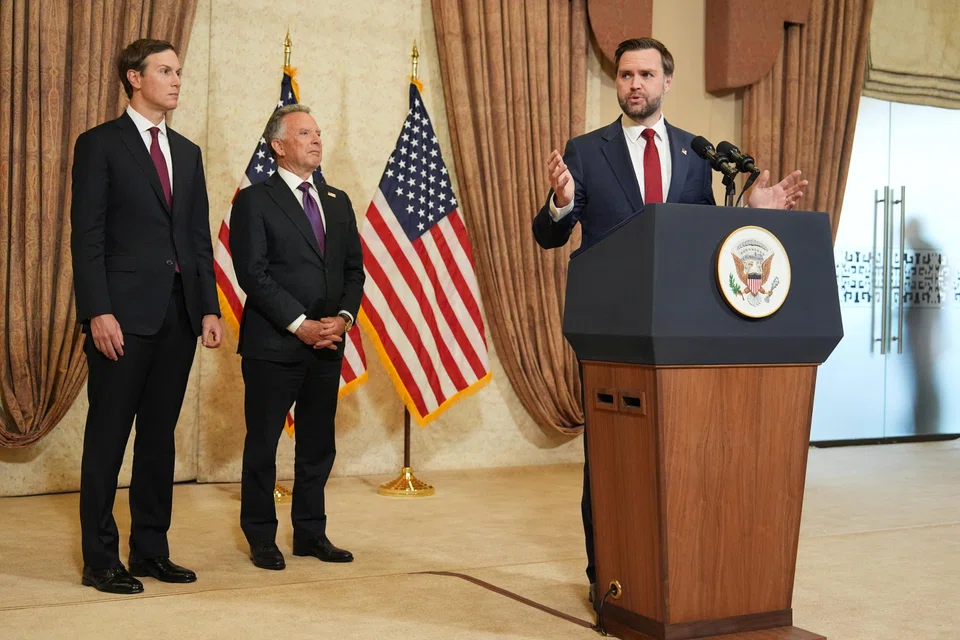
[ISLAMABAD] The US and Iran failed to reach an agreement to end their war despite lengthy talks that concluded on Sunday (Apr 12) in the Pakistani capital Islamabad, jeopardising a fragile ceasefire.
Each side blamed the other for the failure of the 21-hour-long negotiations to end fighting that has killed thousands and sent global oil prices soaring since it began over six weeks ago.
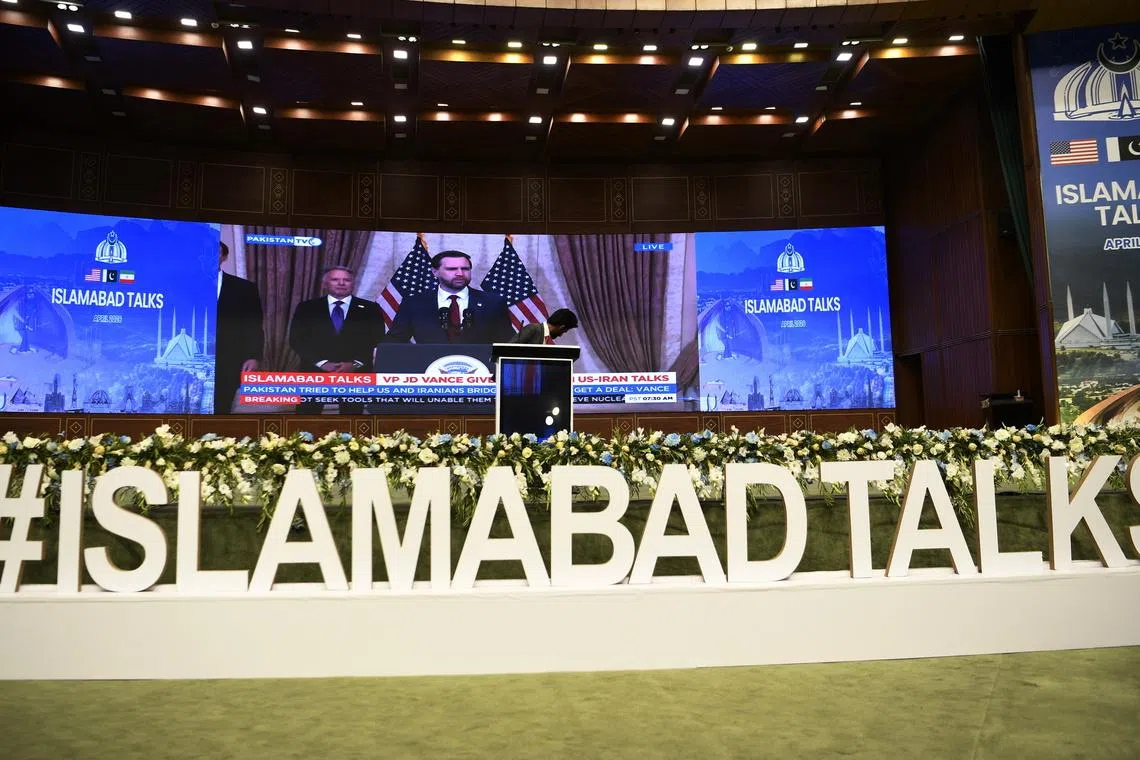
“The bad news is that we have not reached an agreement, and I think that’s bad news for Iran much more than it’s bad news for the United States of America,” Vice-President JD Vance, the head of the US delegation, told reporters shortly before he left Islamabad.
US cites ‘red lines’, Iran says demands ‘excessive’
“So we go back to the United States having not come to an agreement. We’ve made very clear what our red lines are,” said Vance.
The US and Iranian delegations have left Islamabad to return home, Pakistani sources told Reuters.
Vance said Iran had chosen not to accept American terms, including not to build nuclear weapons.
“We need to see an affirmative commitment that they will not seek a nuclear weapon, and they will not seek the tools that would enable them to quickly achieve a nuclear weapon,” said the vice president.
“That is the core goal of the president of the United States, and that’s what we’ve tried to achieve through these negotiations,” he added.

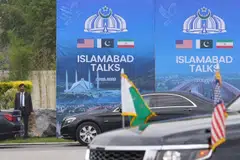
The talks in Islamabad, after a ceasefire earlier in the week, were the first direct US-Iranian meeting in more than a decade and the highest-level discussions since the 1979 Islamic Revolution.


Iran’s semi-official Tasnim news agency said that “excessive” US demands had hindered reaching an agreement.
Tasnim also reported an informed source as saying that there will be no change in the Strait of Hormuz as long as the US does not agree to a “reasonable deal”.
Other Iranian media said there was agreement on a number of issues but that the Strait of Hormuz and Iran’s nuclear programme were the main points of difference.
A spokesperson for Iran’s foreign ministry said the talks were conducted in an atmosphere of mistrust.
“It is natural that we shouldn’t have expected to reach agreement in just one session,” the spokesperson was quoted as saying by Iranian media.
“It is imperative that the parties continue to uphold their commitment to ceasefire,” Pakistan’s Foreign Minister Ishaq Dar said in a statement after the talks.
Washington and Teheran agreed on Tuesday to a two-week ceasefire in an attempt to wind down a war that began on Feb 28 with air strikes by the US and Israel on Iran.
In his brief press conference, Vance did not mention reopening the Strait of Hormuz, a choke point for about 20 per cent of global energy supplies that Teheran has blocked since the war began.
Vance said he had spoken with President Donald Trump as many as a dozen times during the talks. But even as the negotiations continued, Trump said on Saturday that a deal was not entirely necessary.
“We’re negotiating, whether we make a deal or not makes no difference to me, because we’ve won,” he told reporters.
The US delegation included special envoy Steve Witkoff and Trump’s son-in-law Jared Kushner. Iran’s team included Parliamentary Speaker Mohammad Baqer Qalibaf and Foreign Minister Abbas Araghchi.
Strait of Hormuz
“There were mood swings from the two sides and the temperature went up and down during the meeting,” a Pakistani source said in reference to an early round of talks, which carried on overnight. Islamabad, a city of more than 2 million people, was locked down during the talks with thousands of paramilitary personnel and army troops on the streets.
Before the talks began, a senior Iranian source told Reuters the US had agreed to release frozen assets in Qatar and other foreign banks. A US official denied agreeing to release the money.
As well as the release of assets abroad, Teheran is demanding control of the Strait of Hormuz, payment of war reparations and a ceasefire across the region, including in Lebanon, according to Iranian state TV and officials.
Teheran also wants to collect transit fees in the Strait of Hormuz.
Despite the differences in Islamabad, three supertankers fully laden with oil passed through the Strait of Hormuz on Saturday, shipping data showed, in what appeared to be the first vessels to exit the Gulf since the US-Iran ceasefire deal.
Hundreds of tankers are still stuck in the Gulf, waiting to exit during the two-week ceasefire period.
Trump’s stated goals have shifted, but as a minimum, he wants free passage for global shipping through the strait and the crippling of Iran’s nuclear enrichment programme to ensure it cannot produce an atomic bomb.
Teheran has long denied wanting to build a nuclear weapon.
US ally Israel has also been bombing Teheran-backed Hizbollah militants in Lebanon and says that conflict is not part of the Iran-US ceasefire. Iran has insisted that the fighting in Lebanon has to stop. REUTERS
Decoding Asia newsletter: your guide to navigating Asia in a new global order. Sign up here to get Decoding Asia newsletter. Delivered to your inbox. Free.
Share with us your feedback on BT's products and services
TRENDING NOW

DBS completes US$1 billion significant risk transfer deal, in first for Singapore bank

Malaysian tycoon Vincent Tan’s sell-downs point to pruning rather than an exit plan

Singapore private housing is ‘decoupling’ from HDB market as buyer pools diverge: NUS survey

Not in education, employment or training: Why more Hong Kong youths are opting out of work

