US midterm elections: Democrats close in on US House, make gains in Senate
Trump’s approval rating is hovering near his all-time lows
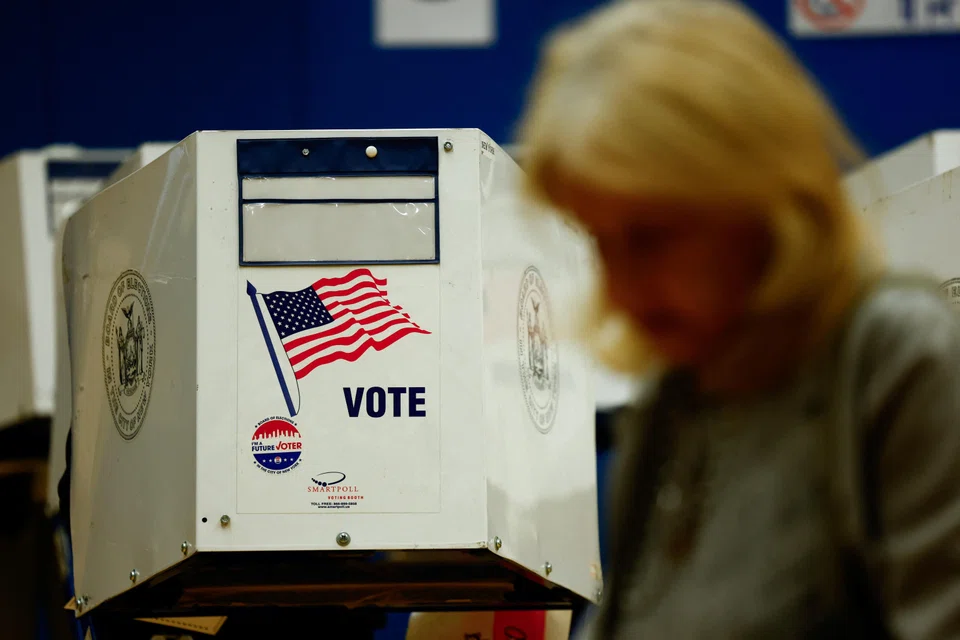
[WASHINGTON] Democrats were on track to win the US House in Tuesday’s (Nov 3) midterm elections, according to media projections, and were moving closer to a Senate majority after seizing Republican seats in South Carolina and North Carolina.
The early results were a sweeping rebuke to President Donald Trump and the Republican Congress that has supported him since he returned to the White House two years ago.
In South Carolina, pediatrician Annie Andrews became the first Democrat to win a Senate seat since 1998, a stunning victory over Trump’s hand-picked candidate Darline Graham in a state that he carried by nearly 18 percentage points in 2024.
Andrews’ win, along with Democrat Roy Cooper’s win in North Carolina’s Senate race, gave the party two of the four seats it needs to net in order to take control of the chamber.
The results also suggested that a Democratic wave was growing large enough to swamp even deeply Republican areas.
After the death of his ally, US Senator Lindsey Graham, Graham’s sister Darline was appointed to fill his seat and Trump encouraged her to run for a full six-year term. But her political inexperience proved a liability.

It was still too early to determine whether Democrats would be able to replicate those performances in the other critical races that will determine the Senate majority, including Alaska, Iowa, Michigan, Maine, Ohio and Texas, with millions of votes still uncounted in those states.
Democrats held onto Senate seats in Georgia and New Hampshire, both races that were once considered competitive but moved out of reach for Republicans amid Trump’s declining approval ratings.
While several television networks projected that Democrats would eventually win a House majority, most of the chamber’s most tightly contested races had yet to be called.


So far, Democrats have picked up four seats from Republicans, meaning they can afford to lose one of their existing seats and still take control of the 435-member chamber.
A rebuke to Trump
“In sweeping and decisive victories, the American people have rebuked the depravity, corruption and incompetence of the man named President Donald J. Trump,” incumbent Democratic Senator Jon Ossoff, the projected winner in Georgia, told supporters at a victory party.
In Florida, Republican Senator Ashley Moody fended off Democrat Angie Nixon but was ahead by only about 3 percentage points in a state Trump carried by 13 points in 2024, according to a vote count compiled by Reuters and USA Today, further evidence that even solidly Republican states were shifting dramatically toward Democrats.
Democrats held onto three House districts in Florida that Republican lawmakers had redrawn earlier this year, all of which backed Trump by at least 9 percentage points. The fate of the House overall remained uncertain, with the majority of races still uncalled.
According to exit polls conducted by SSRS on behalf of a consortium of US media outlets including major television networks and the Associated Press, half of voters said they saw the 2026 midterm elections as an opportunity to rebuke the president, and three-quarters said they are “angry” or “dissatisfied” with the way the country is headed.
In addition, 70 per cent of voters surveyed said they want Congress to provide more checks and balances on the president.
Midterm elections are typically seen as a referendum on the president, and that is particularly true for Trump, who dominates attention like no other modern politician. Trump himself has told his supporters to “pretend I’m on the ballot”, a message Democratic leaders have happily echoed.

In televised remarks on Tuesday that appeared aimed at swaying voters unhappy with US support for Israel, Trump said that he intended to stop US$3.8 billion in promised annual funding to Israel after the end of this year, but it was unclear how he would do so, given a 2020 law mandating the funding levels.
The close US-Israel alliance has been a particular focus in Michigan, where progressive Democrat Abdul El-Sayed, who would become the first Muslim US senator if elected, has faced millions of dollars in opposition spending from Israel-linked groups over his criticisms of the US ally.
Led by Trump, Republicans have portrayed El-Sayed, 42, and other Democratic candidates as radical, un-American and even communist, labels that Democrats dismiss as typical Trump hyperbole.

The president has sought to energise his base with more than two dozen campaign rallies since the start of October, most in states he easily won in 2024, underscoring Republicans’ defensive posture.
Opinion polls show voters are most concerned about affordability and disapprove of Trump’s handling of the issue. His tariffs on imports, many of which the courts threw out, and his decision to attack Iran in February raised prices for consumers.
Trump deploys election monitors
Legal observers and Democrats have warned that Trump, who has long falsely claimed that US elections are rigged, may attempt to challenge Tuesday’s results if Republicans lose.
The US Justice Department said it had deployed 1,000 election monitors and observers to all 50 states in what it called the largest Election Day monitoring effort in history.
Democrats criticised the plan as potential voter intimidation. In roughly two-thirds of the jurisdictions the department listed, voters supported Democrat Kamala Harris over Trump in the 2024 presidential election, a Reuters analysis found.
All 435 seats in the US House of Representatives are up for election, along with 35 of the Senate’s 100 seats, though most contests are not considered competitive. Democrats must flip at least three House seats and four Senate seats to win a majority in each chamber.
There are 47 US House races widely seen as competitive, according to a Reuters analysis of the leading election forecasters. If the other contests all proceed as predicted, Democrats would need to win only 13 of those races to secure a majority.
But Democrats have little margin for error in the Senate. The party must defend all of its current seats while winning at least two states that voted for Trump by a double-digit margin two years ago, such as Alaska, Iowa, Kansas, Nebraska, Ohio, South Carolina and Texas.
Opinion polls show Democrats either narrowly leading or within striking distance in all of those states.
Election intrigue in Alaska
A New York Times report upended the Alaska Senate race when it reported that the campaign of Democratic candidate Mary Peltola, 53, helped recruit a third candidate to run as an independent who shares the first and last name of her Republican opponent, Dan Sullivan, 61.
Peltola has denied involvement. Trump’s Justice Department has launched a criminal probe into the allegations and filed a lawsuit to block certification of the election results, though a judge dismissed the latter effort.
Supporters of the incumbent Sullivan said they were not confused by the presence of two Dan Sullivans on the ballot.
“They make it pretty obvious: It says ‘incumbent’ after his name,” said Jake Wesley, 27, who grew up in Anchorage and is now stationed there in the US Air Force. In recent days, Trump has complained repeatedly that voters may not know the meaning of the word. REUTERS
Decoding Asia newsletter: your guide to navigating Asia in a new global order. Sign up here to get Decoding Asia newsletter. Delivered to your inbox. Free.
Share with us your feedback on BT's products and services