As great powers hedge their bets, Asean needs pragmatism and integration to drive growth: ADB
Digitalisation is a key focus for the bloc, but more consensus is needed, say economists

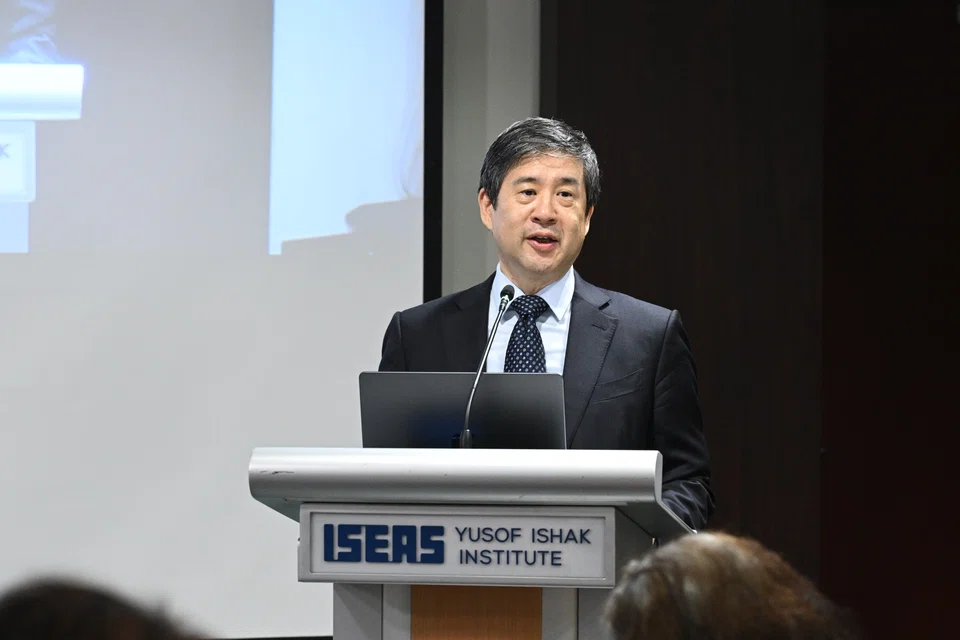
[SINGAPORE] Instead of turning to protectionist measures, South-east Asia’s willingness to deepen economic relations – both within and beyond the region – will be key to accelerating its growth, said Albert Park, chief economist at the Asian Development Bank (ADB).
“The instinct for most countries in the region has been to double down on stronger integration, not to devolve into a world of protectionism,” Dr Park told The Business Times in an exclusive interview.
The ADB launched the latest edition of its annual Asian Economic Integration Report on Thursday (Feb 26) at a seminar held in conjunction with the Iseas-Yusof Ishak Institute.
The report reviewed the region’s efforts to integrate its economies and improve cooperation on multiple levels, including trade, cross-border investment, financial integration and the movement of people.
Amitendu Palit, senior research fellow at the Institute of South Asian Studies at the National University of Singapore, noted during a panel discussion moderated by Dr Park that economic tensions are rising between countries with the economic power to influence global geopolitics.
“But this group of countries are the minority,” said Dr Palit. “The majority of Asia belongs to the silent majority, who would want an ordered house.”
Speaking after the seminar, Dr Park said this pragmatism has underpinned Asia’s rise to become the most dynamic part of the global economy today, with South-east Asia playing a significant role. “At the end of the day, it comes back to clear fundamentals,” he said. “South-east Asia has been open to trade, is well governed, pragmatic and peaceful, while macroeconomic and fiscal management have been sound across the region’s leading economies.”
Dr Park noted that new economy sectors, including artificial intelligence (AI), data centres, electric vehicles and renewable energy, are among the key strategic sectors in the region.
But efforts to cooperate within the region remain similarly important for South-east Asia’s growth, he said.
In particular, the digital economy will open up opportunities for the region as the AI sector continues to grow, with much of the global semiconductor supply chain manufactured in South-east and East Asia.
“On the other side of the AI boom is trying to think about how to use AI broadly in an economy to increase productivity,” Dr Park added.
The sector is a key priority in Asean’s efforts for regional integration, through the upcoming signing of the Digital Economy Framework Agreement (Defa), which the bloc reached a substantial conclusion on in October 2025.
As the world’s first regionwide, legally binding digital economy arrangement, Defa will serve as a blueprint for harmonising digital trade rules and regulations; it will also create a regulatory framework for paperless trading, e-commerce, cybersecurity and digital payments, as well as facilitate cross-border information and data flows.
Digital integration
Economists debated during the seminar about whether Asean has done enough to drive South-east Asia’s economic integration, particularly within the digital economy.
Sanchita Basu Das, economist in the regional cooperation and integration division at ADB, said that the bloc had not yet displayed leadership as a rulemaker, instead often reacting to global events and adjusting its economy accordingly.
She said that Asean will need a more precise consensus on how agreements such as Defa are implemented. “Which sectors should be identified as key priorities where we are going to implement the agreement?”
One country may want to prioritise digitalisation within the agricultural sector, while another may want to prioritise the digital services sector, she explained.
Still, Dr Park told BT that Defa remains important for Asean, as it provides a framework on governance and standards of practice for the region’s digital economy.
The sector remains critical to support competitiveness at many points along the value chain, he said.
“This is a little bit different from in the past, when processes were much simpler,” he added. “Now, you need supportive systems, like digital infrastructure, to make yourself competitive to upgrade into higher value-added production.”
Asean’s efforts towards integration must therefore be carefully considered to remain inclusive across the region.
Dr Park noted that as South-east Asia ramps up its efforts to move further up the value chain, its less developed economies – such as Laos, Cambodia, Brunei, Myanmar and Timor Leste – are at risk of being left behind.
“This can be challenging for poor countries that lack the logistical capacity, the human capital or the digital infrastructure to enable upgrading,” he said.