

Greater freedoms for migrant workers in coming weeks
Residents in some dorms can access the community once a month as part of a pilot scheme to kick off in Q1
 Add BT as a preferred source
Mindy Tan
Singapore
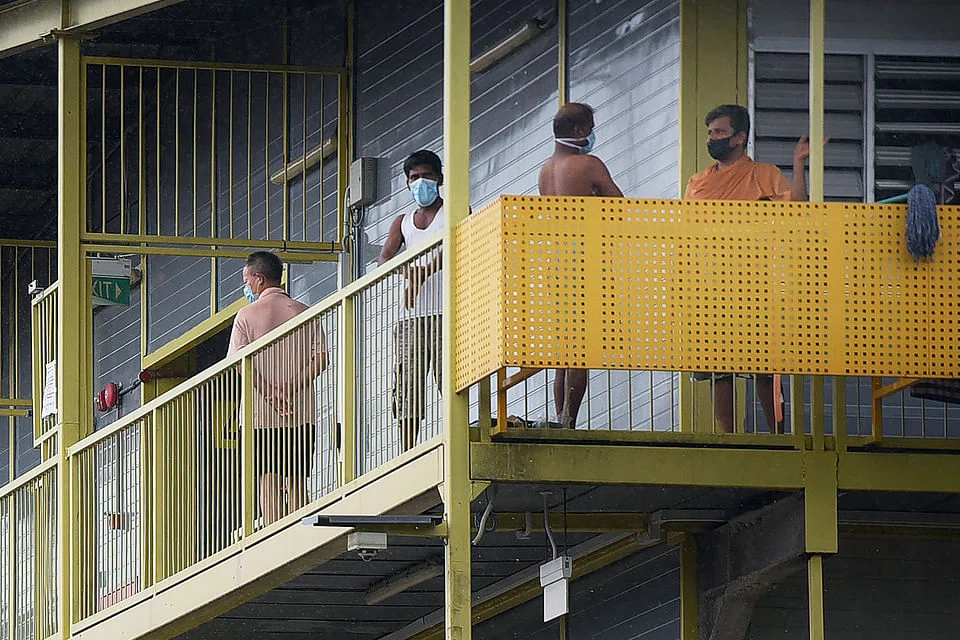
MIGRANT workers will be able to enjoy greater freedoms in the coming weeks as those in some dormitories will be allowed to access the community once a month as part of a pilot scheme to be kicked off in the first quarter next year.
According to Second Minister for Manpower Tan See Leng, they will also be able to access communal facilities in their dormitories such as cooking stations and sports facilities.
They can also visit recreational centres more often to access their daily needs - for example, the barber or remittance services back to their home countries.
"We are also working with the recreational centres to bring in more activities including beer gardens, movie and sports screenings, and even pasar malams."
Dr Tan noted that this is even as the ministry continues to strengthen safe management measures. For instance, migrant workers living in dormitories and working in the construction, marine and process (CMP) sectors must wear their BluePass tokens so that in the event of a new infection, it is possible to quickly isolate and quarantine a smaller number of close contacts and reduce disruption to businesses.
Navigate Asia in
a new global order
Get the insights delivered to your inbox.
The government is in the midst of distributing contact-tracing devices to the more than 450,000 workers living in dormitories or working in the CMP sectors, and are on track to completing distribution of these tokens by end-December.
Access to the community via the pilot programme is subject to compliance with rostered routine testing (RRT), wearing of contact tracing tokens, and safe living measures.
Asked during the multi-ministry taskforce briefing how the taskforce intends to vaccinate long-term pass holders, Dr Tan said: "We will be enlisting the help of the providers of medical services at the regional medical centres within the dorms, the sectoral medical centres and some of the recreational centres, as well as some of the community medical clinics that provide support in terms of the screening and the testing for many of the migrant workers. So it will be a phased sort of approach, whereby we roll out these vaccinations and offer them to all of the migrant workers."
He added: "Based on the population we have, of about 300,000, roughly 100,000 are not immune (to Covid-19). So we will be prioritising this group of workers over and above their other colleagues and the new ones coming in. Because we're also gradually relaxing the borders to allow more migrant workers to come in."
As at Dec 13, 54,505 dormitory residents have tested positive using the PCR test. This is out of a total of over 320,000 migrant workers who live in dormitories.
Meanwhile, another 98,289 have tested serology-positive though they did not have a positive PCR test. People who have been tested serology-positive had been infected earlier. These workers underwent a seven-day period of isolation, at the end of which they were deemed to be no longer infectious and did not need to be tested further.
The Ministry of Manpower (MOM) and Ministry of Health said in a statement that they are still in the process of completing serology tests for about 65,000 migrant workers living in dormitories who had not taken a serology test before. This will provide a full picture of the infection prevalence among the migrant workers.
"As these tests identify past cases of infection, they are used to aid epidemiological investigations and for retrospective assessment of the overall prevalence of infections within a population," the ministries said.
Including the serology test results, the prevalence rate of Covid-19 in the dormitories is currently 47 per cent. For every Covid-19 infection in the dormitories detected through PCR testing, another 1.8 cases were untested and undetected at the time, and were identified subsequently only through serology testing.
The government noted that this is not surprising as many migrant workers did not have symptoms and thus would not have sought treatment and received a PCR test in the process. Among migrant workers who tested PCR-positive or serology-positive, four in five displayed very mild or no symptoms.
The government is also monitoring the earliest cohort of migrant workers who have recovered from Covid-19 and are currently exempt from RRT. "We are studying how their antibodies change over time. We will resume RRT for these workers if we detect their antibodies starting to fade, or if there is evidence of re-infection among them," MOH added.
* More reports on Virus outbreak: Phase 3 and beyond:
Decoding Asia newsletter: your guide to navigating Asia in a new global order. Sign up here to get Decoding Asia newsletter. Delivered to your inbox. Free.
Copyright SPH Media. All rights reserved.
TRENDING NOW

Middle East-linked energy supply shocks put Asean Power Grid back in focus
Thai and Vietnamese farmers may stop planting rice because of the Iran war. Here’s why

How China’s young workers are securing their future even as AI disrupts job market, triggers pay cuts

As more Asean states turn to Russia for fuel, will Moscow boost its influence in the region?

