Greece seeks support from ECB, vows to respect EU rules
New leftist government negotiating with eurozone partners to reduce its debt burden
Frankfurt
GREECE'S new leftist government appealed to the European Central Bank (ECB) on Wednesday to keep its banks afloat and vowed to respect European Union rules as it seeks a negotiated solution with eurozone partners to reduce its debt burden.
The new Greek government also held its first bond auction since taking office on Wednesday, raising 812.5 million euros (S$1.3 billion) in six-month treasury bills as demand fell to an eight-year low.
Finance Minister Yanis Varoufakis said after meeting ECB president Mario Draghi in Frankfurt that he believed Athens could count on central bank support during the short period it would take to conclude talks with international lenders.
Banking sources said that two Greek banks have begun to receive emergency liquidity assistance from the Bank of Greece after an outflow of deposits accelerated after the victory of the hard left Syriza party in a general election on Jan 25.
The Greek government wants that funding to continue because if the ECB were to halt it, Greek banks could collapse, forcing the country out of the eurozone.
Promising to end five years of austerity, Prime Minister Alexis Tsipras and Mr Varoufakis are meeting senior officials across Europe to seek support for a new agreement on Greece's debt. Their reception has been cautious so far, even in eurozone countries such as France and Italy which Athens had hoped would support its case for debt relief.
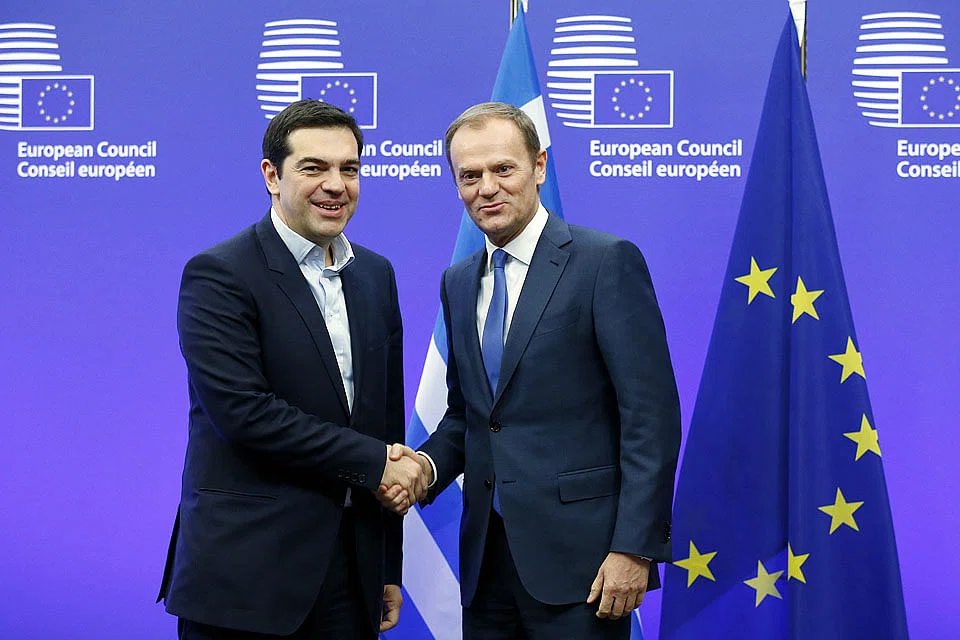
European Council president Donald Tusk said after meeting Mr Tsipras in Brussels that any solution must be acceptable to all member states, a veiled reference to Germany, Greece's biggest creditor which takes the hardest line on fiscal discipline. "Those negotiations ... will be difficult, will require cooperation and dialogue as well as determined efforts by Greece," Mr Tusk said.
Mr Tsipras, 40, said after talks with European Commission president Jean-Claude Juncker that Greece respected European Union rules and would find a solution to its economic problems within the framework of EU law. There was no agreement yet, but talks were going in the right direction, he said.
After meeting Mr Draghi in Frankfurt, Mr Varoufakis said: "The ECB is the central bank of Greece ... The ECB will do whatever it takes to support the member states in the eurozone.
"I have no doubt that we can conclude our discussions with our European partners, as well as with the IMF and the ECB, in a very short space of time so that we can kickstart the Greek economy."
Without the support of its creditors and the ECB, Greece would soon find itself back in an acute financial crisis. Unable to tap the markets because of sky-high borrowing costs, the government has enough cash to meet its funding needs for the next couple of months. But it faces around 10 billion euros of debt repayments over the summer.
Eurozone officials have also responded coolly to a Greek plan to swap its official loans for growth-indexed bonds and swap its ECB loans for perpetual interest-yielding bonds with no repayment date, noting that the ideas amount to a partial write-off by other means.
Meanwhile, demand slumped to a more than eight-year low at a sale of Greek Treasury bills. Greece sold 812.5 million euros of bills maturing on Aug 7, with an average yield of 2.75 per cent, the Athens-based Public Debt Management Agency said.
The bid-to-cover ratio, which gauges demand by comparing total bids with the amount of securities allotted, fell to 1.3, the least since July 2006. Greece has 947 million euros of debt coming due on Feb 6. Greece owes about 15 billion euros in short-term bills, which the country continuously rolls over. This covers financing needs while its bailout review remains stalled and aid disbursements from the euro area and the International Monetary Fund are frozen.
Even during the region's sovereign-debt crisis, when Greece carried out the biggest-ever bond restructuring, the nation never cancelled a bill auction and continued to roll over the securities. REUTERS, BLOOMBERG