

Greek endgame nears as bank collateral runs dry
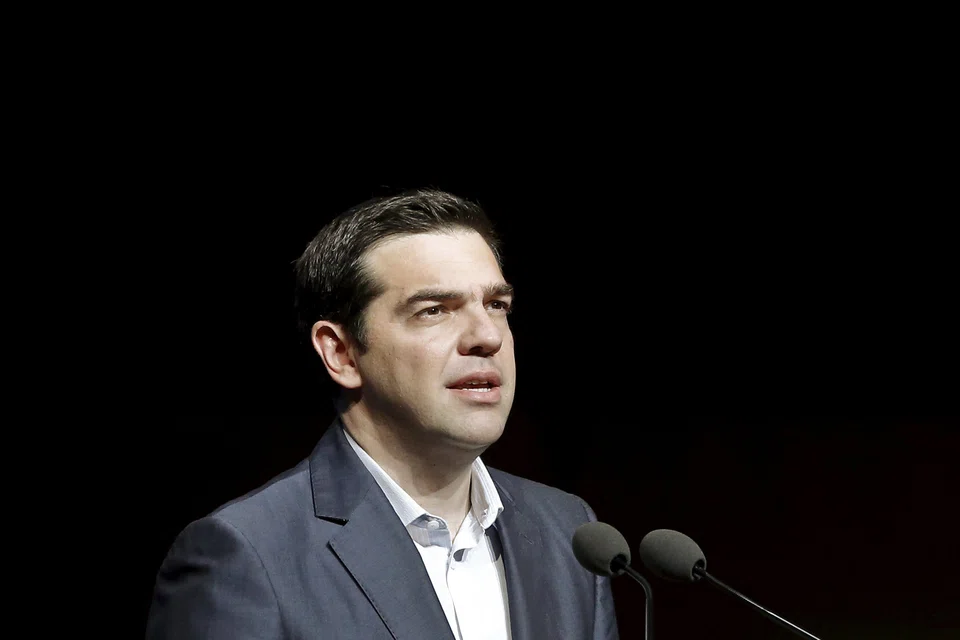
Athens
GREEK banks are running short on the collateral they need to stay alive, a crisis that could help force Prime Minister Alexis Tsipras' hand after weeks of brinkmanship with creditors.
As deposits flee the financial system, lenders use collateral parked at the Greek central bank to tap more and more emergency liquidity every week. In a worst-case scenario, that lifeline will be maxed out within three weeks, pushing banks toward insolvency, some economists say.
"The point where collateral is exhausted is likely to be near," JPMorgan Chase Bank analysts Malcolm Barr and David Mackie wrote in a note to clients May 15. "Pressures on central government cash flow, pressures on the banking system, and the political timetable are all converging on late May-early June."
European policy makers are losing patience with Mr Tsipras who said as recently as May 14 that he won't compromise on any of his key demands. He's planning to force a discussion of Greece at a summit of European Union leaders in Latvia on May 21-22, in the same week that the European Central Bank's (ECB) Governing Council is due to meet.
While talks are centering on whether to give Greece more money, the ECB could raise the stakes if it increases the discount on the collateral Greek banks pledge in exchange for cash under its Emergency Liquidity Assistance (ELA) programme. That could happen as soon as this week, after the Governing Council next meets in Frankfurt on May 20.
Such a move might inadvertently prompt a further outflow of bank deposits and pressure Mr Tsipras to choose between doing a deal and putting his country on the road to capital controls.
"We are in an endgame," ECB Executive Board member Yves Mersch said in an interview with Luxembourg radio 100.7 broadcast on Saturday. "This situation is not tenable."
Greek stocks and bonds fell on Monday. The Athens Stock Exchange index dropped 2.5 per cent.
The arithmetic goes as follows: Greek lenders have so far needed about 80 billion euros (S$120 billion) under the ELA programme.
Banks have enough collateral to stretch that lifeline to about 95 billion euros under the terms currently allowed by the ECB, a person familiar with the matter said. With the central bank raising the ELA by about two billion euros every week, that could take banks to the end of June.
A crunch will come if the ECB increases the haircut on Greek collateral to levels not seen since last year. That could be prompted by anything from a complete breakdown in talks to a missed debt payment, the official said. A continuation of the current impasse could even be all that's needed, the official added.
An increased haircut would reduce the ELA limit to about 88 billion euros, the person noted. While that gives banks about four weeks before hitting the buffers, the leeway is so limited that Greece might need to impose capital controls, limiting transactions such as ATM withdrawals, to conserve the cushion. Market News International first reported on the reduced ceiling on May 12.
"Since the great crisis of 2008, Europe has created many tools to control the flow of money and banks," said Andreas Koutras, an analyst at In Touch Capital Markets in London. "Thus the crisis in Greece is more likely to be resolved through the tools of the ECB rather than" by political means.
Investors in Greek debt are showing few signs of panic for now. The yield on the Greek 10-year bond was at 10.76 per cent on May 15, down from 13.64 per cent on April 21. While Greece's benchmark ASE Index fell 3.2 per cent last week, it has still risen 15 per cent since April 21.
Nor are ECB policy makers willing to raise the pressure on Greek banks on their own. Central bank governors won't take any action which would be seen as pushing Greece out of the currency bloc if negotiations show progress and convergence, the person said.
Greek lenders are also working with the country's central bank on plans to collateralise additional assets, a separate local official with knowledge of the matter said.
Still, it's unclear if these assets, including government guarantees, would be accepted by the ECB if the stand-off in bailout negotiations persists. BLOOMBERG
TRENDING NOW

‘We don’t want to stay as we are’: CEO Patrick Ng builds a more resilient Huationg

URA to review guidelines on floor space to give developers more design flexibility: Chee Hong Tat

He built the Vingroup empire. Now South-east Asia’s richest man is handing some key roles to his sons

32 companies, 6 individuals bag accolades at Singapore Corporate Awards 2026

