Ho Ching to retire from Temasek, hands reins to Dilhan Pillay

Singapore
TEMASEK Holdings will be entering a new chapter with Ho Ching handing over the reins to Dilhan Pillay Sandrasegara.
And the man poised to take over the top job at Singapore's state investment company yesterday reiterated what will be first principles - sustainability must drive whatever Temasek does, and climate change would be a key consideration when shaping its investment strategies.
Mr Pillay - the 57-year-old former corporate lawyer who will become Temasek's new executive director and CEO on Oct 1, the same day when Ms Ho retires - said that the company will not be driven by how the stock markets perform on a short-term basis.
The focus "is always on long-term sustainable returns", said Mr Pillay, who will retain his other role as CEO of the firm's investment arm Temasek International, although short-term market performance is not irrelevant as the group has a portfolio where over 50 per cent is in public markets.
The investment strategies that Temasek has employed over the years have borne much fruit, and this will continue to shape the decisions the company makes in the next decade and beyond, he noted.
"We try to figure out how our capital can be catalytic capital - not just financial capital, but capital that brings value to the companies we invest in."
But with this being a "much more complex" world, the "biggest consideration" for Temasek will centre around the issue of climate change and the impact this will have on businesses in every sector all over the world.
"We have to think about what it means for the various geographies we operate in. That is exactly what we are focused on, and why we say that sustainability is at the core of what we do," he said.
According to Mr Pillay, the company's current portfolio is evenly balanced between developed and emerging markets.
"Our developed markets are the US, Europe, Singapore and Australia - those are very significant. Emerging markets are China, India, South-east Asia and also parts of Latin America," he said.
"That's how we look at geographic orientation, and where we decide our portfolio should be. It's where we put our capital in line with how we see the world devolving, and how we see our portfolio evolving in the context of a changing world."
As far as China is concerned, Mr Pillay said Temasek is "still very positive about the long-term trajectory" of the world's second-largest economy, despite recent incidents such as the surprise scrapping of Ant Financial Group's much-anticipated public listing. Temasek's exposure to China reached 29 per cent as of March 31 last year, surpassing the 24 per cent for Singapore.
The company has stakes in big names such as Alibaba, Tencent, Meituan Dianping and Industrial & Commercial Bank of China.
"Consumption spending is evolving in China, and there's the emergence of strong domestic brands. We typically will invest in where we see those trends - not just today, but for the future," he said, citing the country's biotech, consumer and enterprise sectors as areas for the company to keep its eyes on.
Leadership succession at Temasek Holdings has been widely discussed for several years. Ms Ho had planned to step down in October 2009 but stayed on after then CEO-designate, Charles Goodyear, left the company.
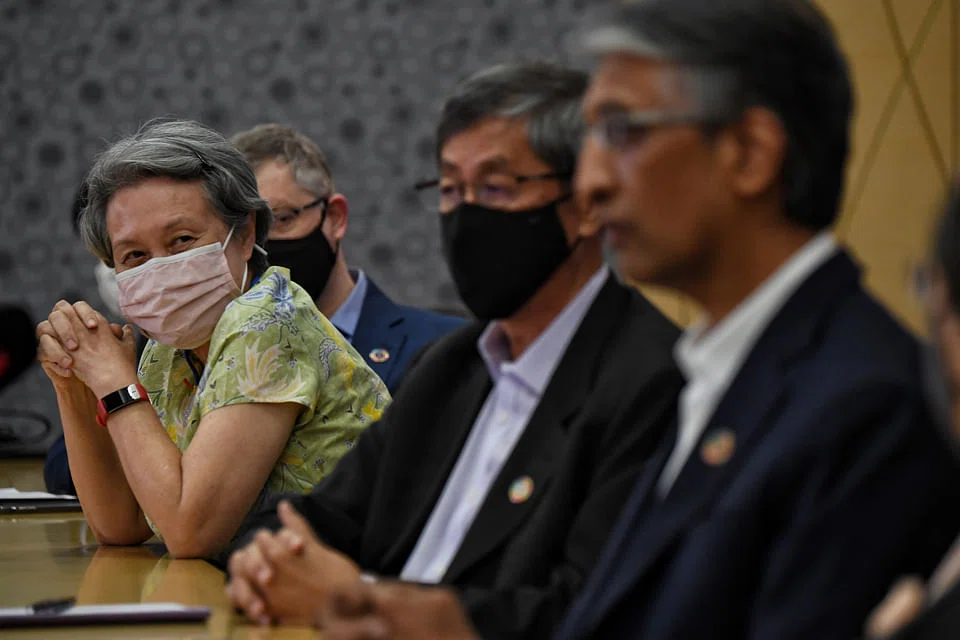
At the hour-long press conference was Ms Ho, who recalled how she spent the better part of three years - meeting each other "over more than 100 weekends" - before finally convincing Mr Pillay to resign from law firm WongPartnership in 2010.
"It was a hard sell for me, not a slam dunk. But then again, if you want to recruit the best, it will always be a hard sell," said Ms Ho.
Mr Pillay described it as a "big risk" and a "big career decision to leave the comfort zone" of the law firm, adding that he was intrigued by what Temasek had to offer him, as well as the company's values and mission.
He eventually rose up the ranks and took on key roles including a two-year stint as head, Americas based in New York.
He was appointed CEO of Temasek International in 2019.
Temasek Holdings chairman Lim Boon Heng said that leadership succession is a "strategic responsibility" of the board, with an annual review in place since the early 2000s.
"This is to enable the board to be prepared for all eventualities, with various succession options over different time horizons," he added.
The 67-year-old Ms Ho herself has been part of this process and helped identify potential successors both within and outside of Temasek.
Temasek's portfolio stood at S$90 billion, mostly in Singapore, when Ms Ho became CEO in 2004. Since then, it has more than tripled to over S$300 billion, even with the impact of the global financial crisis in 2008/09 and the ongoing Covid-19 pandemic, Temasek said in a news release.
Mr Lim noted that she has led Temasek through a "remarkable period of transformation".
The company has evolved from a relatively passive owner of the shares in former government-owned companies in Singapore to a globally recognised and respected investor, forward-looking institution and trusted steward, he said.
In response to a reporter's question about Ms Ho's "dual role" as Temasek CEO and the wife of Prime Minister Lee Hsien Loong, and how this has put Temasek in the spotlight for different reasons, Mr Lim stepped in to say that people in Singapore "do not realise (there is a) great firewall between husband and wife".
He added: "From time to time, when there are issues that Temasek faces with the government, it is not the Prime Minister's wife who talks to the Prime Minister to resolve the problem. It is me as chairman, interceding with the relevant ministries or even with PM himself, to put across Temasek's point of view. So let me state very clearly - there is a great firewall between the PM and his wife, the CEO of Temasek."
Ms Ho chose not to comment on her post-Temasek plans, only saying she would stay focused on seeing out the rest of her time as CEO until Oct 1. She will also step down from the board on the same day.
She added that it was her "personal belief" that she should not stay on as a board member after retirement.
"This is something we have instituted as a policy, we generally do not encourage (departing) CEOs to remain. The key thing is to allow the new CEO to establish his style, his leadership, and to have flexibility without somebody overlooking and saying this is not right," she said.
With additional reporting by Vivienne Tay
TRENDING NOW
He built the Vingroup empire. Now South-east Asia’s richest man is handing some key roles to his sons
Quarter of Singtel special discounted shares sold ahead of CPF Board transfer
Why Tan Aik Keong of digital solutions specialist Agmo wants to make himself less indispensable
Asia needs new energy security architecture