

Hong Kong, buckling under Covid, leaves its most vulnerable in the cold
 Add BT as a preferred source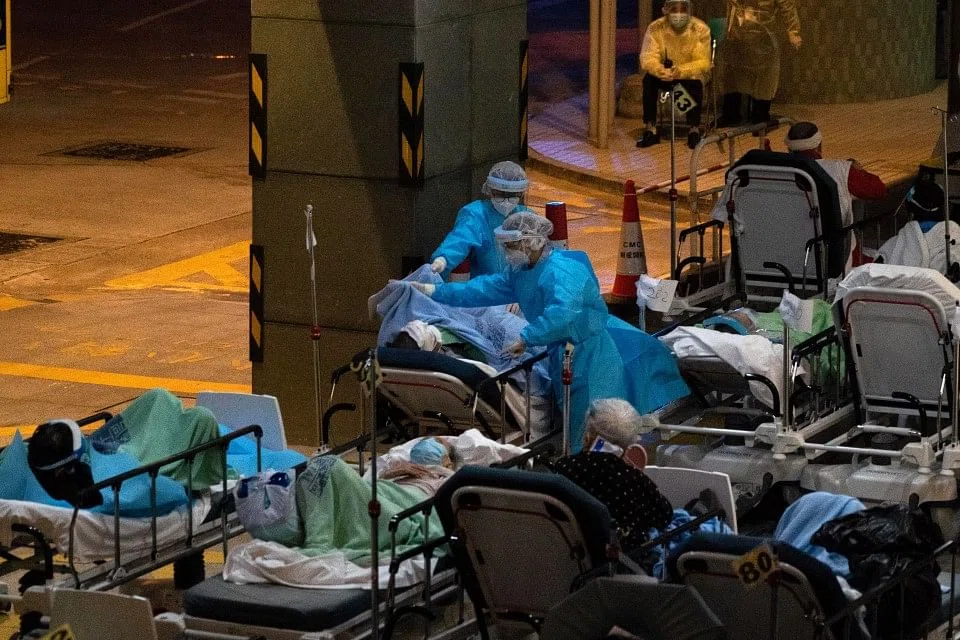
DeeperDive is a beta AI feature. Refer to full articles for the facts.
Hong Kong
FOR Chan Shun Ki, a cleaner at a construction site in Hong Kong, getting over the coronavirus was the easy part.
She was anxious to return to work after missing more than a week last month while recovering. She had already skipped her rent payment after the pandemic wiped out her previous jobs cleaning hotels and waiting tables. She was borrowing money from relatives to make up for the loss of her US$83 daily wage.
But then she received a text message from the government health system, which was battling days-long backlogs. It ordered her to stay home for 2 more weeks because her coronavirus test had come back positive. She had taken it 12 days earlier.
"I feel so much pressure," said Chan, who is a single mother of a 15-year-old. "The government is really incompetent, and it leaves us residents not knowing what to do."
As Hong Kong sinks under its fifth, and worst, coronavirus wave, the brunt is falling upon its most vulnerable: migrants, racial minorities, the working class. While the city has long been one of the most unequal on earth, rarely has the cost of that inequality been as steep as now.
Navigate Asia in
a new global order
Get the insights delivered to your inbox.
That is, in part, because of the sheer scale of this wave, which in 2 months has led to more than 250,000 infections and 800 deaths - multiple times as many as in the previous 4 waves combined. Bodies have piled up in hospital hallways because morgues have no more room. Older patients have been left on gurneys outdoors.
But the suffering has also been exacerbated, some say, by government policy. Under direction from the central Chinese authorities, Hong Kong officials have insisted on some of the world's most stringent social distancing rules, crippling many service industries. Yet, they have failed to contain the virus.
As a result, poor residents in cramped apartments have spread the virus to their families because the government has run out of isolation facilities. Those who recover cannot return to work because the testing jam means they cannot prove they are negative.
Migrant domestic workers, predominantly South-east Asian women who work as caregivers and cleaners, have been fired after getting sick and forced to sleep on the streets.
At times, officials have actively challenged efforts to help the needy. A top official threatened to prosecute members of the public who raised funds for migrant workers fined for violating social distancing rules.
Roger Chung, a professor of public health ethics at the Chinese University of Hong Kong, said the containment measures risked doing as much harm to low-income residents as the virus itself.
Even before the pandemic, Hong Kong's inequality was staggering. It has more billionaires than any city but New York, yet more than 200,000 residents live in carved-up tenement homes where the average living space per person is 48 square feet.
Amid the pandemic, those often dilapidated living quarters are even more perilous. The plumbing is frequently reconfigured to accommodate the multiple households sharing one apartment, and faulty installation can allow the virus to spread between floors. Insufficient ventilation has also fuelled transmission. Social distancing is impossible too.
Some residents, desperate to avoid infecting their relatives, have slept on their rooftops or in stairwells. The Society for Community Organization, a non-profit organisation, said it had received calls for help from nearly 300 people who were isolating at home, without access to food or medical supplies, since the fifth wave began in January.
The lack of isolation facilities has proved equally, if not more, challenging for migrant domestic workers, who make up about 10 per cent of the working population, have few legal rights and often suffer discrimination. Even residents who have avoided infection are straining under the pandemic's economic burden. NYTIMES
Decoding Asia newsletter: your guide to navigating Asia in a new global order. Sign up here to get Decoding Asia newsletter. Delivered to your inbox. Free.
Share with us your feedback on BT's products and services
TRENDING NOW

Ministry of Home Affairs Permanent Secretary Pang Kin Keong to retire

Shelving S$5 billion office redevelopment plan proved ‘wise’ as geopolitical risks mount: OCBC chairman

Richard Eu on how core values, customers keep Singapore’s TCM chain Eu Yan Sang relevant
China pips the US if Asean is forced to choose, but analysts warn against reading it like a sports result

