

Hong Kong Budget: What to expect from vouchers to interest rates
 Add BT as a preferred source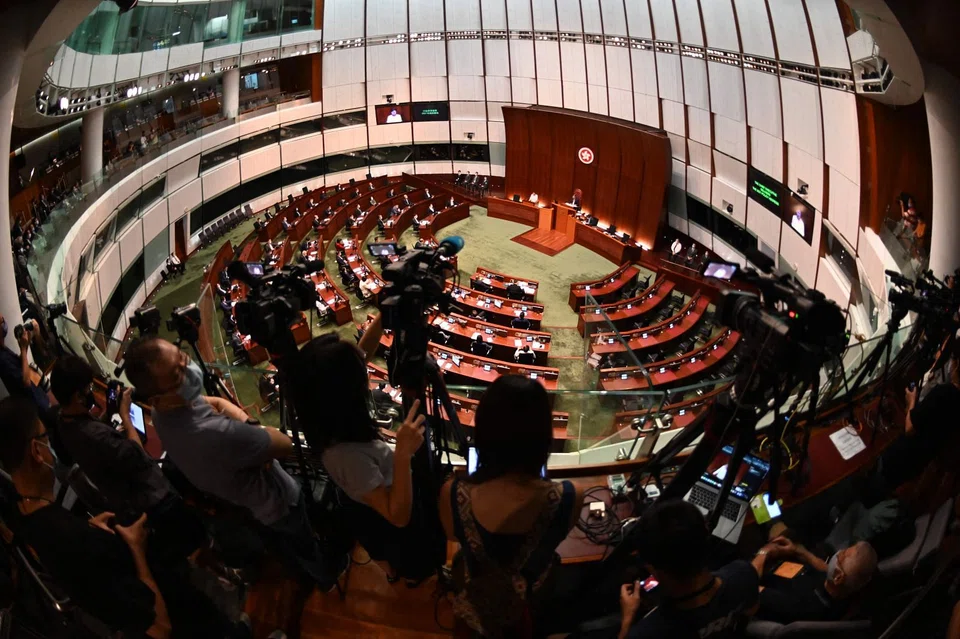
[HONG KONG] Hong Kong's government is expected on Wednesday to unveil a budget that's headed further into the red as the surging virus threatens to engulf the economy.
Since January, the Covid-19 outbreak has forced authorities to implement tough restrictions on everything from restaurant opening hours to draconian flight bans that economists warn will leave a heavy toll on growth.
To cushion the economy, Financial Secretary Paul Chan is expected to keep the fiscal taps open, driving the government's budget to its fourth deficit in a row in the coming fiscal year, the longest period of shortfalls in almost a decade.
Tipped as a contender for the city's chief executive role that's set for a contest in May, Chan is expected to dole out more support to business and consumers that may include consumption vouchers and tax rebates, according to analysts.
Yet the ferocious pace of the virus outbreak and ensuing measures to control it mean any support measures would have only a limited effect in curbing the fallout for an economy heavily reliant on tourism and retail spending. "Government support will not be unlimited and last forever," said Gary Ng, senior economist in Natixis. "Hong Kong will need to rethink whether the current epidemic approach is sustainable in the medium run given the heavy fiscal and social cost."
Whoever takes over as Hong Kong's leader faces an economic backdrop that is darkening by the week. Top banks including Morgan Stanley have downgraded their annual growth forecasts, while Fitch Ratings expects Hong Kong to post the worst outlook among 120 economies it tracks. Experts including Bloomberg Economics have forecast a contraction in the first quarter, a setback for an economy that rebounded last year after a two-year recession.
Much of the fiscal hole Hong Kong finds itself in is due to past support when the economy was hit by social unrest in 2019 and subsequently by the pandemic in 2020. Last week, a sixth round of a HK$27 billion (S$4.65 billion) anti-epidemic fund was approved by the country's legislative council, bringing the total stimulus since 2020 to HK$320 billion.
Any additional relief measures are more likely to target the general public in the form of consumption vouchers, tax rebates, or rates concession, said Dah Sing Bank senior economist Gary Wan.
"In the face of the rapid spreading of the virus in the community, bottlenecks on various fronts have been seen and additional supports are urgently needed," Chan said in a blog post this month. He also highlighted risks from inflation and a Federal Reserve interest rate hike, though added that the city can manage them.
Chan is set to deliver his budget speech at the Legislative Council on Wednesday at 11 am local time.
Here's a look at some of the key areas he's likely to focus on:
- Another Deficit
The deficit in the year beginning April 1 will likely come in at HK$74.5 billion, or 1 per cent of GDP, according to the median estimate in a Bloomberg survey of economists. That would be lower than the government's original estimate for this year's shortfall of HK101.6 billion, but would be the fourth straight year of a budget deficit. The last time that happened was in 2004.
Still, the government is in a strong position to issue a few more rounds of virus relief funds as it has a healthy level of reserves and is essentially free of debt, said Aries Kin-Ming Wong, an expert on Hong Kong's economy and monetary policy at Hong Kong Baptist University. Fiscal reserves were estimated at HK$871 billion as of the end of July.
For GDP growth, economists are now predicting 2.35 per cent for this year, according to the Bloomberg survey, down from last year's 6.4 per cent. Among other Asia financial hubs, South Korea on Monday passed a larger-than-planned first extra budget of the year as infections surged. In Singapore, a nation often touted as Hong Kong's key rival, the government said last week it expects to post its third straight deficit.
- Consumption Vouchers
Economists expect another round of consumption vouchers, which the government doled out last year and has proved useful in boosting consumer spending. The second disbursement of the vouchers paid in October helped to fuel a double-digit rise in retail sales, similar to the results of the first distribution.
"Economically speaking, fiscal policy has a very limited effect in a small and open economy," said Wong. "However, this kind of relief measure for most citizens is more likely to receive support from the public."
A large portion of its implementation costs is fixed and have also been incurred in the last round, he added. The vouchers should have designated portions allocated to certain targeted sectors such as catering and entertainment, said KPMG China tax partner Alice Leung in her budget recommendation. Those sectors could benefit more from the stimulus, she said.
- Employment and Tax
While Hong Kong's unemployment rate has improved since hitting a 17-year high last year, its labor chief has warned that recent curbs could lead to joblessness rising again. In the latest round of anti-epidemic measures, the unemployed were set to get a HK$10,000 Covid-relief handout, although lawmakers have questioned how that would help those on unpaid leave.
All salaries tax allowances should be increased by at least 10 per cent, said PwC Hong Kong tax partner Agnes Wong, adding that over the long term, the government should do a comprehensive review of Hong Kong's tax system.
- Impending Fed Hike
Chan is expected to address the implications of an interest rate hike by the Federal Reserve. The city imports US monetary policies due to a linked exchange rate with the greenback, which means that it will be forced to raise borrowing costs just when the economy is under strain. Higher interest rates and the virus create a "strong case" for Hong Kong to slip back into a technical recession, according to Kevin Lai, chief economist for Asia ex-Japan at Daiwa Capital Markets Hong Kong Ltd. The territory has already seen US$48 billion in capital outflows in 2021 even without actions by the Fed, and outflows are likely to exceed US$100 billion over the next 24 months, he said.
Still, risks from higher rates are "manageable" and Hong Kong banks remain well-capitalized with robust liquidity positions, Chan said in his blog post. Changes in capital flows will not lead to an increase in interbank rates, and the city's current account remains strong, he said.
- Property and Infrastructure
Hong Kong's real estate market has been under pressure amid the virus and persistent population outflows. Citigroup predicts prices may fall as much as 10 per cent this year, with sellers increasingly willing to offer discounts. The expected interest rate hike and slowing economic growth in China are also seen dragging down the city's property prices. However, unlike what some might have hoped, the government is unlikely to lift market cooling measures such as additional stamp duties as prices are not falling drastically, according to Patrick Wong, a real estate analyst at Bloomberg Intelligence. BLOOMBERG
Decoding Asia newsletter: your guide to navigating Asia in a new global order. Sign up here to get Decoding Asia newsletter. Delivered to your inbox. Free.
Share with us your feedback on BT's products and services
TRENDING NOW

Trickier across borders: Why commercial disputes are getting more complex
Too little, too late? Manila’s billion-dollar bid to ignite its sputtering EV industry
When every phone becomes a satellite phone, what happens to Asia’s telcos?
How BYD disrupted Singapore’s car market – and why the strategy is turning on itself

