

Hong Kong leader skips mask to highlight 'solemn' effort against Covid
 Add BT as a preferred source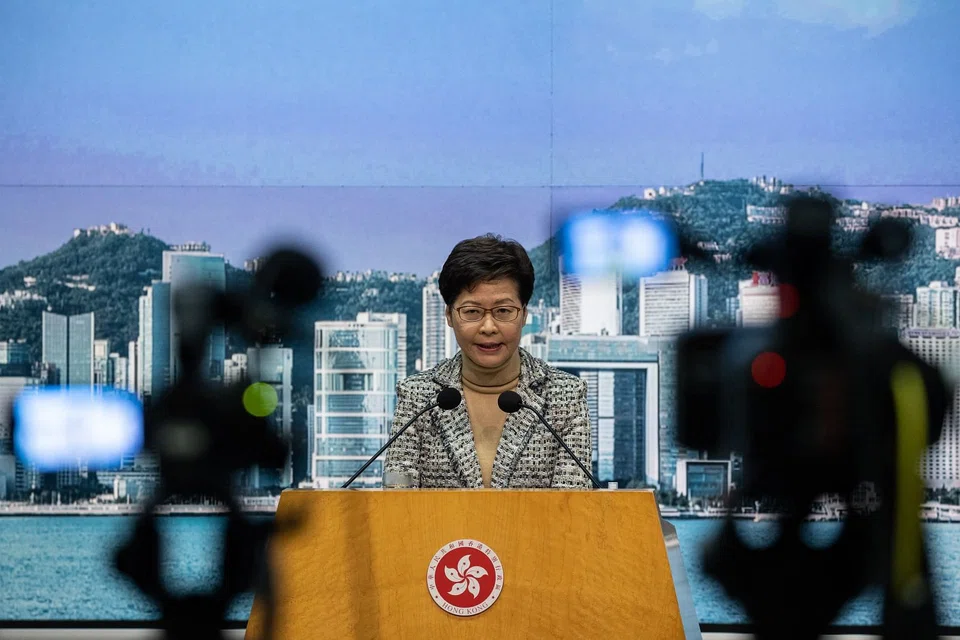
DeeperDive is a beta AI feature. Refer to full articles for the facts.
[HONG KONG] Hong Kong leader Carrie Lam defended herself on Tuesday against criticism for not wearing a face mask at news conferences, saying it was so people could see how "solemn" she was when talking about the coronavirus outbreak.
On Monday, Hong Kong reported 109 new infections, in stark contrast with many other places reporting tens or hundreds of thousands of daily cases. Of the 426 people in hospital with Covid-19, none were in serious or critical condition.
But the discovery in Hong Kong at the end of last year of some local transmissions after a clean streak of three months led to the imposition of restrictions that have made the global financial hub one of the world's most isolated major cities.
Lam has been criticised on social media and by some health experts for not wearing a mask while asking society to follow the strict rules her government has reimposed.
Lam told a weekly press conference her decision not to wear a mask during media briefings was "well thought out" and that she wears one during other activities.
"Now I am very sombre, I am very solemn, because I am very worried. People need to understand and feel my feelings," Lam said. "I'm not going to smile to you or look very relaxed or casual. This is a very solemn occasion."
Navigate Asia in
a new global order
Get the insights delivered to your inbox.
Microbiologist Yuen Kwok-yung, one of Lam's top Covid-19 advisors known in Hong Kong for wearing face masks shaped like a duck beak, was quoted by local media on Monday as saying "when we are experts or leaders, we must set examples ourselves."
The last time Hong Kong was subject to such stern restrictions was in 2020, during the early months of the pandemic.
Schools, pubs and gyms have been shut, with restaurants closing at 6 pm and many people working from home again.
Additionally, very few flights are allowed to land and hardly any allowed to transit.
Last week, Hong Kong authorities enraged pet lovers with an order to cull more than 2,000 hamsters after tracing an outbreak to a worker in a shop where 11 hamsters tested positive.
Hong Kong has adopted a strategy similar to mainland China, by aiming to quickly smother any outbreak and prevent infected residents from returning, whereas the trend among governments globally has been towards "living with the virus." By contrast, rival finance hub Singapore, with a population three quarters that of Hong Kong, is reporting 3,000 new infections a day, but has eased curbs, including border controls. It maintains a mask-wearing mandate, limits group dining and operates a vaccine pass in shopping malls.
But also, only around 70 per cent of people in Hong Kong are double-vaccinated, compared with some 90 per cent in Singapore. Most of Hong Kong's elderly have not taken a single vaccine shot.
On Tuesday, Lam urged people to avoid gatherings and family reunions over the Chinese New Year period at the start of February and reiterated that social restrictions are unlikely to be relaxed after the break as initially hoped.
"This wave of the outbreak is vicious," Lam said.
REUTERS
Decoding Asia newsletter: your guide to navigating Asia in a new global order. Sign up here to get Decoding Asia newsletter. Delivered to your inbox. Free.
Copyright SPH Media. All rights reserved.
TRENDING NOW
Japan stocks look set for new highs in 2025 on earnings, reform

Beijing’s calculated silence on the Iran war

China pips the US if Asean is forced to choose, but analysts warn against reading it like a sports result

Richard Eu on how core values, customers keep Singapore’s TCM chain Eu Yan Sang relevant

