

Hong Kong to send tens of millions of Covid tests to residents
 Add BT as a preferred source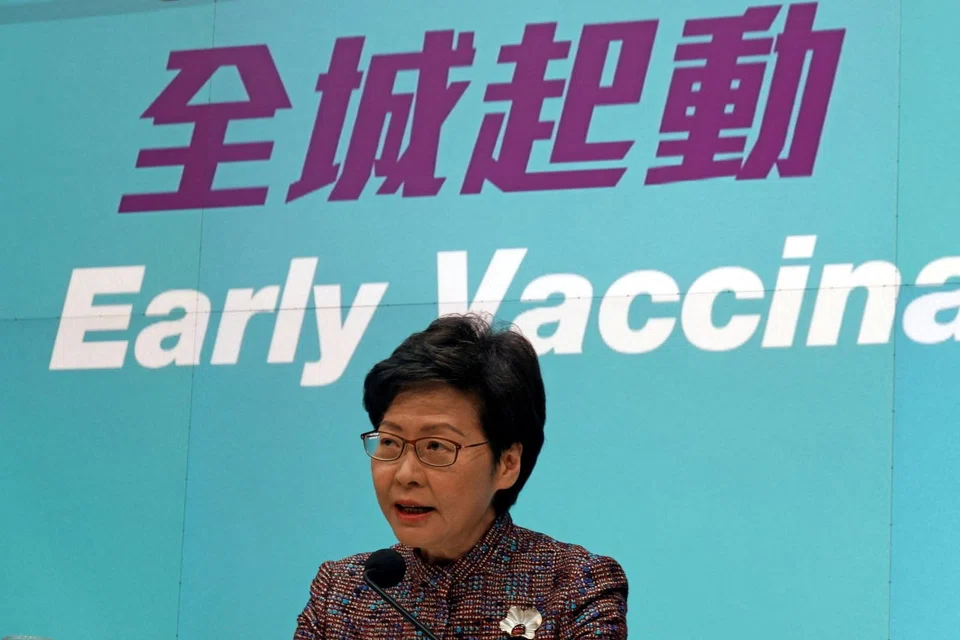
DeeperDive is a beta AI feature. Refer to full articles for the facts.
[HONG KONG] Hong Kong is buying "tens of millions" of home testing kits to send to the city's 7.4 million residents, as surging Covid cases threaten to overwhelm the financial hub's health-care system.
"This latest outbreak is the worst we have seen in the past two years," Chief Executive Carrie Lam said at a press briefing Friday. "So we will launch a universal rapid antigen test that means each member of the Hong Kong public will be able to obtain one kit."
Lam also said the government-run Penny's Bay quarantine centre could be converted into an isolation facility for those with mild infections if cases continued to rise.
Currently, the spartan facility is reserved for healthy close contacts of someone infected and some inbound travellers. Under the new plans, these people would home quarantine, Lam said, adding that the changes were still a work in progress.
The city's vaccine passport program that requires people to be immunised to enter restaurants and public buildings and goes into effect on Feb 24 will eventually be strengthened beyond the one shot.
More venues will be included, Lam said without elaborating, and residents will in future need to have received three inoculations to meet the passport requirements.
Navigate Asia in
a new global order
Get the insights delivered to your inbox.
Lam said the government will on Tuesday ask the city's Executive Council to approve tighter social distancing curbs, to be effective Feb 17 if passed, but didn't specify the proposals.
She also announced a sixth round of anti-epidemic funding of some HK$20 billion (S$3.45 billion), directed to individuals and enterprises directly affected by the pandemic, such as bars and gyms.
Hong Kong reported 131 new cases on Friday, with all but one stemming from community transmission. Nearly half of local infections, affecting 59 people, have no known origin. There were roughly another 195 preliminary positive infections. The rising number of untraceable infections suggests silent chains of transmission in the community.
There have been at least 30 cases a day without a known source for the past three days, the highest number in the current outbreak and an increase from a maximum of three less than two weeks ago.
Officials said they expect a significant increase in the number of infections following this week's three-day Lunar New Year holiday, when people tend to gather with families and friends indoors.
The current mitigation measures, including restrictions on dining-in at restaurants after 6 pm, closed cinemas, gyms and bars, has only reduced movement within the city by 20 per cent to 30 per cent, Lam said.
Visits to family and houses of worship over the holidays are expected to further diminish that progress, said Lam, who called for a suspension of religious and other large gatherings.
While Hong Kong's case numbers are a fraction of what other locations are seeing, its Covid Zero strategy of tracking and isolating infected people means that its health-care resources are at breaking point.
The government this week lowered the criteria for releasing patients from mandatory hospital stays and said health care facilities could delay non-emergency surgeries if needed.
The government also announced shortened quarantine periods for some inbound travelers and close contacts after rising case numbers pushed facilities to capacity.
Further adjustments to make better use of facilities and prevent a mass outbreak from paralysing the health-care system may be considered, officials said. That could include home quarantine in certain circumstances, they said.
The government will mail the rapid antigen tests, which can be performed at home in minutes, to everyone in the city once they are available, Lam said. People won't be punished if they don't use the test, she said. "We hope that it will bring peace of mind to the residents," she said. "We are procuring the rapid antigen tests in the tens of millions. We think that they will be arriving soon. Each member of the Hong Kong public will be able to obtain one kit."
The government also wants to rapidly increase inoculation rates, especially among the city's elderly. Currently 80 per cent of people aged 12 and older have received at least one dose of the vaccine. "If a few months go by and we still cannot hit the 90 per cent vaccination rate, then I will be worried," Lam said.
"Many places have opened and the mainland has reached vaccination rates of over 90 per cent. What will happen to Hong Kong? Should we stay this way, or what should be the way forward? The public should know the consequences." BLOOMBERG
Decoding Asia newsletter: your guide to navigating Asia in a new global order. Sign up here to get Decoding Asia newsletter. Delivered to your inbox. Free.
Copyright SPH Media. All rights reserved.
TRENDING NOW
Air India asks Tata, Singapore Airlines for funds after US$2.4 billion loss
‘Boring’ is the new black: The stars are aligning for a Singapore stock market revival

From 1MDB to ‘corporate mafia’: Is Malaysia facing a new governance test?
South-east Asian markets account for 8.8% of global capital inflows from 2021 to 2024: report

